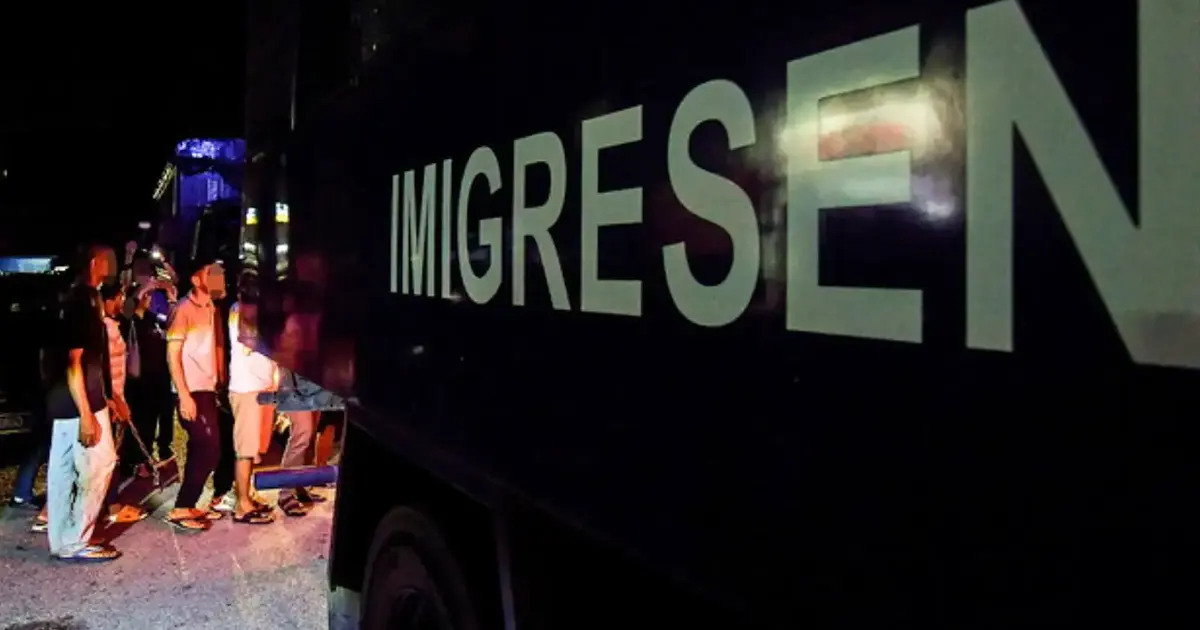
A large-scale immigration enforcement operation conducted under cover of darkness in Kuala Lumpur's Pudu district has resulted in the detention of 186 foreign nationals suspected of breaching Malaysia's immigration regulations. The midnight raid, coordinated by federal authorities, focused on individuals believed to be residing illegally within the densely populated commercial and residential precinct.
The detainees are suspected of multiple immigration violations, including overstaying beyond the permitted duration of their visit permits and failing to maintain valid travel documentation required under Malaysian law. These offences represent persistent challenges for immigration enforcement agencies across the country, particularly in urban areas where transient populations and informal labour networks make tracking compliance difficult.
Pudu, located in the heart of Kuala Lumpur's commercial district near the central railway station, has long been identified as a hotspot for irregular migration activity. The area's dense urban fabric, mix of low-cost accommodation, and proximity to informal employment opportunities create conditions that can inadvertently shelter undocumented workers and overstaying migrants. Authorities have periodically intensified operations in such zones to maintain border and immigration integrity.
The midnight timing of the operation reflects a deliberate enforcement strategy. By conducting sweeps during off-peak hours, authorities aim to maximize apprehension rates and minimize public disruption. The early morning window also increases the likelihood of encountering individuals at rest in residential or makeshift accommodation facilities, improving detection efficiency compared to daytime operations when people disperse across the urban landscape.
Overstaying represents one of the most common immigration violations in Malaysia, driven by a combination of factors including genuine bureaucratic delays, employment situations that complicate visa renewal, and deliberate circumvention of immigration rules. The nation's significant informal economy attracts migrant workers who may lack proper documentation or whose legal status deteriorates after initial entry. Meanwhile, travel document fraud and loss create additional compliance complications for otherwise well-intentioned visitors and residents.
The scale of this operation—involving nearly 200 individuals in a single sweep—underscores the volume of undocumented foreign nationals present within Malaysian urban areas. While such raids generate headline-catching arrest figures, they represent only a snapshot of enforcement activity. The broader immigration landscape involves thousands of cases processed through administrative channels, legal deportations, and voluntary departures that occur beyond public view.
For Malaysia's immigration management system, operations of this magnitude serve multiple purposes beyond immediate apprehension. They generate intelligence about trafficking networks, employment patterns involving migrant labour, and geographical concentrations of irregular migration. Detained individuals are interviewed to identify employer networks, housing arrangements, and documentation fraud schemes that facilitate illegal residence.
The immediate consequence for those detained involves documentation of charges, background verification, and processing through the immigration court system. Individuals found guilty of overstaying face fines, detention periods, and deportation orders. The financial cost of maintaining detainees pending hearings and deportation remains significant for federal authorities, creating ongoing budgetary pressures on immigration enforcement agencies.
From a Southeast Asian perspective, Malaysia's immigration challenges reflect broader regional migration dynamics. The country functions as both a transit point and destination for migrants from neighbouring countries and South Asia, creating complex enforcement scenarios. Coordinated regional approaches to documentation standards, information sharing, and deportation procedures remain inconsistently implemented, allowing some individuals to move between countries exploiting gaps in coordination.
Employers utilizing undocumented workers face potential liability for knowingly or negligently employing individuals without valid permits. However, enforcement against employers remains comparatively lighter than enforcement against migrants themselves, creating structural incentives that encourage hiring of irregular workers. This asymmetry means supply of undocumented labour persists despite periodic detention operations.
The detention of 186 individuals raises questions about capacity within Malaysia's immigration detention facilities and the speed of subsequent legal processing. Crowded detention conditions, language barriers, and access to legal representation present ongoing concerns highlighted by international observers. The eventual deportation of such cohorts requires coordination with origin countries, which varies considerably depending on diplomatic relations and documentation verification standards.
Looking forward, the effectiveness of such operations depends partly on sustained political commitment to immigration enforcement and adequate resource allocation. Raids generate visible enforcement activity satisfying public expectations around border security and rule of law, yet their long-term impact on reducing undocumented populations depends on systemic factors including employer compliance, documentation verification technology, and inter-agency coordination across both federal and state levels.

%22%2F%3E%3C%2Fpattern%3E%3C%2Fdefs%3E%3Crect%20width%3D%22100%25%22%20height%3D%22100%25%22%20fill%3D%22url(%23ph56fyng)%22%2F%3E%3Crect%20width%3D%22100%25%22%20height%3D%22100%25%22%20fill%3D%22url(%23ph56fynp)%22%2F%3E%3Ctext%20x%3D%2250%25%22%20y%3D%2250%25%22%20text-anchor%3D%22middle%22%20dominant-baseline%3D%22central%22%20fill%3D%22rgba(255%2C255%2C255%2C0.95)%22%20font-family%3D%22Georgia%2C%20'Times%20New%20Roman'%2C%20serif%22%20font-weight%3D%22700%22%20font-size%3D%22151%22%20letter-spacing%3D%22-0.02em%22%3EMalaysian%3C%2Ftext%3E%3C%2Fsvg%3E)