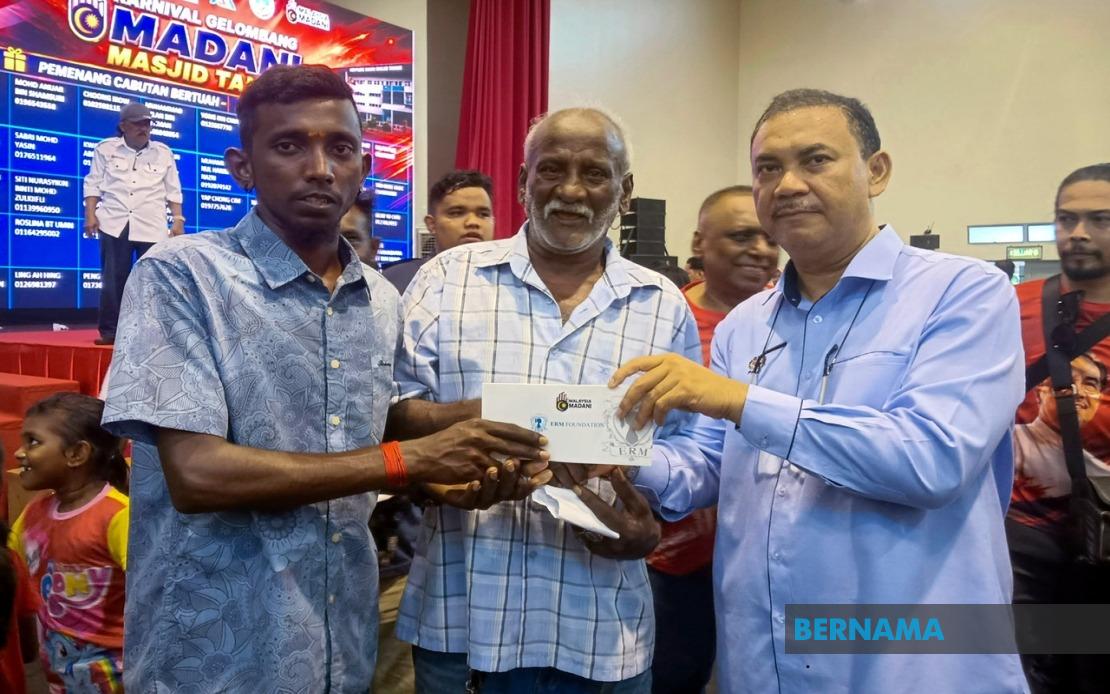
The Sentuhan MADANI Donation initiative reached approximately 2,000 underprivileged residents in the Masjid Tanah parliamentary constituency on August 7, distributing cash assistance as part of the broader Gelombang MADANI Carnival event held at the Masjid Tanah Sports Complex in Alor Gajah. The programme represents an ongoing commitment by the federal government to provide targeted financial relief to vulnerable segments of the population across Melaka's Masjid Tanah division.
Each beneficiary received RM200 in direct cash assistance, as announced by Datuk Azman Abidin, the Prime Minister's political secretary, during the formal presentation ceremony. The quantum of assistance, while modest, is designed to provide immediate relief for essential household expenses among families already struggling with limited incomes and competing financial pressures. This direct cash transfer model has become increasingly prevalent in Malaysian social assistance programming, offering flexibility and dignity to recipients compared to in-kind aid distributions.
The assistance programme encompassed residents from five constituent state assemblies operating under the Masjid Tanah parliamentary umbrella: Kuala Linggi, Lendu, Tanjung Bidara, Ayer Limau, and Taboh Naning. This multi-constituency approach ensures broad geographic coverage within the parliamentary division and recognises that poverty and economic vulnerability are dispersed across rural and semi-urban areas rather than concentrated in specific locations. The decentralised distribution strategy also enables local elected representatives to participate actively in the delivery process.
Eligibility criteria for the Sentuhan MADANI assistance specifically targeted households classified within the B40 income bracket, representing the bottom forty percent of earners in Malaysia's income distribution hierarchy. Beyond income-based targeting, the programme extended inclusion to persons with disabilities and senior citizens, recognising that these groups face compounded vulnerabilities in the labour market and accumulate health-related expenses that exceed average household budgets. This multi-criteria approach reflects nuanced policymaking that acknowledges intersecting forms of disadvantage.
Beneficiary Ramlah Othman, a 63-year-old resident of Tanjung Bidara, articulated the practical value of the assistance, noting that the RM200 would meaningfully reduce her household's daily financial strain. Her testimony illustrates how modest cash transfers can provide psychological as well as material relief to those living with chronic economic insecurity. For many recipients, such assistance represents an opportunity to address deferred maintenance needs or catch up on utility payments that have accumulated.
Similarly, N. Mariappan, a 69-year-old stroke patient from Ladang Sungai Baru, emphasised how the initiative acknowledged the particular vulnerability of elderly citizens and persons managing chronic health conditions. Mariappan's participation underscores the compounding nature of age and disability, whereby healthcare costs, restricted employment opportunities, and limited mobility combine to create acute financial hardship. Government recognition of this demographic reality through targeted assistance programmes has become increasingly important as Malaysia's population ages.
The Gelombang MADANI Carnival framework within which the Sentuhan MADANI Donation was delivered represents a broader government initiative to expand public engagement with social assistance and community development programmes. By embedding cash transfers within carnival settings, the government seeks to reduce stigma associated with receiving assistance while creating broader community participation and visibility for social support initiatives. This event-based approach also facilitates media coverage and public awareness of government programmes.
For Malaysian policymakers and development analysts, such initiatives raise important questions about the sustainability and scalability of cash transfer programmes as poverty alleviation tools. While the RM200 distribution reaches thousands of households across Masjid Tanah, the one-time nature of the assistance necessarily limits its impact on long-term poverty reduction or structural economic mobility. Complementary programming in skills development, employment facilitation, and access to credit would be required to generate sustained income improvement.
The emphasis on vulnerable population segments—B40 households, disabled persons, and elderly residents—reflects government recognition that conventional economic growth alone has not eliminated persistent pockets of poverty within developed electoral constituencies. Masjid Tanah, encompassing parts of the relatively urbanised state of Melaka, contains communities that have not fully benefited from the state's economic progress, highlighting how uneven development persists even within developed regions.
Looking forward, the Sentuhan MADANI initiative's success in identifying and reaching 2,000 eligible recipients across five state constituencies demonstrates the administrative capacity of government machinery to execute targeted assistance programmes at scale. The involvement of Datuk Azman Abidin and coordination through parliamentary constituency structures suggests that similar Gelombang MADANI events may be replicated across other electoral divisions, potentially establishing a recurring cycle of assistance delivery.
For residents across Malaysia's lower-income communities, such periodic assistance programmes provide incremental financial relief but underscore the importance of permanent structural reforms in wage settings, social safety net design, and access to economic opportunity that would reduce dependence on one-off government disbursements. The residents' expressions of gratitude and relief, while genuine, also implicitly reveal the inadequacy of existing income-generation mechanisms and permanent social support systems.

