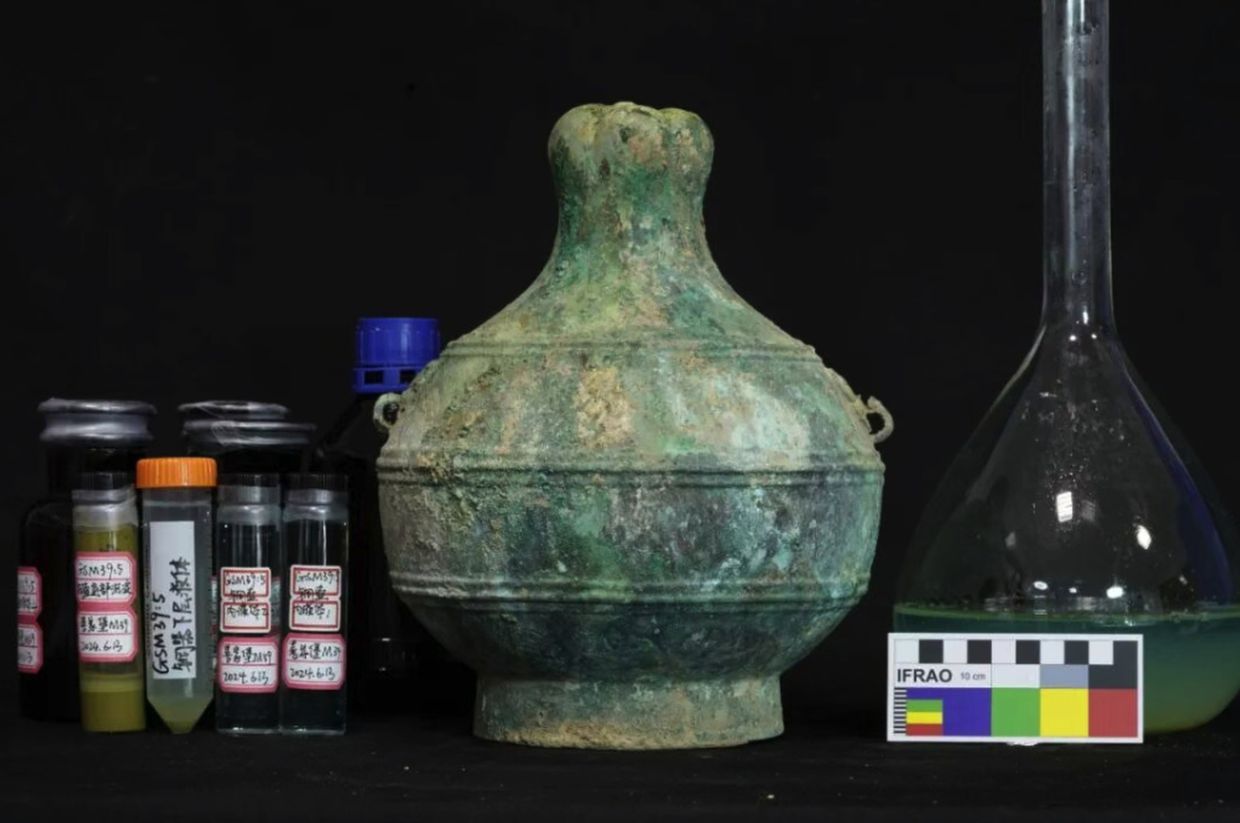
A sealed bronze wine jar discovered at the Shanjiabao cemetery in Ningxia, just two kilometres from the Warring States Qin Great Wall, has yielded remarkable revelations about ancient Chinese winemaking that predate modern brewing science by more than two millennia. The artifact, described in the Journal of Archaeological Science as the most intact and information-rich wine relic from the Qin state ever publicly documented, contained 3,740 millilitres of liquid residue that laboratory analysis confirmed was grain-based wine—a find that illuminates the daily lives and cultural practices of soldiers stationed along China's ancient frontier defences.
The Shanjiabao cemetery site, excavated over recent years, has proven to be a crucial window into military and civilian life during the Warring States period. Among 183 tombs unearthed at the location, 179 belonged to Qin culture, leading archaeologists to conclude the site functioned as a communal burial ground for garrison troops and their families stationed within the numerous forts and defensive outposts that dotted the 170-kilometre stretch of the Qin Great Wall. The concentration of military burials suggests this was a significant garrison settlement where soldiers, administrators, and their households maintained permanent residences, complete with the domestic practices and ritual customs that accompanied death and ancestor veneration.
The vessel itself exemplifies the sophisticated engineering and preservation techniques available to ancient craftspeople. According to Wang Xiaoyang, head of the Shanjiabao cemetery archaeological project at the Ningxia Institute of Cultural Relics and Archaeology, the bronze pot employed a double-layer sealing mechanism combining a textile inner lining with an outer clay coating infused with organic materials. This ingenious design created an oxygen-free environment that allowed the wine to remain essentially unchanged across more than two thousand years—a preservation achievement that rivals modern conservation methods and speaks to both the technical knowledge and cultural investment the Qin people placed in their burial rituals.
The chemical composition of the ancient liquid tells a complex story about regional brewing traditions and ingredient selection. Researchers identified 24 distinct compound types within the wine, encompassing organic acids and their derivatives, amino acids, and carbohydrates. Significantly, the pattern of organic acids matched that of artificially aged yellow wine, confirming that this was a deliberate fermentation process rather than an accidental spoilage or uncontrolled fermentation. The scientific fingerprint embedded in the chemical structure demonstrates that ancient winemakers understood fundamental fermentation chemistry, even without the modern microbiology that explains how and why these reactions occur.
Perhaps most revealing was the discovery through starch residue analysis that over 92 per cent of the grain substrate originated from broomcorn millet, a cereal crop that thrived in the arid climate of northern China's Ningxia region. This finding distinguishes northern brewing traditions from their southern counterparts, where rice-based fermentation dominated due to the warmer, wetter climate of provinces south of the Yangtze. The Qin garrison soldiers stationed at this remote frontier pass were thus consuming a product tailored to local agriculture and regional terroir—a pattern that echoes modern wine culture and suggests that ancient peoples understood the connection between geography, available crops, and culinary production.
The discovery carries particular significance for understanding Qin state economic organisation and resource management during a period of intense military competition and territorial consolidation. The capacity to produce stable, preservable alcoholic beverages near frontier posts speaks to logistical sophistication and the ability to support complex garrison systems far from administrative centres. Unlike fresh agricultural goods that spoil quickly, wine could be produced seasonally and stored for extended periods, providing both nutritional supplementation and psychological comfort to soldiers enduring harsh conditions in remote mountain passes.
China's long history as a pioneering civilization in fermented beverage production has drawn increasing scholarly attention in recent years, with archaeological discoveries across the country revealing successive waves of brewing innovation stretching back millennia. The Ningxia find fills a specific archaeological gap regarding winemaking practices in the Qin state during the Warring States period, a transformative era that ultimately culminated in China's first imperial unification. By documenting the material culture and consumption patterns of ordinary soldiers, the discovery contributes to a more nuanced understanding of how frontier garrison systems functioned and what daily life actually entailed for those defending territorial boundaries.
The research methodology employed by the Ningxia Institute demonstrates how contemporary archaeology bridges traditional excavation with cutting-edge analytical chemistry. By sending samples to Northwest University for detailed analysis, the team accessed scientific capabilities that enabled precise identification of the beverage type, ingredient composition, and preservation conditions. This collaborative approach between archaeological institutions and university laboratories has become standard practice in China, yielding discoveries that might otherwise remain silent artifacts in museum collections.
Beyond the technical achievements represented by the jar itself, the artifact carries profound humanistic significance. Wang Xiaoyang's team has reconstructed a touching narrative: over 2,300 years ago, a Qin person—likely a soldier stationed at this frontier garrison—passed away. Their family members honoured their memory through an elaborate funeral ritual that included filling this precious bronze vessel with the finest wine they could produce, intending it to accompany their loved one into the afterlife. This act of devotion transcends temporal and cultural distance, revealing emotional continuities between ancient and modern humans, and demonstrating how archaeological discovery can resurrect not merely technical knowledge but also the hopes, fears, and affections of ordinary people separated from us by more than twenty centuries.

