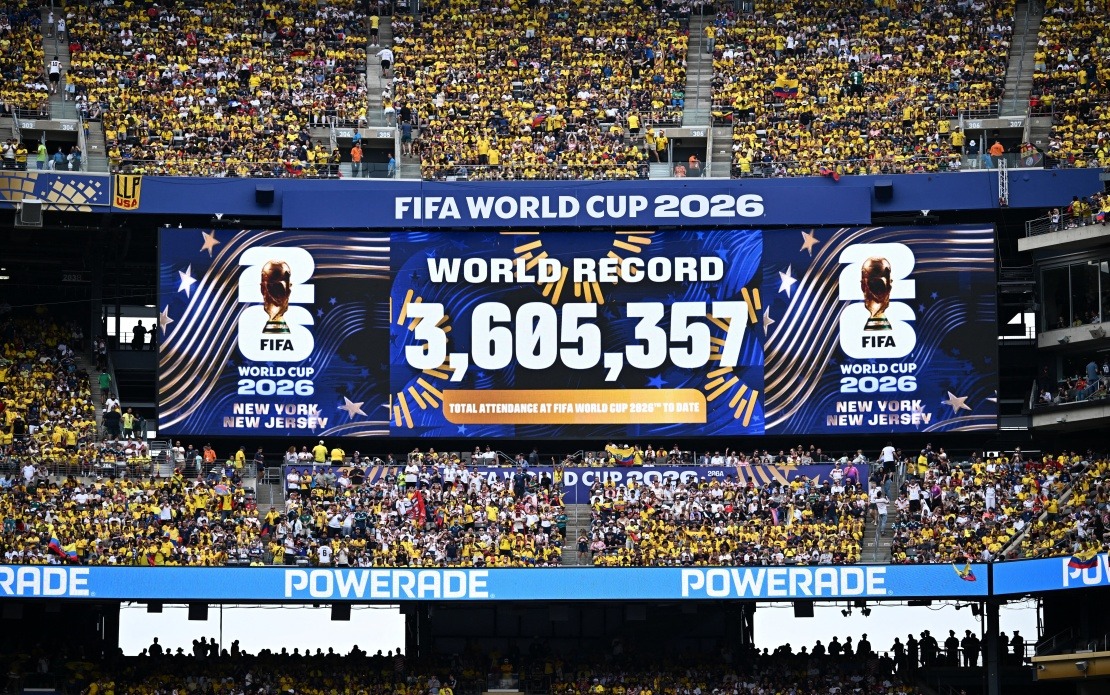
Football's global appeal reached new heights this week as the 2026 World Cup surpassed the attendance record set three decades ago, becoming the most-watched tournament in the competition's history. The milestone was announced during Germany's match against Ecuador in East Rutherford, New Jersey, when electronic displays throughout the stadium confirmed that the cumulative turnout had exceeded 3.6 million spectators. The announcement drew sustained applause from fans present in the venue, marking a watershed moment for world football as the tournament continues to captivate audiences across multiple nations.
The previous benchmark had stood since 1994, when the United States hosted the World Cup and drew nearly 3.6 million supporters across 52 matches. What makes the current achievement particularly striking is that the 2026 tournament has accomplished this feat with considerably fewer matches completed. The tournament structure has expanded significantly from the traditional format, allowing organisers to host matches in substantially larger venues across a broader geographic footprint. This structural change, combined with unprecedented global appetite for the competition, explains how the attendance ceiling has been shattered so decisively.
The scale of the remaining tournament presents intriguing possibilities for final attendance figures. With 48 matches still scheduled before the tournament concludes, the total attendance could realistically approach double the 1994 record. This projection underscores how enthusiasm for football has transcended previous boundaries, driven partly by expanded stadium capacity and the geographic reach of the 2026 host nations. Football administrators have observed that the spectacle of the World Cup continues to draw casual fans alongside dedicated supporters, creating broad-based interest that translates into remarkably full venues across all competition stages.
Operational metrics from the tournament reveal the consistency of this popularity. Across all stadiums hosting matches, average occupancy has exceeded 99 per cent, a figure that demonstrates systematic, rather than sporadic, interest in attending games. This consistency challenges assumptions that World Cup enthusiasm concentrates primarily in headline matches featuring traditional powerhouses. Instead, evidence suggests that the globalisation of football and the accessibility of competitive play have generated audience engagement that extends across all fixtures, regardless of participating teams' historical prominence.
The geographic distribution of matches across 16 host cities has clearly influenced attendance patterns and overall participation figures. Spreading the tournament across multiple metropolitan areas and regions has allowed organisers to tap into football enthusiasm that might remain untapped if venues concentrated in a small number of locations. This dispersed model creates opportunities for fans throughout the host nations and nearby territories to experience World Cup competition without undertaking prohibitive travel, thereby expanding the addressable market for tickets and generating the extraordinary attendance that has characterised the tournament thus far.
FIFA President Gianni Infantino has characterised the attendance surge as reflective of football's enduring capacity to galvanise global audiences and foster community engagement through shared experience. According to Infantino's assessment, the scenes witnessed in stadiums and fan zones across the 16 host cities have been exceptional, transcending typical sporting spectacle to encompass celebration and collective joy. This interpretation frames attendance records not merely as numerical achievements but as evidence that football continues to function as a unifying cultural force capable of momentarily transcending political, social, and economic divides.
For Southeast Asian audiences and regional sports enthusiasts, the 2026 World Cup's attendance performance carries significance beyond the obvious statistical accomplishment. The tournament's expansion and the demonstrated capacity to attract extraordinary crowds suggest that football's commercial and cultural infrastructure continues expanding globally. Regional federations and domestic league operators may draw lessons from how the expanded 2026 format and distributed venue strategy generated unprecedented engagement, potentially informing how football competitions are structured and marketed throughout Asia.
The contrast between the 1994 and 2026 tournaments illuminates broader trends in global sports participation and media engagement. When the United States hosted the World Cup previously, many commentators questioned whether American audiences would embrace the tournament with sufficient enthusiasm to generate strong attendance. The subsequent three decades have witnessed football's consolidation as a mainstream sport across North American markets, fundamentally altering assumptions about geographical receptivity to the competition. The 2026 record therefore represents validation of football's expansion beyond traditional European and South American strongholds into markets that were previously considered underdeveloped or secondary.
Stadium infrastructure advancement has also contributed meaningfully to the record-breaking attendance figures. Modern venues constructed or renovated in recent years typically feature expanded capacity, improved amenities, and enhanced accessibility compared to facilities available during the 1994 tournament. Technological improvements in ticketing, crowd management, and fan experience have likely reduced friction in the match-day process, making attendance more convenient and appealing for potential spectators. These infrastructure enhancements, combined with the growing commercial professionalisation of football globally, have created circumstances where enormous attendance figures become operationally achievable.
The economic implications of record attendance extend beyond immediate tournament revenue. Hosting a World Cup that draws nearly twice the previous record generates extraordinary demand for accommodation, transportation, dining, and entertainment services in host cities. For Malaysia and other Southeast Asian nations potentially competing for future major football tournament hosting rights, the 2026 experience provides compelling evidence of the substantial economic stimulus and global attention that such events can generate. The opportunity to position regional infrastructure on the world stage and expose domestic football audiences to international competition has become increasingly valuable as tournaments grow in scale and visibility.

