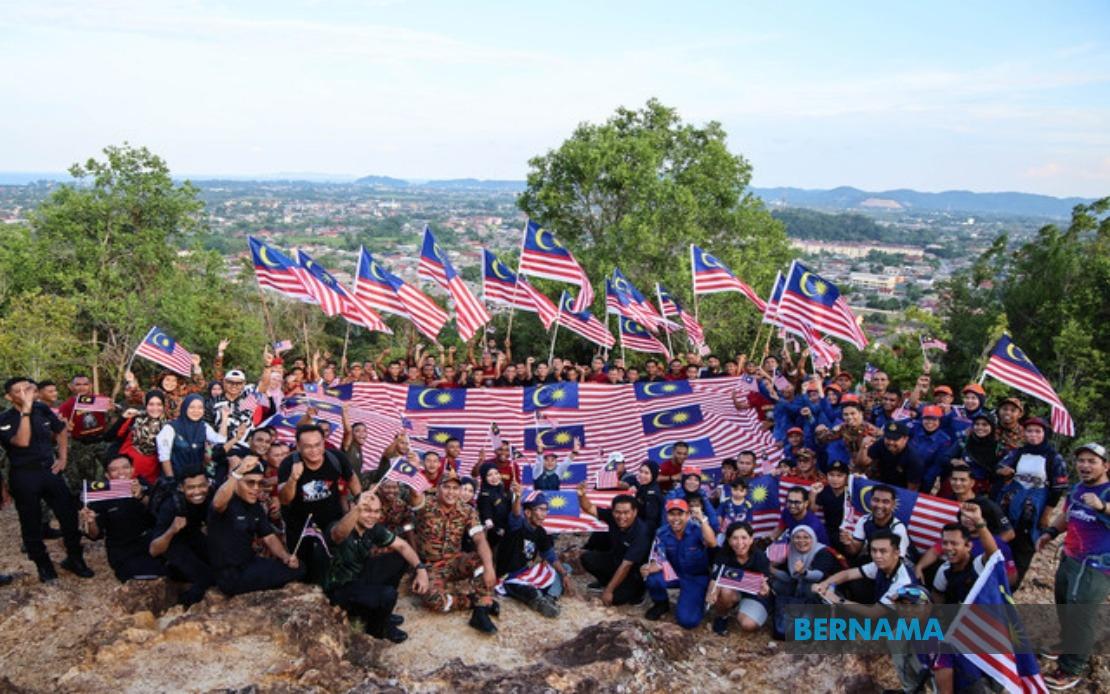
A collective effort to blend patriotism with public service brought together three hundred people in Terengganu on August 21, as uniformed personnel, government officials and journalists participated in a summit expedition that doubled as a National Month commemoration. The event, held in Kuala Terengganu, represented a rare gathering of multiple government bodies united around a shared mission of national pride and institutional strengthening during Malaysia's annual month-long patriotic observance.
The inaugural gathering drew representation from across Terengganu's security and administrative landscape. The Terengganu Fire and Rescue Department (JBPM), Malaysian Armed Forces (ATM), Road Transport Department (JPJ), Malaysian Anti-Corruption Commission (MACC), the state unit of the Ministry of Domestic Trade and Cost of Living (KPDN), Royal Malaysian Customs Department (JKDM), and Malaysia Civil Defence Force (APM) all fielded participants for the coordinated climb. This breadth of institutional involvement underscores a deliberate strategy to position the event as something beyond a symbolic gesture, instead framing it as an opportunity for operational linkages between agencies that might otherwise interact only in crisis situations.
METRA president Mohd Zaid Mohd Noor characterised the expedition as fulfilling a dual mandate for media practitioners during Malaysia's National Month. Beyond the immediate goal of reaching a summit summit and unfurling a flag, organisers viewed the climb as a platform for disseminating patriotic messaging across various communication channels. The media contingent's presence reflected METRA's conviction that journalists carry particular responsibility in articulating and amplifying narratives of national cohesion, especially during moments designed to reinforce civic bonds.
The decision to stage the event as a physical, communal undertaking rather than a conventional ceremony suggests recognition that contemporary patriotic expression requires active participation rather than passive observation. By combining the physical demands of a summit hike with symbolic acts like flag deployment, organisers created conditions where participants would experience the endeavour collectively, potentially strengthening the emotional resonance of the patriotic message beyond what a static ceremony might achieve.
For Terengganu specifically, the event served to inject additional momentum into the state's National Month programming. While August celebrations typically feature speeches, flag-raising ceremonies and cultural performances across Malaysia, dedicating resources to a multi-agency summit climb demonstrated local commitment to making the month's significance felt through substantive activity. This approach reflects broader evolution in how Malaysian institutions mark the National Month, moving incrementally toward experiential rather than purely ceremonial formats.
The inter-agency dimension warrants particular attention for what it reveals about institutional relationships in Terengganu. By assembling personnel from law enforcement, customs, fire services, civil defence and anti-corruption bodies in a non-operational context, the summit hike created informal opportunities for relationship-building that rarely occur through standard bureaucratic channels. Such horizontal networking, conducted in settings divorced from formal hierarchies, often generates practical benefits when agencies subsequently need to coordinate on actual crises or public service delivery challenges.
Healthy lifestyle promotion emerged as an additional stated objective, positioning the summit expedition within Malaysia's broader public health agenda. By linking physical activity to patriotic purpose, organisers attempted to reframe outdoor recreation not as leisure but as an expression of national responsibility. This framing aligns with sustained governmental emphasis on combating sedentary lifestyles and associated health complications across the Malaysian population.
The scale of participation—three hundred individuals—suggests organisers achieved meaningful mobilisation across target constituencies. For media practitioners specifically, the event represented a collective statement about the profession's understanding of its civic role beyond reportage. Rather than merely covering National Month activities, METRA's membership chose direct participation in a patriotic undertaking, potentially signalling attempts to rebuild public trust in institutions through visible engagement in national projects.
For other Southeast Asian contexts grappling with institutional fragmentation and declining civic engagement, Terengganu's model offers lessons about using shared symbolic endeavours to reinforce inter-agency coordination and public institutional legitimacy. The combination of physical challenge, patriotic expression and institutional participation creates multiple layers of meaning-making that purely ceremonial approaches cannot replicate.
The event also reflects Malaysian emphasis on visual and experiential patriotic expression during August. While National Day commemorations across the region typically feature speeches and military displays, initiatives like the Terengganu summit hike suggest increasing sophistication in designing activities that generate both immediate symbolic satisfaction and practical institutional benefits. Success in such events may ultimately depend less on the specific activity chosen than on careful orchestration of participation across genuine stakeholder groups and sufficient scale to generate authentic community engagement rather than mere tokenism.

