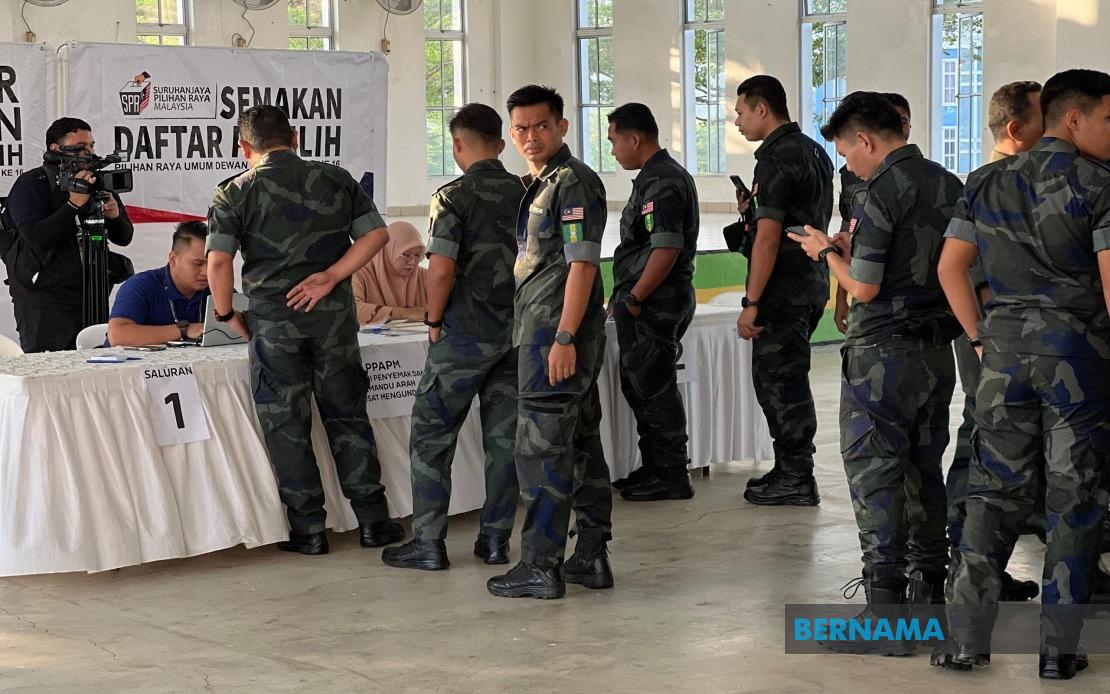
The 16th Johor state election got underway with an early voting phase on July 7, when 64 polling centres welcomed members of the security establishment who needed to cast their ballots before the main election day. The Election Commission had established this parallel voting stream specifically to accommodate 24,751 eligible voters from the Malaysian Armed Forces, Royal Malaysia Police, and General Operations Force, along with their spouses, enabling them to participate despite their operational duties. The centres opened promptly at 8 am to facilitate the voting process for personnel whose security responsibilities might otherwise prevent them from voting on the scheduled polling day.
The Malaysian Armed Forces contingent represented a significant portion of the early voters. According to Election Commission data, approximately 12,041 personnel from the MAF and their eligible family members were assigned to 11 dedicated polling centres across the state. This arrangement reflected the military's structured organization and the need to streamline voting logistics for uniformed personnel stationed at various bases and installations throughout Johor. The segregation of voting facilities by service branch was designed to minimize disruption to regular operations while ensuring comprehensive voter participation across the security sector.
The remaining portion of early voters comprised personnel from the police and paramilitary forces. Some 12,710 individuals from the Royal Malaysia Police and General Operations Force, together with their spouses, were allocated across 53 polling centres. This larger number of centres for the police and GOF contingent reflected their more dispersed deployment pattern compared to the centralized military structure, with officers stationed across urban centres, towns, and rural areas throughout the state. The Election Commission's distribution strategy ensured that no single centre became overwhelmed while maintaining the security and integrity of the voting process.
The operational schedule for early voting demonstrated careful planning by the Election Commission. All 64 centres operated on a staggered closing timeline rather than a single cutoff point, with voting ending in stages from noon onwards until 6 pm. This graduated approach prevented congestion at individual centres and allowed election officials to manage vote counting and security protocols more effectively as each location closed. The measured pace reflected best practices in election administration, balancing the need for efficiency with the requirement for meticulous procedural adherence.
Weather conditions across Johor on voting day appeared favorable for the electoral process. A survey conducted by Bernama found that several districts, including Batu Pahat, Muar, Pontian, and Tangkak, experienced sunny weather throughout the day. Good weather conditions typically facilitate voter movement and reduce potential complications in election logistics, allowing citizens to travel to polling centres more easily and reducing the risk of weather-related disruptions to the voting machinery or administrative procedures.
The early voting phase represented just the opening chapter of a broader electoral contest. The following Saturday would see approximately 2.7 million ordinary voters participate in the main polling day across 56 state seats, transforming Johor into a focus of electoral activity at the state level. This massive voter participation would determine the composition of the Johor State Assembly and ultimately the formation of the next state government. The scale of participation across 2.7 million voters underscored the significance of the election and the substantial population stake in the outcome.
The provision for early voting accommodates a fundamental principle of democratic participation, ensuring that citizens in essential services can exercise their franchise despite operational demands. Security personnel, by virtue of their roles protecting the nation and maintaining public order, often face unpredictable schedules and deployment requirements that could conflict with standard polling day participation. Early voting provisions recognise this reality while maintaining the principle of universal suffrage, demonstrating how electoral systems can be adapted to serve diverse citizen circumstances without compromising democratic integrity.
For Malaysian voters and observers, the Johor election held particular significance within the broader political landscape. As one of the largest and most influential states in the federation, developments in Johor elections typically carry implications beyond the state's boundaries, influencing national political dynamics and power distributions. The participation of security forces in the electoral process underscored the military and police establishment's engagement with democratic processes, maintaining the tradition of security sector alignment with constitutional governance that has characterized Malaysian democracy since independence.
The Election Commission's management of the early voting process demonstrated institutional competence in executing complex electoral logistics. Coordinating 64 separate voting locations, ensuring proper voter verification and ballot security, and managing the flow of nearly 25,000 security personnel and family members represented a significant administrative undertaking. The successful implementation of this early voting phase set the stage for the larger main polling day to follow, suggesting that the commission had developed effective systems for managing the Johor state election across its entire duration.

