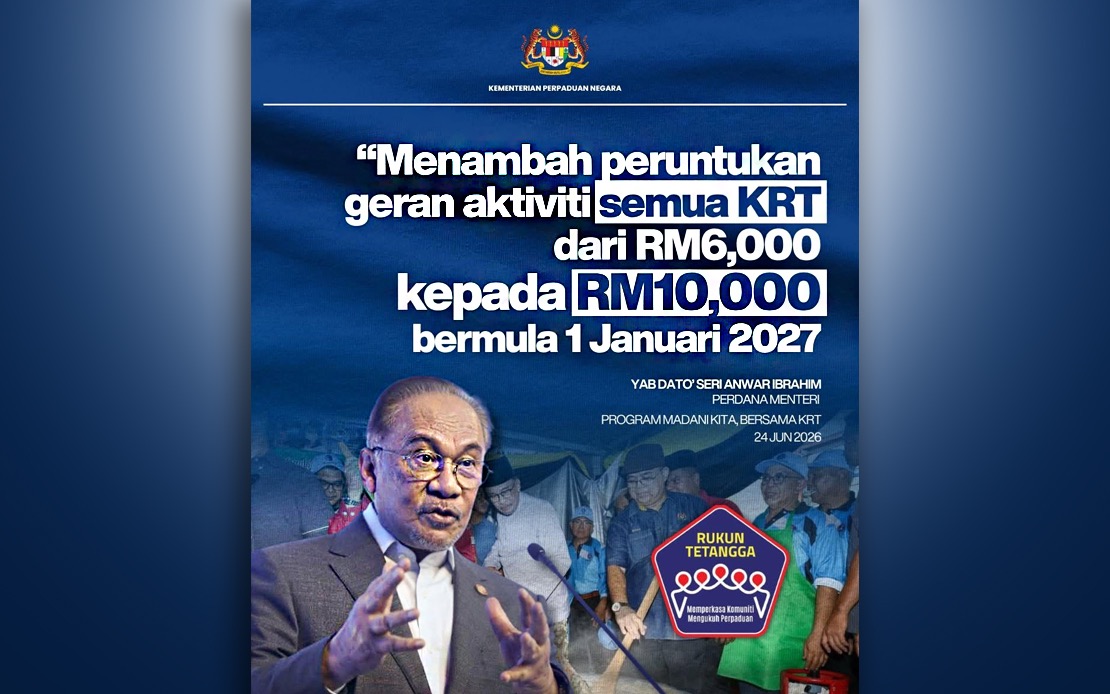
The Malaysian Government's decision to double annual grant allocations for neighbourhood watch groups represents a significant commitment to grassroots institution-building. A total of 8,615 KRT (Kawasan Rukun Tetangga) neighbourhood watch areas nationwide will receive enhanced funding, with the annual grant climbing from RM6,000 to RM10,000, beginning January 1, 2027. Prime Minister Datuk Seri Anwar Ibrahim unveiled the increase during a MADANI KITA programme event held in Dataran Segamat, Johor, signalling the administration's determination to invest in community-level infrastructure that has existed for more than fifty years.
National Unity Minister Datuk Aaron Ago Dagang characterised the funding increase as vindication of the KRT model's decades-long contribution to social cohesion and neighbourhood stability. According to the minister, the boost acknowledges KRT's proven track record as a foundation for unity, harmony, and social welfare delivery. The announcement underscores how the MADANI Government perceives grassroots movements not as peripheral initiatives but as essential drivers of a united and progressive society. This framing positions KRT within a broader national development strategy that prioritises building consensus and social trust from the neighbourhood level upward.
The scale of KRT's existing operational footprint demonstrates why enhanced funding carries practical importance for communities across Malaysia. The ministry oversees approximately 250,000 KRT members who, through their volunteer work, reach more than 12 million Malaysians annually. Over the preceding year alone, these neighbourhood groups had organised more than 100,000 community activities. This substantial engagement suggests that incremental funding boosts translate directly into expanded service capacity at the hyperlocal level. For Malaysian households, stronger KRT funding could mean more frequent community policing initiatives, welfare support networks, and preventive social programmes.
The expansion in available resources addresses a longstanding resource constraint facing volunteer-driven organisations. With additional capital, KRT groups will be positioned to initiate higher-impact programming that traditionally stretches their capacity. Aaron outlined that enhanced funding would enable neighbourhood watch areas to deepen activities spanning unity promotion, infrastructure development, social assistance, educational outreach, security enhancement, volunteerism coordination, and grassroots economic initiatives. The breadth of these domains illustrates how KRT functions as a multifaceted community institution rather than a narrowly focused neighbourhood patrol mechanism. The financial injection essentially allows these groups to diversify and sophisticate their interventions.
For Southeast Asian observers, Malaysia's investment in neighbourhood-level social infrastructure reflects broader regional trends toward subsidiarity and community-centred governance. Many nations in the region have recognised that top-down policy implementation often falters without robust local institutional scaffolding. By strengthening KRT, Malaysia positions itself ahead of peer countries in institutionalising grass-roots participation mechanisms. The neighbourhood watch model, operating through voluntary membership and localised decision-making, offers a template for civic engagement that transcends formal government bureaucracy while remaining aligned with national objectives.
The timing of the announcement also carries strategic significance for Malaysian political discourse. The MADANI Government's emphasis on unity initiatives responds to societal concerns about inter-communal relations and polarisation. KRT groups, by definition, require cross-cultural cooperation among neighbours regardless of ethnicity or faith background. Aaron's repeated emphasis that neighbourliness underpins national unity reframes community safety and welfare within a unity-building paradigm. Rather than presenting neighbourhood watch purely as a security mechanism, the Government presents it as a forum for Malaysians of different backgrounds to collaborate on shared concerns. This rhetorical positioning may reshape public understanding of KRT's purpose and legitimacy.
The implementation framework—with funding commencing January 2027—provides KRT leadership with an 18-month planning horizon. This timeline allows neighbourhood groups to develop coherent strategies for deploying the additional resources rather than facing unexpected windfalls they cannot absorb efficiently. The staggered approach suggests considered Government planning, acknowledging that grassroots organisations require advance preparation to utilise enhanced budgets effectively. For KRT committees nationwide, the announcement likely triggers internal discussions about priority areas, skill development for volunteer coordinators, and programme design that can absorb the funding increase while generating measurable community outcomes.
The financial mathematics underlying the grant increase merit consideration. Raising per-group allocations by 67 percent (from RM6,000 to RM10,000) translates to approximately RM36.86 million in additional annual expenditure across all 8,615 groups. For a nation-state with substantial fiscal capacity, this sum represents modest budgetary commitment to institutional strengthening. Yet its impact reverberates through 8,615 distinct communities, touching the lives of millions of Malaysians through expanded neighbourhood-level services. This efficiency in resource allocation—achieving national reach through decentralised disbursement—explains why successive Malaysian governments have relied on KRT as a policy instrument.
Government assurances regarding oversight indicate awareness that funding increases require accountability mechanisms. Aaron committed the ministry to monitoring optimal utilisation of additional resources, ensuring that the augmented grants translate into tangible community benefits rather than administrative accumulation. This supervisory posture acknowledges past criticisms that some Government transfers to grassroots organisations have generated minimal visible outcomes. By explicitly pledging oversight, the ministry signals to taxpayers and beneficiary communities alike that enhanced funding entails corresponding responsibility for results. Such commitments also guard against accusations of political patronage, positioning the grant increase as programmatic investment rather than electoral manoeuvring.
For Malaysian neighbourhoods, the practical implications of enhanced KRT funding extend beyond headline programme expansion. Stronger financial resources likely enable volunteer coordinators to implement longer-term initiatives that require seed funding or sustained investment. Crime prevention activities, educational scholarship programmes, disaster preparedness networks, and elderly care coordination all represent efforts that benefit from financial stability and planning horizon extension. The grant increase therefore facilitates transition from episodic, ad-hoc community activities toward institutionalised, sustainable neighbourhood services that residents can reliably access.
The framing of KRT strengthening within Malaysia's MADANI development framework situates neighbourhood watch within broader national aspirations rather than isolated community activity. MADANI—representing Government priorities around prosperity, people, planet, peace, and Malaysia's sovereignty—positions KRT as contributors to peaceful, prosperous, and united national development. This integration of grassroots institutions into overarching national narratives elevates volunteer neighbourhood workers as active participants in realising Government's long-term vision. Such recognition may enhance recruitment and retention of KRT volunteers, providing deeper purposefulness than functional neighbourhood safety provision alone.