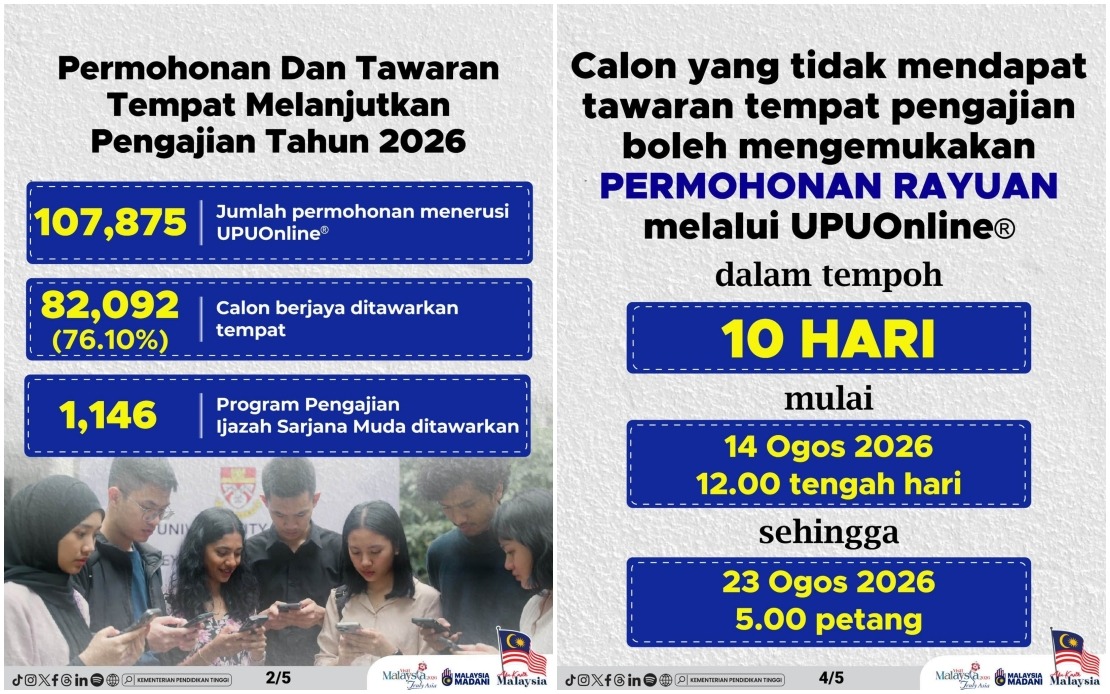
Malaysia's Ministry of Higher Education (KPT) has concluded its main admissions round for undergraduate programmes, announcing that 82,092 candidates have secured study places across the country's 20 public universities for the forthcoming academic session. The figure, released in Putrajaya, reflects a substantial intake that accounts for 76.10 per cent of the 107,875 applications deemed eligible to pursue bachelor's degrees through the centralized UPUOnline application platform.
The volume of successful placements underscores the continued demand for higher education among Malaysian school-leavers and reflects the capacity of the public university system to absorb qualified applicants. Across these institutions, a combined total of 1,146 distinct bachelor's degree programmes have been made available, spanning diverse academic disciplines from engineering and medicine to humanities and business studies. This breadth of offerings enables prospective students to pursue qualifications aligned with their interests and career aspirations within the public sector, which remains a primary pathway to tertiary education for many Malaysians.
The ministry has reaffirmed its commitment to meritocratic principles in determining admissions, emphasizing that all eligible candidates have been ranked according to academic merit scores arranged from highest to lowest. This standardized approach aims to ensure transparency and fairness in the selection process, removing subjective elements from placement decisions. For Malaysian policymakers and education commentators, the maintenance of merit-based criteria reflects an ongoing tension between equitable access and academic standards—a balance that public universities must continually navigate as they expand enrolment while preserving institutional quality.
The successful cohort represents the culmination of months of application processing and evaluation. Each candidate's academic credentials, accumulated through secondary education and standardized examinations, have been quantified into comparable merit scores that determined their position in the allocation hierarchy. This data-driven methodology, while administratively robust, also highlights the critical importance of secondary school performance in shaping educational trajectories for Malaysian youth, with performance gaps potentially widening access disparities across different socioeconomic backgrounds.
For the approximately 25,783 eligible applicants who have not yet received offers through this primary allocation round, the KPT has established an appeal mechanism to provide a second opportunity for university placement. This supplementary process operates through the same UPUOnline portal and runs for ten days commencing from noon on August 14 through 5 pm on August 23, 2026. The appeals window allows candidates who believe they should have been selected or wish to contest their initial outcome to make formal representations, potentially accessing remaining vacancies across the system or repositioned places.
The provision of an appeals process reflects a more compassionate approach to university admissions compared to rigid single-round systems employed elsewhere. It acknowledges that merit scores, while objective measures, may not fully capture a candidate's potential or may occasionally contain administrative errors. For unsuccessful applicants, this represents a meaningful safety net rather than an absolute barrier to public university entry, though the number of additional places available through appeals is typically limited and competitive.
Beyond the immediate admissions cycle, the KPT's announcement carries broader implications for Malaysia's higher education landscape and economic development. A well-educated workforce remains essential for the country's transition toward high-value industries and knowledge-based sectors. The scale of this undergraduate intake demonstrates that Malaysia's public universities continue to function as mass providers of tertiary education, absorbing the majority of domestic demand for degree qualifications and complementing the private sector.
The ministry extended formal congratulations to all successful candidates, expressing hope that the opportunity to study at tertiary institutions will be pursued with dedication and seriousness. This language reflects an underlying expectation that admission itself represents not merely a starting point but a commitment requiring sustained effort from students to maximize their educational investment. Such messaging resonates with broader Malaysian social narratives emphasizing personal responsibility and national contribution through academic achievement.
For families navigating the university selection process, the completion of primary admissions allocations marks either a moment of celebration or concern. Those whose children have secured places face immediate practical decisions regarding accommodation, financial arrangements, and pre-university preparations. Those awaiting outcome of appeals must contend with uncertainty during a critical window in the academic calendar. The timing and pace of admissions decisions therefore carry real emotional and logistical consequences for thousands of Malaysian households.
Looking forward, the admissions data captured in this cycle will likely inform KPT's strategic planning regarding programme capacity, institutional resource allocation, and demand patterns across different fields of study. Demographic trends, employment market signals, and evolving national skills requirements all influence how universities calibrate their offerings in subsequent years. For policymakers monitoring higher education expansion, understanding which programmes attract the highest caliber of applicants provides valuable intelligence for aligning university provision with anticipated workforce needs across Southeast Asia's fastest-growing economy.

