Deep in the Czech countryside, roughly 90 kilometres east of Prague, stands a house unlike any other in the village of Bukovka. The three-storey residence is painted in the unmistakable sky-blue and white of the Argentine national football team, complete with a towering sun emblem—the central symbol of Argentina's flag—dominating one wall. This is the home of Miloslav "Curby" Urbanec, a 51-year-old music promoter whose devotion to all things Argentine football has transformed his dwelling into what amounts to a pilgrimage site for supporters of La Seleccion across Central Europe.
Urbanec's commitment to his adopted team extends far beyond a simple coat of paint. A life-size statue of Diego Maradona stands sentinel in the courtyard, while a sprawling mural of Lionel Messi covers the rear of the house—a daily reminder of the two figures who have defined Argentine football across generations. Behind the residence lies a full-sized all-weather football pitch, its perimeter decorated with photographs and placards celebrating players from Boca Juniors, the Buenos Aires club most closely associated with Maradona's legendary career. Every element of the property speaks to a passion forged nearly five decades ago and never dimmed.
The origin of Urbanec's extraordinary attachment to Argentina traces back to the 1978 FIFA World Cup, an event that coincided with a formative moment in his childhood. At just four years old, he watched the tournament unfold alongside his father, captivated not merely by the football itself but by the aesthetic of the Argentine players—particularly the flowing long hair of striker Mario Kempes and his teammates. That World Cup triumph, achieved on home soil in Buenos Aires, ignited something within the young Czech boy that would ultimately define his entire adult life. What began as youthful admiration evolved into an unshakeable devotion that has persisted through decades of changing circumstances, technological revolutions, and shifting global politics.
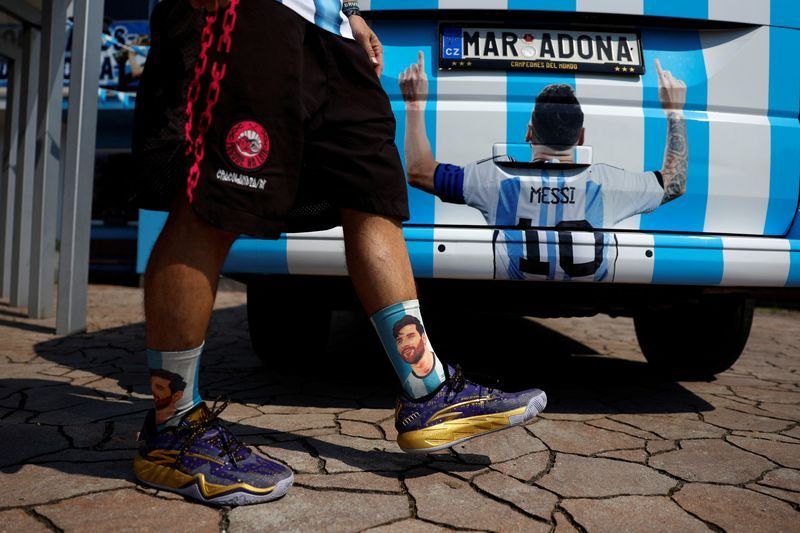
The depth of Urbanec's connection becomes apparent in the smallest details of his daily existence. His personal vehicle has been customised in Argentine colours, adorned with imagery of both Maradona clutching the World Cup and Messi in his prime. The van carries a personalised licence plate reading "MARADONA" and displays the slogan "In Messi we trust"—a secular prayer from a man who treats football with almost religious reverence. These are not the trappings of casual fandom; they represent deliberate, sustained choices to embed Argentine football into every visible aspect of his life.
Perhaps most tellingly, Urbanec passed his passion to the next generation through an act of naming. His second son, now seven years old, bears the name Lionel—a deliberate homage to Messi. When asked about this decision, Urbanec explained that seven years ago it had become abundantly clear that "this guy is absolutely special." The choice reflects not merely enthusiasm for a talented player, but rather recognition of someone destined to reshape the sport. In naming his child after Messi, Urbanec made a prophetic statement about the Argentine's place in football history, a wager that few at that time would have made with such absolute certainty.
For Southeast Asian readers, Urbanec's story illuminates a broader phenomenon: the democratisation of global football fandom. Argentine football, centred on Buenos Aires and its legendary clubs, has transcended geographical boundaries to inspire devotion in unlikely places—a small Czech village being merely one example among millions worldwide. The internet age has facilitated unprecedented connections between supporters and distant clubs, allowing someone in Central Europe to feel as emotionally invested in Argentine football as someone living in the capital itself. This phenomenon mirrors the growth of European and South American football support across Malaysia and the region, where Manchester United, Liverpool, Barcelona, and now increasingly Argentine sides command passionate followings among local populations.
Urbanec's conviction about Argentina's prospects on the pitch reflects the confidence many supporters held regarding the team's trajectory. Speaking with obvious conviction, he declared that "La Seleccion this time is absolutely amazing," expressing complete certainty that victory would follow. He anticipated not merely sporting success but a global celebration of what he considers Argentine football's supreme aesthetic qualities. In his estimation, Argentina "play the most beautiful football," a judgement rooted in decades of observation and comparison. Such statements reveal how football fandom often transcends mere results and statistics; it encompasses an entire philosophy of how the game should be played and experienced.
The timing of this profile—with Argentina preparing to face Cape Verde in the round of 32 on July 3—placed Urbanec at a crucial juncture in the football calendar. Whether his prophecy would be fulfilled remained uncertain, yet his faith remained unshaken. For someone whose entire adult identity has been constructed around Argentine football, such moments represent both the promise of vindication and the ever-present risk of heartbreak. The stakes are personal and profound for this Czech dreamer in his blue and white house.
Urbanec's journey from a four-year-old watching a distant World Cup to a middle-aged man who has physically transformed his home and named his children after Argentine players encapsulates something essential about sport's capacity to transcend borders and create lasting meaning. In an increasingly fragmented world, his unwavering devotion to a South American national team offers testament to football's unique power to unite disparate individuals across vast geographical and cultural distances. Whether measured in blue and white paint, bronze statues, or names given to children, his passion represents an investment in something larger than himself—a connection to a distant nation and its beautiful game that has defined his existence.

