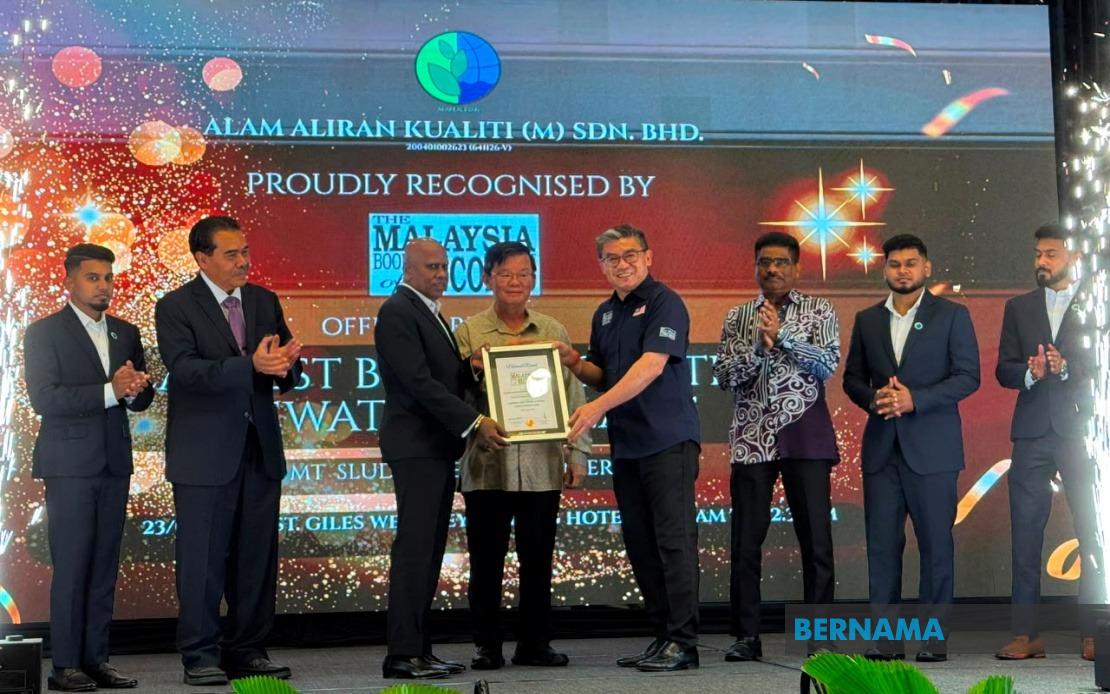
Alam Aliran Kualiti (M) Sdn Bhd (AAK) has been officially recognised by the Malaysian Book of Records (MBOR) for operating the nation's largest belt press system dewatering plant, a facility that underscores Malaysia's growing capability in advanced water treatment infrastructure. The Sungai Dua Dewatering Plant, developed jointly with Perbadanan Bekalan Air Pulau Pinang (PBAPP), represents a significant engineering achievement for the country's environmental sector and signals how local expertise can compete with international standards in complex water management solutions.
The facility's operational specifications reveal its substantial scale and contribution to Penang's water infrastructure. With a daily treatment capacity of 10 million litres, the plant simultaneously manages approximately 450 tonnes of water treatment sludge, transforming what would traditionally become landfill waste into valuable materials through an innovative circular economy model. This capacity places the installation among the region's most significant dewatering operations, addressing both the immediate challenge of treating drinking water residuals and the broader imperative to reduce environmental burden through waste valorisation.
AAK's director Gokulaan Balan framed the achievement as validation of Malaysian engineering prowess in delivering world-class environmental infrastructure, yet notably contextualised the record as a beginning rather than an endpoint. His comments reflect a strategic mindset within the sector that treats such recognition as a platform for further innovation rather than a completion milestone, signalling that the company and its collaborators view this capability as foundational for more ambitious environmental projects. The emphasis on continued commitment to engineering excellence and sustainability suggests that Malaysian operators in this space are positioning themselves to pursue increasingly complex water challenges across the region.
Penang Chief Minister Chow Kon Yeow underscored the facility's significance within broader economic and environmental policy frameworks, characterising the project as a practical demonstration of how circular economy principles can generate commercial value whilst solving infrastructure challenges. The conversion of water treatment residuals into Eco Green Cement Bricks represents a fundamental shift from the traditional linear model of waste disposal to an integrated system where every output becomes a potential input for another process. For a state facing long-term water security concerns, such facilities become critical infrastructure that simultaneously improves service resilience and reduces operational costs through material recovery.
The recovered treated water channelled back into the treatment process carries particular significance for Penang's water management strategy. By reducing water losses during treatment cycles, the facility contributes measurably to conservation efforts in a region where population growth and climate variability pose ongoing threats to supply security. This closed-loop approach transforms what appears in conventional accounting as waste into quantifiable reductions in fresh water extraction requirements, a consideration increasingly important as Southeast Asian regions grapple with competing water demands from agriculture, industry, and domestic consumption.
The MBOR recognition ceremony assembled significant institutional stakeholders, with Pengurusan Aset Air Berhad (PAAB) chairman Datuk Seri Jaseni Maidinsa present alongside Penang's political leadership. This constellation of participants from water utilities, asset management authorities, and state government indicates the cross-sectoral coordination required to implement large-scale environmental infrastructure. Such visibility at the leadership level also reflects growing political awareness that sustainable waste management and water treatment improvements deliver tangible quality-of-life benefits that resonate with constituents and support long-term strategic objectives around environmental stewardship.
AAK's operational profile has evolved considerably since its establishment in 2004, when the company entered a market with relatively limited local capacity in environmental engineering and scheduled waste management. The fifteen-year trajectory from founding to record-holding facility represents the maturation of Malaysia's domestic expertise in managing complex environmental challenges that previously required substantial foreign technical input. This progression carries implications for Malaysia's positioning within Southeast Asia's environmental services market, where countries increasingly seek to develop indigenous capacity rather than relying on external specialists.
The Eco Green Brick Manufacturing Plant component of the operation transforms treated SW204 scheduled waste—a category encompassing water treatment sludge and similar residues—into construction materials suitable for commercial deployment. This conversion process adds significant value to material flows that would otherwise incur disposal costs, fundamentally altering the economics of water treatment operations. For other utilities across Malaysia and Southeast Asia confronting similar sludge management challenges, the successful implementation and commercial viability of this model creates a replicable pathway that governments and operators can pursue to improve both environmental outcomes and financial sustainability.
The facility's integration within PBAPP's operations demonstrates how public water authorities can partner with specialist private operators to develop infrastructure that would be difficult for either sector to achieve independently. Such collaboration models increasingly characterise environmental infrastructure development across the region, where public utilities provide scale and regulatory authority whilst private firms contribute technical innovation and operational efficiency. For Malaysia's broader environmental policy objectives—including meeting commitments to circular economy development and sustainable resource management—such partnerships provide practical mechanisms for translating policy aspirations into operational reality.
Chow's observations regarding the economic value creation embedded within sustainability initiatives reflect a critical policy insight gaining traction across Asia: environmental responsibility and financial viability are not opposing objectives but increasingly compatible pursuits. By capturing commercial value from waste streams, the Sungai Dua facility generates revenue that can offset treatment costs, improve facility economics, and create reinvestment capacity for further innovation. This economic logic makes sustainability projects more politically viable and financially resilient, particularly important in developing economies where budget constraints often impede environmental improvements despite their long-term necessity.
The recognition by MBOR carries symbolic weight beyond technical achievement, functioning as formal validation that Malaysian companies can establish and operate infrastructure of genuinely distinctive scale and capability. Such recognition supports domestic industry positioning in regional markets where clients may traditionally have assumed that scale advantages and technical sophistication reside primarily with established foreign operators. For AAK and similar companies, the record serves as marketing validation that supports business development efforts across Southeast Asia's water and waste management sectors, where demand for specialist treatment capacity continues expanding.
Looking forward, the facility's success creates templates and demonstrations that may accelerate adoption of similar technologies across Malaysian water utilities and potentially throughout the region. As other operators confront mounting sludge management challenges and regulatory pressure to improve environmental performance, the proven viability of advanced belt press dewatering systems and waste valorisation approaches becomes increasingly relevant. The Sungai Dua plant thus transcends its immediate operational role to become a knowledge asset that influences how the sector addresses evolving water treatment challenges across Malaysia and Southeast Asia.

