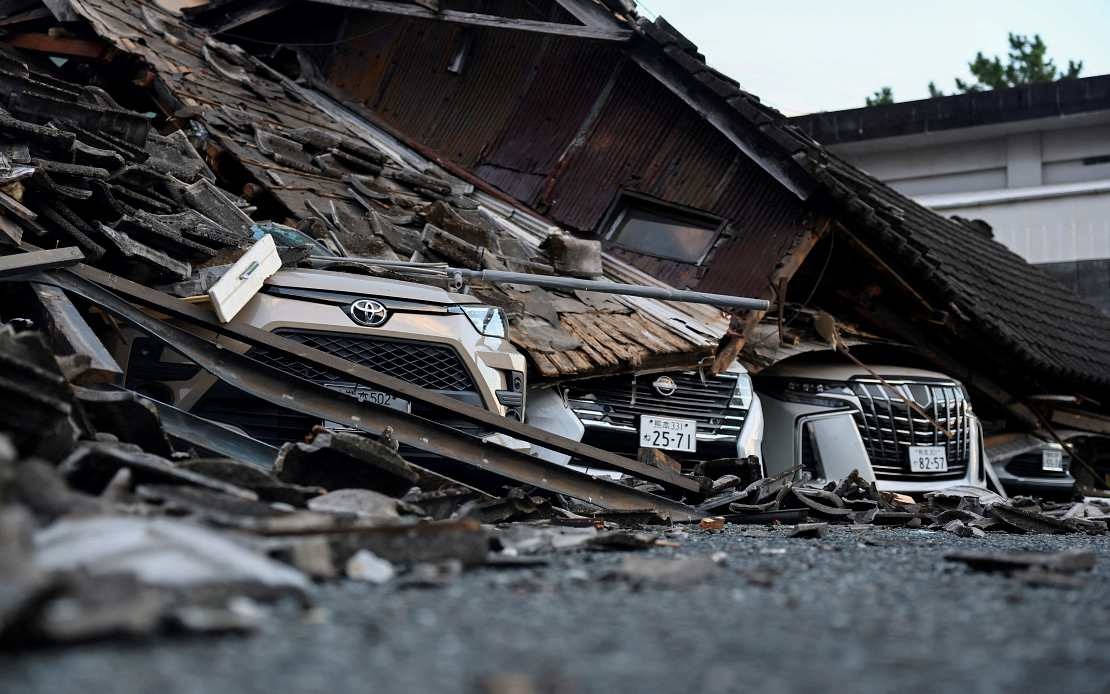
A disaster that claimed seven lives at an Aeon shopping mall in Kumamoto Prefecture, southwestern Japan, has exposed a fatal breach of workplace safety protocol when company management ordered two evacuated staff members back into the building to retrieve money. The women, including a 22-year-old, had made it to safety after a magnitude 7.1 earthquake struck the region on Tuesday, the strongest level on Japan's seismic intensity scale, but were inexplicably directed to re-enter the Aeon Mall Kumamoto structure in Kashima Town to transfer the day's sales proceeds to a secure location.
Habita, the operator of the variety store chain within the mall, formally admitted responsibility for the instruction on Monday. Company leadership provided bereaved families with a written statement detailing the sequence of events and offered an apology for the decision that ultimately cost the employees their lives. The revelation marks a serious lapse in emergency response procedures and raises questions about the protocols governing employee safety during natural disasters across Japan's retail sector.
Koji Yuse, a 64-year-old sales manager at the Kumamoto-based Habita operation, took direct responsibility during a press briefing on Monday afternoon. He explained that he had personally instructed the store manager to dispatch the two workers back inside the building to move cash from the second-floor retail counter to a first-floor safe. The magnitude of this miscalculation became apparent moments later when a massive explosion devastated the shopping complex, catching the employees who had re-entered the premises.
Yuse's public acknowledgment of culpability included an expression of regret, stating that the order was "inappropriate" and that he "deeply regret[s]" the decision. However, his admission came only after the tragic consequences were already irreversible. The comments underscore the tension between financial preservation and human safety that sometimes emerges in commercial operations during emergencies, though few cases result in such deadly outcomes. The incident raises uncomfortable questions about workplace culture in Japan where employee compliance with management directives often supersedes individual safety judgments.
The broader context of destruction from the Tuesday earthquake paints a grim picture of the disaster's scale. The Kumamoto prefectural government reported that as of Tuesday morning, 36 individuals had been confirmed dead as a direct result of the seismic event, with an additional two deaths still under investigation. The explosion at the Aeon Mall, triggered by the earthquake itself, represents one component of a larger catastrophe that disrupted the entire region's infrastructure and emergency response capacity.
For Malaysian readers and Southeast Asian observers, this incident carries particular relevance given the region's own seismic vulnerabilities and the prevalence of similar retail chains across the area. The Aeon brand operates extensively throughout Malaysia, Thailand, Vietnam, and other neighbouring countries, meaning that local employees and management structures operate under comparable corporate hierarchies and decision-making frameworks. Understanding how such crises unfold in a geographically similar nation provides crucial lessons for workplace safety protocols in the region.
The explosion mechanism itself warrants examination. Japan's building codes and safety standards are among the world's most stringent, yet the catastrophic nature of this incident suggests that even advanced structural protections and earthquake-resistant design cannot account for all possible failure modes, particularly when human judgment compounds natural hazards. The interaction between seismic activity and potential gas leaks or other ignition sources within commercial buildings remains an underexplored vulnerability in disaster preparedness discussions.
From a corporate accountability perspective, Habita's swift admission of responsibility distinguishes this case from typical disaster responses where companies often attempt to deflect blame or invoke force majeure arguments. Japanese corporate culture, despite its challenges, has demonstrated capacity for formal apology and acknowledgment of institutional failure, though critics argue this does not adequately address systemic issues that enabled such decisions in the first place. The company's provision of written statements and direct engagement with bereaved families represents a procedural response, but cannot restore lives or undo the trauma inflicted on families who lost loved ones.
The incident illuminates the gap between theoretical emergency protocols and practical implementation under pressure. Most retail operations worldwide maintain written evacuation procedures that prohibit re-entry during active natural disasters, yet Habita management evidently overrode such basic safeguards in pursuit of financial protection. This suggests that training, documentation, and even formal policies may prove insufficient without a fundamental cultural shift prioritizing human welfare above monetary considerations, particularly during crisis situations when normal risk calculus breaks down entirely.
Looking forward, this tragedy will likely prompt reviews of emergency response procedures not only at Aeon operations throughout Japan but potentially across the retail sector regionally. Malaysian authorities and regional workplace safety organisations may draw on these findings to strengthen guidance for commercial operations in seismically active zones. The incident serves as a stark reminder that no amount of structural engineering or financial preparation can substitute for clear-headed decision-making prioritizing employee safety when natural disasters strike, a lesson that transcends national borders and corporate cultures.

