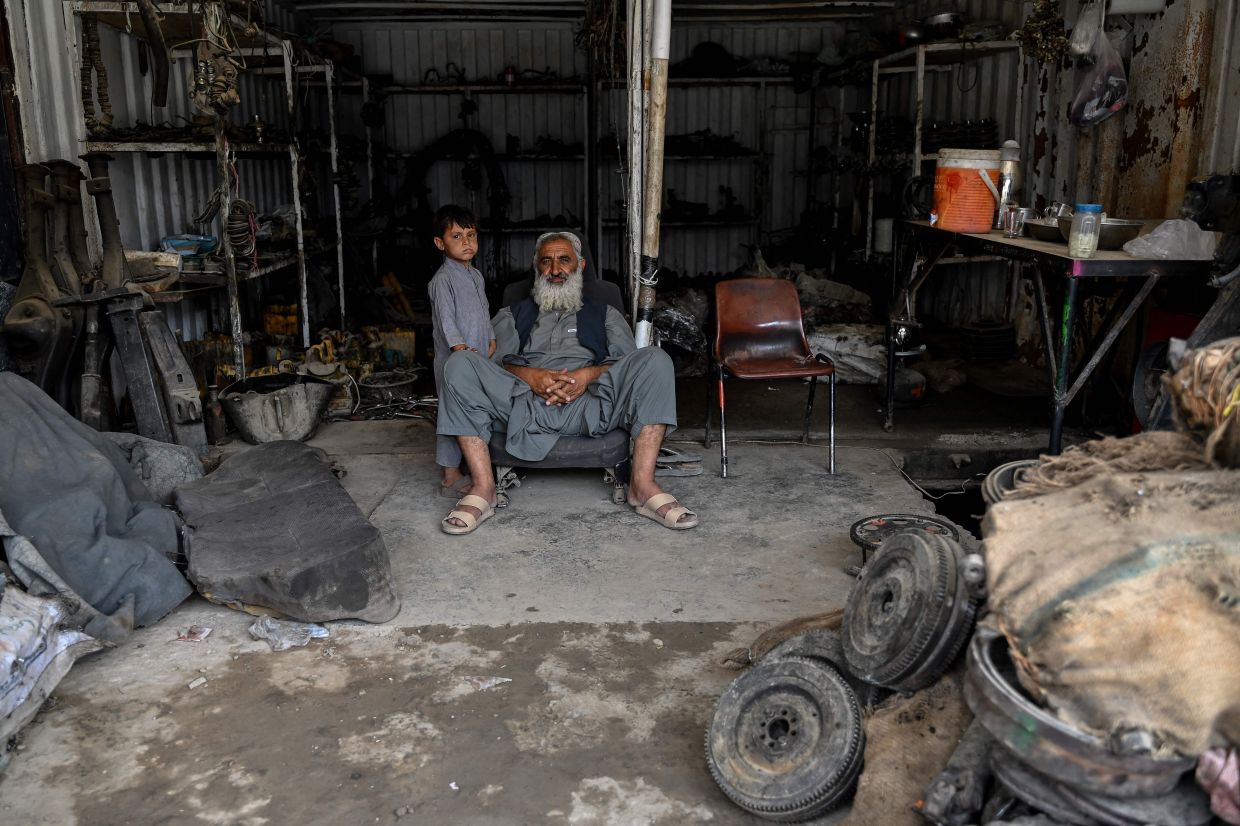
The automotive supply chain serving Afghanistan's southern Kandahar province has effectively frozen, with merchants and manufacturers in the Spin Boldak market facing unprecedented commercial paralysis triggered by overlapping geopolitical crises along regional trade corridors. Once a bustling hub where imported components were assembled into finished vehicles and distributed nationwide for repairs, the market now sits eerily quiet, its workshops idle and its workers confronting potential joblessness as the flow of parts from Asia and the Middle East has nearly ceased entirely.
The first rupture in this supply network came in October when escalating cross-border violence with Pakistan forced closure of the frontier, a corridor through which Japanese vehicles parts and components had traditionally moved overland into Afghanistan. This initial disruption compelled traders to pursue alternative routes, redirecting shipments through Iran's Bandar Abbas port at considerable additional expense and logistical complexity. Abdul Baqi Bina, deputy head of the Kandahar Chamber of Commerce and Investment, acknowledged that while this reroute proved costly and cumbersome, it at least preserved some commercial lifeline for the beleaguered traders. The adaptability demonstrated a resilience born of necessity, yet the fragility of this makeshift arrangement became apparent within months.
The situation deteriorated catastrophically when Middle East tensions erupted into open conflict in February, triggering seismic disruptions to maritime commerce through the Strait of Hormuz, a chokepoint through which immense volumes of global shipping normally transit. For Afghanistan's importers, already stressed by the Pakistan closure, this fresh shock severed their most viable remaining pathway. Bina characterised the compounding crises as creating "very difficult problems for Afghanistan," a measured assessment that masks the genuine commercial devastation unfolding on the ground. Shipping companies have signalled that restoring normal operations through these vital waters will prove neither swift nor straightforward, offering no immediate relief to stranded traders.
The financial impact on individual businesses reveals the severity of the disruption. Asadullah, an importer who sourced merchandise from Dubai and Japan, described how the February escalation "paralysed business" entirely. The cost per shipping container—the fundamental unit of his operation—has skyrocketed from approximately $2,000 to $8,000, a fourfold increase that obliterates profit margins and renders many transactions economically unviable. More troublingly, Asadullah currently has over thirty containers detained in transit between Japan and the UAE, held up by congestion at Dubai's Jebel Ali port, a facility that normally functions as a critical logistics hub for Middle Eastern commerce. This situation mirrors the predicament of countless other importers whose merchandise sits in expensive limbo, generating storage fees while remaining inaccessible.
Masoud, another parts importer who specialises in Japanese sourcing, has witnessed his business collapse even more dramatically. His monthly import volumes once numbered in the dozens or even hundreds of containers, representing a substantial operation serving the broader Afghan market. Today, that figure has descended to zero, a complete cessation reflecting the impossibility of economical importing under current conditions. Rather than continue paying mounting storage charges on containers stranded in the UAE, Masoud has begun the economically grim process of shipping his merchandise back to Japan entirely, accepting the loss as preferable to ongoing holding costs. His accounting books and calculator, the physical tools of his profession, sit idle beside him as he contemplates whether his business can survive this extended disruption.
The World Bank has characterised Afghanistan as particularly susceptible to such external economic shocks, an assessment validated by this unfolding crisis. The international financial institution noted in May that the country faces a "widening gap between imports and exports" that reached 70 per cent of Afghanistan's GDP in the 2025 fiscal year, a structural vulnerability that leaves the economy extraordinarily exposed to supply chain disruptions. Afghanistan's heavy dependence on imports combined with limited export capacity means that when international commerce seizes up, the consequences ripple through the entire economic structure with multiplied force.
The human dimension of this commercial collapse manifests acutely among Spin Boldak's workshop operators. Samiullah, a workshop owner aged thirty, previously coordinated production of five to seven completed vehicles weekly, work that generated employment and income for his staff. Production has now halted entirely due to the absence of incoming parts. The mathematics of his predicament are brutal: he must continue paying his employees despite generating no revenue, a situation he recognises is unsustainable. The longer parts fail to arrive, the greater his accumulated losses and the higher the probability he will be forced to dismiss workers. In the darkened workshop spaces where vehicles were assembled, men now sit idle while their tools rust and wheels gather dust.
Younger workers face even starker prospects. Mohammad Naeem, a twenty-one-year-old crane operator at the market, has begun contemplating career abandonment if conditions fail to improve soon. For workers at his life stage and with limited alternative skills, prolonged unemployment in the market represents not merely temporary hardship but potentially permanent derailment of their economic futures. The skills he has developed operating heavy equipment have limited applicability outside the automotive supply sector, making his vulnerability acute.
Downstream businesses dependent on parts availability have similarly ground to a halt. Noor Ali operates a vehicle showroom in the Spin Boldak market, his inventory comprising an array of completed cars assembled from imported Japanese components. With container arrivals reduced to a trickle, his customer base has evaporated; he has gone an entire month without a single sale. The showroom that once represented commercial vitality now displays unsold vehicles as monuments to interrupted supply chains. For Noor Ali and hundreds of others whose livelihoods depend on functioning commerce through Spin Boldak, the restoration of stable maritime corridors through the Strait of Hormuz has transformed from an abstract geopolitical question into an immediate existential economic necessity.

