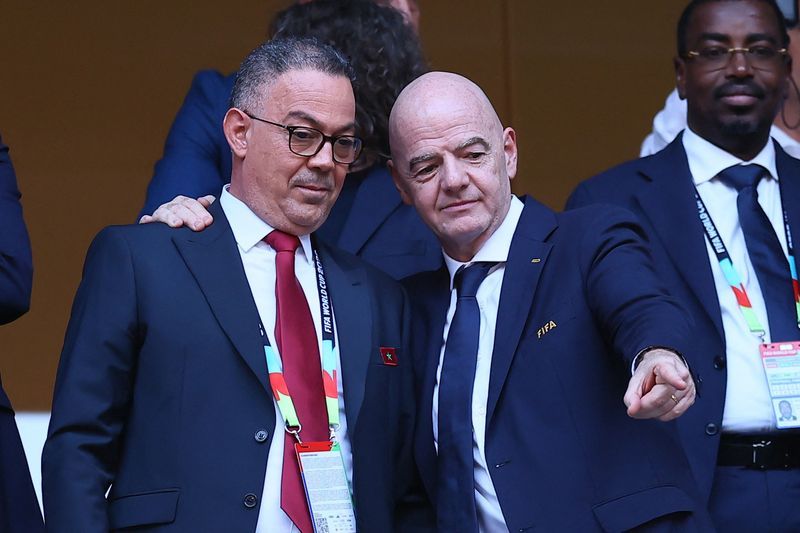
Embattled FIFA President Gianni Infantino is banking on substantial support from Africa's football establishment as he navigates a significant leadership crisis threatening his tenure ahead of the presidential election scheduled for next March. Several prominent African football administrators have issued statements of backing for the Swiss executive, positioning the continent's 54 member associations as potentially his strongest lifeline at a critical moment when governing bodies across Asia, Europe and North America have publicly withdrawn their confidence in his leadership.
The show of support from influential African figures marks a striking contrast to the deteriorating political landscape elsewhere in global football governance. While the Confederation of Asian Football, European football's governing body, and CONCACAF, which oversees competition across North and Central America and the Caribbean, all signalled their loss of confidence in Infantino's leadership over the weekend, the Confederation of African Football has strategically maintained neutrality, neither endorsing nor condemning the embattled executive. This calculated restraint suggests potential backing from the continent's substantial voting bloc when the matter moves to the broader FIFA membership.
Among the senior figures expressing support are CAF Vice President Fouzi Lekjaa of Morocco, along with fellow FIFA Council members Hany Abo Rida from Egypt, Hamidou Djibrilla of Niger, and Ahmed Yhaya representing Mauritania. Additionally, Veron Mosengo-Omba, the recently elected president of the Democratic Republic of Congo's football federation and former CAF general secretary, has released a statement backing Infantino. Notably, Mosengo-Omba studied at university in Switzerland alongside Infantino, suggesting a personal relationship beyond professional ties. Their statements, while diplomatically worded, consistently welcomed the FIFA president's decision to abandon a controversial proposal to monetise future World Cup revenue streams.
The controversial scheme at the heart of this crisis sought to generate $4.2 billion from a new commercial rights entity that would have claimed a stake in forthcoming World Cup revenues. Infantino shelved the FIFA Forward Enterprise initiative on Friday after encountering intense opposition, though the decision came only after CAF had cautiously announced it would study the proposal. The project had served as a lightning rod for critics questioning the governance and financial priorities of world football's administrative structure, making its abandonment a necessary concession to mounting international pressure.
The foundation of African football's willingness to stand by Infantino lies fundamentally in financial dependency. Since his election in 2016 on promises to substantially increase development funding to struggling member associations, Infantino has systematically expanded FIFA's financial commitments to continental federations. Each of FIFA's 211 member associations receives a baseline funding guarantee of $8 million across a four-year cycle, with CAF additionally providing annual grants to its members. This financial architecture has become essential infrastructure for many African football programmes, effectively replacing government support that often fails to materialise in nations grappling with more pressing economic priorities.
The scale of this financial interdependence cannot be overstated. Officials from resource-constrained nations have openly acknowledged their reliance on FIFA funding as a prerequisite for international competitiveness. Saïd Ali Athouman, president of the Comoros Football Federation, articulated this dependency plainly: wealthy nations possess inherent advantages through government investment in player development, training facilities, and equipment, creating structural inequalities that African federations struggle to overcome without external financial support. Fleetwood Haiya, leading Malawi's football association, echoed this assessment, highlighting how governments unable to adequately fund basic healthcare and hospital supplies inevitably prioritise such essential services over sporting development, leaving football administrators dependent on international revenue streams.
Infantino did not originate the strategy of distributing direct grants to member associations as a mechanism for securing political support. His predecessor, Sepp Blatter, pioneered this approach during his 1998 presidential campaign against UEFA president Lennart Johansson, successfully leveraging previously unimaginable FIFA financial support to secure backing from African nations who had never before received direct development assistance from world football's governing body. Despite CAF formally endorsing the Swedish candidate, African federations recognised the material benefits Blatter offered and provided decisive electoral support. Infantino essentially inherited and dramatically expanded this successful political formula, rebranding Blatter's Goal Project as FIFA Forward whilst exponentially increasing available funding.
The CAF executive committee meeting scheduled for Thursday will formally consider the abandoned World Cup revenue monetisation proposal, though there remains no certainty the continental body will issue any public position regarding Infantino's political future. However, the private communications from influential committee members suggest a working consensus favouring the FIFA president's continuation in office. This internal alignment among decision-makers, combined with the structural financial dependency of member associations on FIFA distributions, creates formidable political obstacles for any organised effort to challenge Infantino's re-election within the continental federation.
For Malaysian and Southeast Asian observers, this African political positioning carries significant implications for the broader global football governance balance. The potential consolidation of substantial African voting support would substantially strengthen Infantino's electoral prospects, particularly if Asian and European resistance fails to coalesce around a unified alternative candidate. The episode also illuminates how financial power operates as a political tool within international sports governance, with resource-constrained federations effectively exchanging electoral support for access to development funds. This dynamic extends beyond Africa's borders and reflects the structural inequalities within global football's administrative apparatus that periodically generate governance crises.

