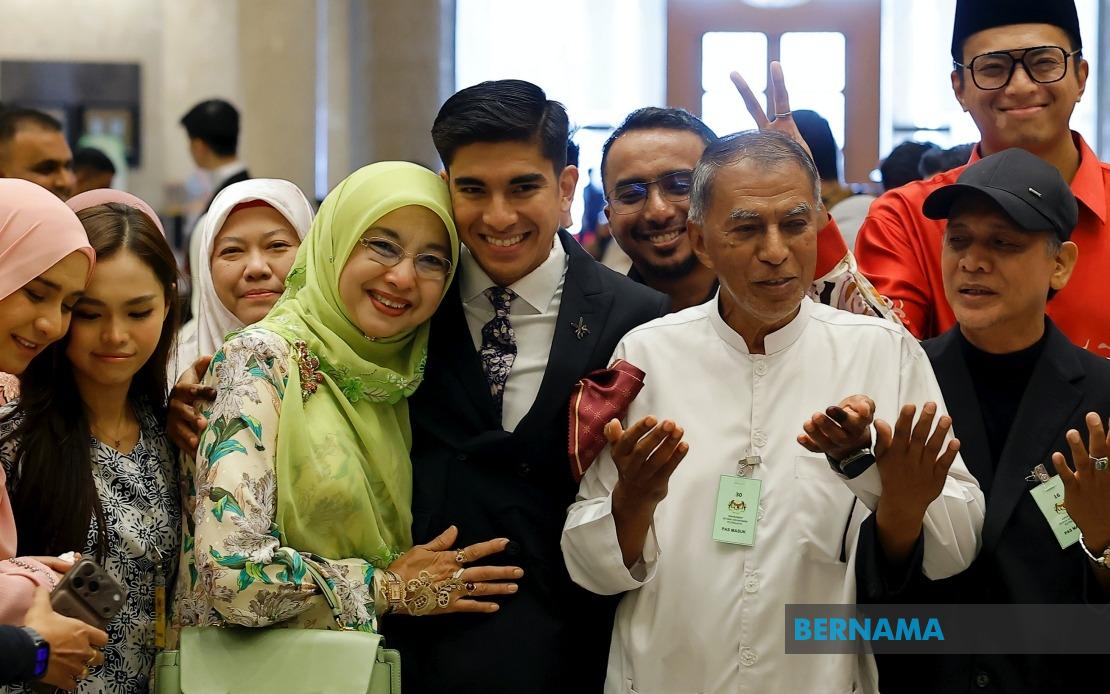
The Federal Court has upheld the acquittal of Muar Member of Parliament Syed Saddiq Syed Abdul Rahman, bringing to a close a six-year legal battle that consumed significant personal and political energy. The 33-year-old politician was cleared of four charges involving abetting criminal breach of trust, misappropriation of property, and money laundering linked to funds belonging to Angkatan Bersatu Anak Muda (Armada), the youth wing of his political coalition. The verdict marks a decisive moment in a case that has dominated Malaysian political discourse and raised important questions about the trajectory of Malaysia's judicial system during a period of substantial institutional transition.
Syed Saddiq's relief was evident as he performed a sujud syukur, or prostration of gratitude, alongside his family members in the Palace of Justice lobby. Speaking to reporters immediately after the judgment, he articulated a philosophical perspective shaped by years of legal uncertainty, emphasizing his unwavering conviction that justice and truth would ultimately find vindication. His remarks suggested that the ordeal, while exhausting, had reinforced rather than diminished his faith in Malaysia's judicial institutions as foundational pillars of national strength and stability.
The implications of this case extend well beyond the individual defendant. The lengthy legal proceedings had rippled outward, affecting not only Syed Saddiq's immediate family and personal relationships but also the broader political landscape of Malaysia. The uncertainty surrounding his legal status had created complications for MUDA, the political party he founded, and raised broader questions about the resilience of Malaysia's judiciary under pressure. The acquittal thus provides some reassurance to observers concerned about the independence and fairness of the country's legal institutions at a time when Malaysian democracy has undergone considerable strain and realignment.
Syed Saddiq's public statement reflected a maturity forged through adversity. He articulated the principle that courage derives from righteousness, a conviction he credited with sustaining him and his legal team through what he acknowledged were periods that seemed hopeless and devoid of prospect. This framing is significant for how it shapes the narrative around Malaysia's judicial processes—suggesting that the system, despite its sluggishness and the burden it places on defendants, ultimately fulfills its foundational purpose of distinguishing innocence from guilt.
The former youth and sports minister disclosed that he intends to step back from active political engagement in the immediate term, seeking time to restore equilibrium to his personal and family affairs. This decision underscores the toll that protracted criminal proceedings exact on individuals, regardless of eventual outcome. However, he emphasized his continued commitment to MUDA, indicating that his withdrawal is tactical rather than permanent. He also noted that his parents had given their blessing for him to proceed with wedding plans—a personal milestone previously shadowed by legal uncertainty.
Syed Saddiq's forthcoming retreat from the political spotlight comes at a moment when Malaysia's younger generation of political figures continues to navigate complex institutional terrain. His stated intention to focus on family and personal restoration reflects a recognition that political capital, once invested, requires periodic replenishment through personal well-being and family stability. For observers monitoring succession and renewal within Malaysian political parties, this signals both a consolidation period and an implicit acknowledgment that his immediate priority is repairing the personal relationships and circumstances disrupted by six years of litigation.
The legal team representing Syed Saddiq, led by counsel Datuk Hisyam Teh Poh Teik, expressed satisfaction with the court's decision and gratitude to the judicial panel. The lawyer's remarks highlighted the collaborative nature of the defense, underscoring that acquittals in complex cases typically result from sustained effort by multiple professionals working in concert. Such acknowledgments serve an important function in Malaysian political culture, where individual achievements are often contextualized within broader team dynamics.
The prosecution's response, delivered through Deputy Public Prosecutor Datuk Wan Shaharuddin Wan Ladin, was measured and professional. The prosecutor's indication that the Attorney General would determine whether to pursue a review of the Federal Court's decision leaves a thin thread of legal uncertainty, though such reviews are relatively uncommon in Malaysian practice. The prosecution's acceptance of the verdict, despite reserving the theoretical possibility of further action, suggests resignation to the finality of the court's judgment.
This case occupies a significant place in the recent history of Malaysian criminal law and political accountability. The charges stemmed from scrutiny of fund management within Armada, and the acquittal raises questions about how youth political wings handle their financial obligations and internal accountability structures. The verdict suggests that the threshold for proving criminal misconduct in such contexts is appropriately stringent, requiring substantial evidence rather than suspicion or administrative irregularity.
For Southeast Asian observers monitoring Malaysia's institutional health, the resolution of this case provides cautious grounds for confidence. The Federal Court's willingness to uphold an acquittal—sometimes a politically fraught position—indicates that Malaysian judges retain capacity to render decisions based on legal merit rather than political pressure. However, the six-year duration of proceedings underscores persistent problems with trial efficiency that continue to afflict Malaysia's lower courts, a systemic challenge that endures despite periodic reform initiatives.
Looking forward, Syed Saddiq's return to parliamentary duties signals his continued presence in Malaysia's political architecture, even as he recalibrates his immediate priorities. His experience contributes to an evolving body of Malaysian political narratives about justice, vindication, and institutional resilience. The case serves as reminder both of the judiciary's capacity to function responsibly and of the significant personal costs that accompany extended legal entanglement, regardless of ultimate outcome.
The acquittal closes a chapter in Malaysian politics marked by considerable turbulence for the defendant, his family, and his party. Yet it opens a new phase in which Syed Saddiq must reconcile his public political ambitions with the personal restoration necessary after years of legal uncertainty. How he navigates this balance in subsequent months will offer insights into his political trajectory and the broader trajectory of Malaysian political renewal during a period of institutional transition and realignment.

