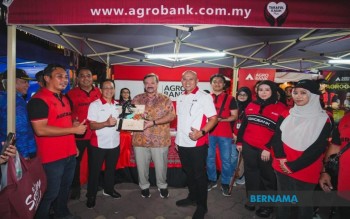
Malaysia's Agricultural Bank has mobilised over RM8 million in financing applications through a series of targeted engagement sessions with street traders and small business operators, reflecting strong demand for accessible capital among the country's grassroots entrepreneurial community. The initiative represents a deliberate shift away from traditional branch-based banking toward personalised, location-based outreach designed to meet businesses where they operate rather than requiring them to navigate formal financial channels.
Agrobank's strategy took concrete form in Kota Kinabalu on July 5, when the bank conducted two separate engagement sessions—one at the Api-Api Night Market along Jalan Gaya and another at the Papar Tamu Farmers' Market. These venues were strategically selected because they function as vital economic hubs within their respective communities, generating consistent foot traffic and serving as anchors for local supply chains. The Api-Api session alone attracted 153 hawkers and entrepreneurs, while the Papar market engagement drew 95 traders, demonstrating substantial participation from businesses eager to explore financing options tailored to their circumstances.
The expansion into Sabah marks a significant geographical milestone for Agrobank's community-focused lending programme. Prior to these Borneo sessions, the bank had already conducted similar outreach across multiple farmers' markets in the Klang Valley, establishing proof of concept for the model. By replicating this approach in Malaysia's largest state by area, Agrobank signals its commitment to bridging a persistent financing gap that affects small traders outside major urban corridors. The diversity of trading environments—from night markets to agricultural tamus—underscores the bank's recognition that capital needs vary considerably depending on sector, seasonality, and local market dynamics.
Finance Minister II Datuk Seri Amir Hamzah Azizan's presence at the Kota Kinabalu sessions lent official endorsement to the initiative, reflecting government support for initiatives that democratise access to working capital. The focus of discussions centred on identifying financing requirements aligned with operational realities, particularly working capital needs for inventory replenishment and funds for modest business expansion. Rather than imposing standardised loan products, Agrobank's engagement model prioritises understanding individual trader circumstances before structuring appropriate financing solutions.
Agrobank Group president and chief executive officer Datuk Tengku Ahmad Badli Shah Raja Hussin characterised the Sabah expansion as evidence of the bank's commitment to serving small business communities beyond Kuala Lumpur and other metropolitan centres. His remarks highlighted a fundamental principle guiding the initiative: different geographic regions and trader communities face distinct operational challenges and have varying capital requirements. This nuanced understanding shapes how Agrobank tailors its advisory approach, moving beyond one-size-fits-all financing models toward customised guidance aligned with local business realities.
The engagement sessions function as dual-purpose platforms, combining immediate financing applications with longer-term relationship building. Beyond capital access, Agrobank explicitly aims to provide financial advisory services and non-financial support mechanisms that enable hawkers and micro-entrepreneurs to professionalise operations and pursue sustainable growth trajectories. This holistic approach acknowledges that many small traders lack exposure to formal business management practices, accounting systems, and strategic planning tools—capabilities that prove essential as operations scale.
These efforts gain additional significance within the context of Prime Minister Datuk Seri Anwar Ibrahim's directive to financial agencies to intensify outreach and accelerate disbursement of RM5 billion designated specifically for small traders. Agrobank's RM8 million in accumulated applications represents meaningful progress toward this broader government target, though the gap indicates substantial untapped demand remains. The success of these engagement sessions suggests that proximity and personalised communication remove considerable psychological and informational barriers that traditionally prevented informal sector traders from accessing formal financing.
For Malaysian small traders and hawkers, particularly those operating outside major urban centres, Agrobank's approach offers tangible advantages over conventional banking relationships. Street traders and market operators often lack formal business registration, collateral, or detailed financial records—factors that traditionally disqualify them from standard lending assessment frameworks. By coming directly to markets and tamus, Agrobank evaluates character, operational history, and cash flow patterns visible within community contexts, allowing creditworthiness assessment through alternative metrics.
The regional implications extend beyond Sabah. Malaysia's informal trading sector comprises hundreds of thousands of micro-entrepreneurs generating substantial economic activity yet remaining systematically underserved by conventional financial institutions. Successfully replicating the Kota Kinabalu model across other states—Sarawak, Johor, Penang, and others—could unlock significant capital deployment to businesses currently financing operations through informal lending networks or foregone expansion opportunities. Each successful session generates practical knowledge about regional trading patterns, capital requirements, and borrower characteristics that improve subsequent programme implementation.
Looking forward, the metrics from these engagement sessions warrant close monitoring. The RM8 million figure captures applications submitted; tracking actual disbursement rates, repayment performance, and borrower business outcomes over subsequent quarters will reveal whether the model genuinely delivers sustainable support or merely generates applications that fail subsequent underwriting scrutiny. Success requires Agrobank to maintain momentum through timely lending decisions, accessible disbursement procedures, and follow-up support that helps traders deploy capital effectively.
The initiative also signals potential repositioning of Agrobank's competitive positioning within Malaysia's financial services landscape. By targeting market segments historically neglected by larger commercial banks, Agrobank establishes itself as a specialised lender willing to incur origination costs that bigger institutions avoid. This positioning could strengthen the bank's developmental mandate and justify continued government support, while simultaneously expanding the financial system's depth by incorporating previously excluded borrower populations. Success ultimately depends on whether community-based engagement generates lending portfolios that perform adequately while achieving the broader social objective of supporting grassroots economic activity.

