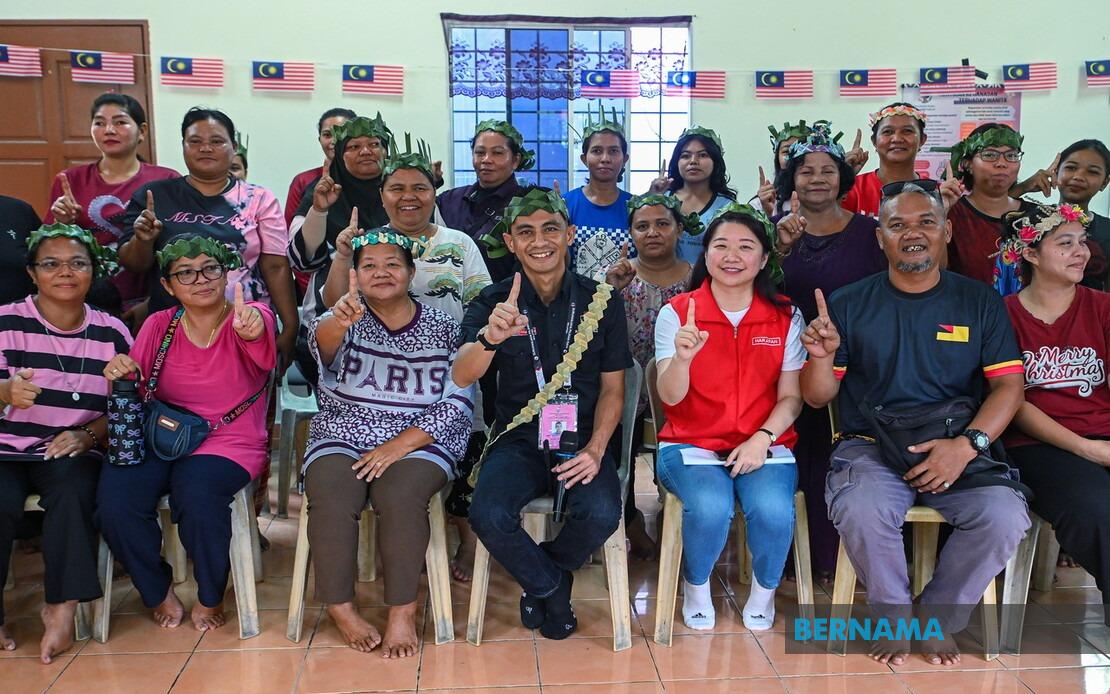
Datuk Ahmad Faez Abdul Razak, the Pakatan Harapan candidate vying for the Labu state assembly seat in Negeri Sembilan, has made the welfare and economic empowerment of the Orang Asli community a cornerstone of his campaign platform. Speaking at Kampung Orang Asli Tekir after participating in a women's empowerment initiative, Ahmad Faez outlined an ambitious development agenda aimed at transforming living standards within the indigenous settlement through targeted infrastructure investment and sustainable income generation schemes.
The proposal to address customary land issues affecting Kampung Orang Asli Tekir represents one of Ahmad Faez's primary legislative objectives should Pakatan Harapan secure victory in the state election. This commitment acknowledges a long-standing grievance within Orang Asli communities across Malaysia, where tenure insecurity and disputes over ancestral territories have historically hindered development and investment. By pledging to bring the matter before the State Legislative Assembly, Ahmad Faez signals recognition of how institutional barriers have constrained opportunities for indigenous populations to secure their land rights and build generational wealth.
Beyond legal frameworks, the candidate has proposed concrete infrastructure improvements that would modernise basic services currently inadequate in the 796-person village. Road networks and internet connectivity feature prominently in his platform, reflecting how digital isolation compounds economic disadvantage in rural Orang Asli settlements. These infrastructure deficits have traditionally limited market access for local producers and restricted educational opportunities for younger residents seeking to acquire digital literacy and modern vocational skills essential in today's economy.
Education and youth development emerge as parallel pillars of Ahmad Faez's vision, framed around channelling the community's human potential toward income generation. Rather than viewing Orang Asli populations through a deficit lens, the candidate emphasises existing capabilities requiring institutional support and skill enhancement. This represents a meaningful departure from patronising approaches that have historically characterised government engagement with indigenous communities, instead positioning Orang Asli youth as agents of their own economic advancement.
Handicraft production presents an immediate economic opportunity Ahmad Faez believes deserves strategic expansion. The village possesses existing artisanal capacity that remains severely underutilised due to limited marketing infrastructure and supply chain access. By facilitating broader market linkages and formalising production networks, locally-made products could reach Malaysian and potentially regional consumer bases, generating sustainable livelihoods grounded in cultural heritage and traditional knowledge rather than exploitative resource extraction or subsistence agriculture.
The introduction of modern agricultural technologies, particularly fertigation systems, addresses the productivity constraints that have confined farming households to marginal incomes. Such innovations enable more efficient water utilisation and targeted nutrient application, substantially increasing yields while reducing environmental degradation common in conventional smallholder agriculture. For communities historically dependent on rain-fed cultivation or shifting patterns, mechanised efficiency improvements could transition farming from survival activity to genuine commercial enterprise, particularly when coupled with market access and price stabilisation mechanisms.
Ahmad Faez's framing of his engagement as pre-existing rather than election-driven represents a calculated political positioning, claiming two years of ground-level presence and assistance prior to announcing his candidacy. This narrative, corroborated by village chief Nasir Musil's acknowledgement of frequent visits and tangible support, attempts to establish credibility as a leader genuinely invested in community welfare beyond electoral cycles. In Malaysian politics, where parachute candidates dropping into constituencies only during campaign season generate considerable scepticism, this positioning carries strategic weight among voters evaluating authenticity and commitment.
The village chief himself has articulated community priorities that align substantially with Ahmad Faez's platform, notably flagging infrastructure development and economic upliftment as essential concerns for the settlement's future. Nasir Musil's mention of stray cattle as a persistent hazard affecting road safety introduces a granular, locally-specific issue often overlooked in broader campaign messaging yet critically important to residents' daily experience. Such details suggest Ahmad Faez has engaged in substantive rather than superficial dialogue with constituents.
The three-way electoral contest featuring incumbent Mohamad Hanifah Abu Baker of Parti Pribumi Bersatu Malaysia and Siti Nur Umaira Hasim representing Barisan Nasional introduces competitive pressure that may determine whether Ahmad Faez's development proposals materialise. As a first-time contestant, he enters against an incumbent holding administrative advantage and resource access, while the Barisan Nasional candidate represents Malaysia's historically dominant coalition. This configuration mirrors broader Negeri Sembilan dynamics, where Pakatan Harapan has strengthened significantly yet faces persistent establishment challenges.
The Negeri Sembilan state election scheduled for August 1, with early voting on July 28, will determine whether Orang Asli-focused development agendas advance through parliamentary channels or remain unfulfilled campaign promises. The outcome carries implications beyond the individual constituency, potentially signalling whether mainstream Malaysian political parties are substantively engaging with indigenous communities as development constituencies deserving targeted policy focus, or continuing longstanding patterns of marginalisation masked by rhetorical commitments. Ahmad Faez's performance will offer clarity regarding whether Pakatan Harapan's inclusionary rhetoric translates into actionable governance priorities prioritising populations historically underserved by state institutions and dominant political actors.

