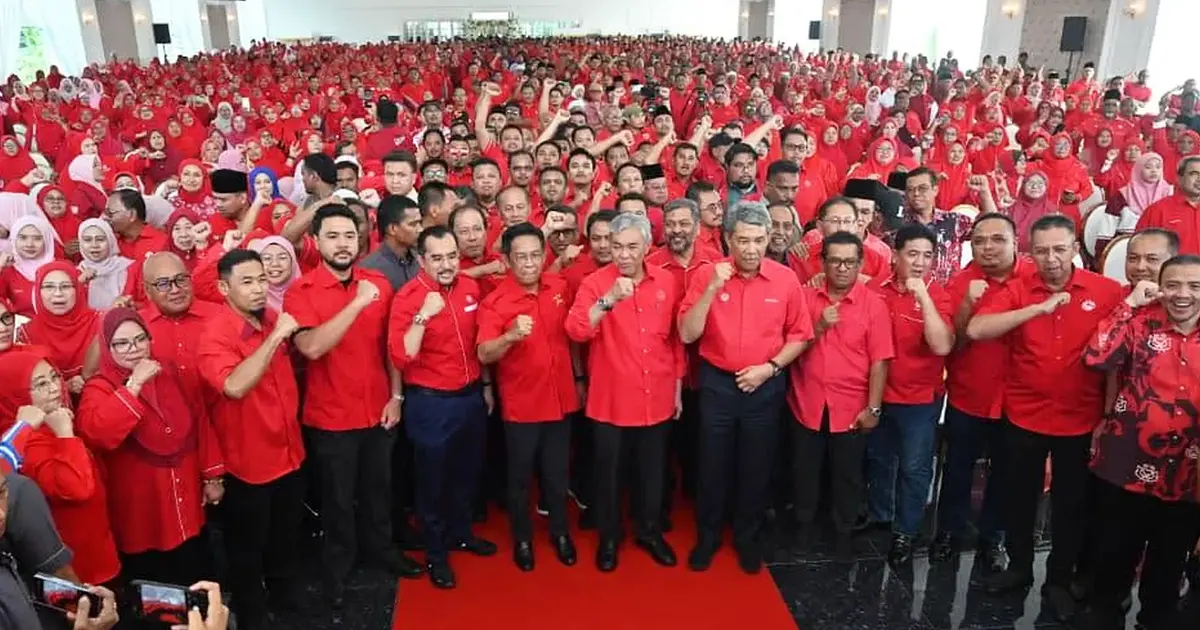
Barisan Nasional's top leadership has entrusted the Negeri Sembilan state election machinery to the coalition's regional command, marking a shift towards delegated decision-making on the sensitive matter of candidate selection and constituency negotiations. Ahmad Zahid Hamidi, the BN chairman, has stepped back from direct involvement in the party mechanics for Negeri Sembilan's upcoming polls, instead placing full authority with the state-level BN leadership to determine both which candidates will fly the coalition's banner and how contested seats will be distributed among member parties.
This arrangement places Tok Mat—the BN chief in Negeri Sembilan—at the epicentre of what promises to be a complex and politically delicate process. The delegation reflects a pragmatic strategy within BN's federal structure, where state wings maintain considerable autonomy in organising local campaigns and managing intra-coalition tensions. By ceding direct control to Tok Mat's office, Ahmad Zahid has effectively insulated the national BN hierarchy from the friction that typically accompanies these negotiations, a move that could prove tactically astute given the historical sensitivities surrounding seat allocations in Malaysia's coalition politics.
For Negeri Sembilan voters, this development carries several implications. The state has long occupied a pivotal position in Malaysian politics, and BN's performance there remains consequential for national representation. When national party chairs step back from state-level operations, it often signals confidence in local structures but can also indicate a willingness to let state leaders absorb the political costs if negotiations become contentious or if electoral outcomes disappoint. Tok Mat's expanded mandate suggests that the Negeri Sembilan leadership is perceived as sufficiently robust to navigate the competing demands of BN's component parties while maintaining coalition cohesion.
Candidate selection in coalition politics remains one of the most fraught exercises any political grouping must undertake. Each component party within BN seeks to maximise its allocated seats, particularly in regions where it commands significant grassroots support. In Negeri Sembilan, where UMNO, MCA, and MIC maintain active organisations, these negotiations will inevitably involve horse-trading, compromise, and careful calibration of party interests. By handing this responsibility to Tok Mat, Ahmad Zahid has positioned the state BN chief as the arbiter of these disputes, a role that carries both prestige and substantial political risk.
The timing of this announcement underscores BN's strategic calculations ahead of what many observers anticipate could be imminent state-level elections. Malaysia's electoral cycle remains fluid, with several state assemblies approaching the end of their five-year terms. Negeri Sembilan's state government, led by the current administration, operates within this broader context of political uncertainty. Early delegation of responsibility for campaign preparations suggests that BN machinery is readying itself for a potential electoral contest sooner rather than later, with state-level operatives now empowered to move swiftly on organisational matters without awaiting clearance from Kuala Lumpur.
Tok Mat's elevation to primary decision-maker on this front reflects his standing within BN circles and perhaps signals confidence in his ability to manage the coalition's various factions within the state. As the state BN chief, he will need to demonstrate even-handedness in allocating desirable constituencies while ensuring that weaker candidates are positioned where they stand reasonable prospects. This balancing act will test his political acumen and his relationships with party leaders and grassroots activists across the coalition.
The broader context of Malaysian coalition politics makes this development noteworthy. BN has historically relied on centralised decision-making on sensitive matters, with the party president and chairman wielding considerable authority. By delegating state-level campaign architecture to Tok Mat, Ahmad Zahid may be responding to lessons learned in previous elections where delays in candidate selection or perceived unfairness in seat distribution have weakened BN's electoral performance. Empowering state leaders to move with greater autonomy could accelerate preparations and foster a sense of local ownership over campaign decisions.
For political observers monitoring BN's institutional health, this move demonstrates a pragmatic evolution within the coalition. Rather than insisting on centralised control, the national leadership is opting for a federal model that leverages state-level expertise and political networks. This approach may prove particularly valuable in Negeri Sembilan, where local political dynamics and intra-coalition relationships are nuanced and deeply rooted. Tok Mat's authority to conduct these negotiations without constant reference to Ahmad Zahid's office suggests confidence that state-level mechanisms can resolve disputes internally and present a unified front.
Seat allocation and candidate selection will almost certainly consume weeks of negotiations as Tok Mat's team engages with leaders of BN component parties. The outcomes of these discussions will significantly influence how effectively BN can mobilise its base and project electoral competitiveness in Negeri Sembilan. Constituencies where BN fielded strong performers previously may see different faces, while new candidates may emerge as potential standard-bearers in areas where the coalition seeks to regain lost ground or consolidate existing advantages.
From a Southeast Asian perspective, Malaysia's coalition management offers instructive lessons about how multi-party alliances navigate internal governance challenges. BN's evolution towards more decentralised decision-making on state elections reflects broader trends across the region, where political coalitions increasingly recognise the value of empowering state and provincial structures. Tok Mat's expanded responsibilities position him as a key figure not only in Negeri Sembilan politics but also as someone whose success or failure in managing these processes will be closely watched by other state BN leaders contemplating similar transitions.
The delegation announced by Ahmad Zahid serves as a concrete example of how Malaysia's political establishment adapts organisational structures in response to electoral pressures and institutional experience. Whether this approach ultimately strengthens BN's electoral prospects in Negeri Sembilan will become evident once polling takes place, but it undoubtedly represents a significant shift in how the coalition organises itself at the state level.

