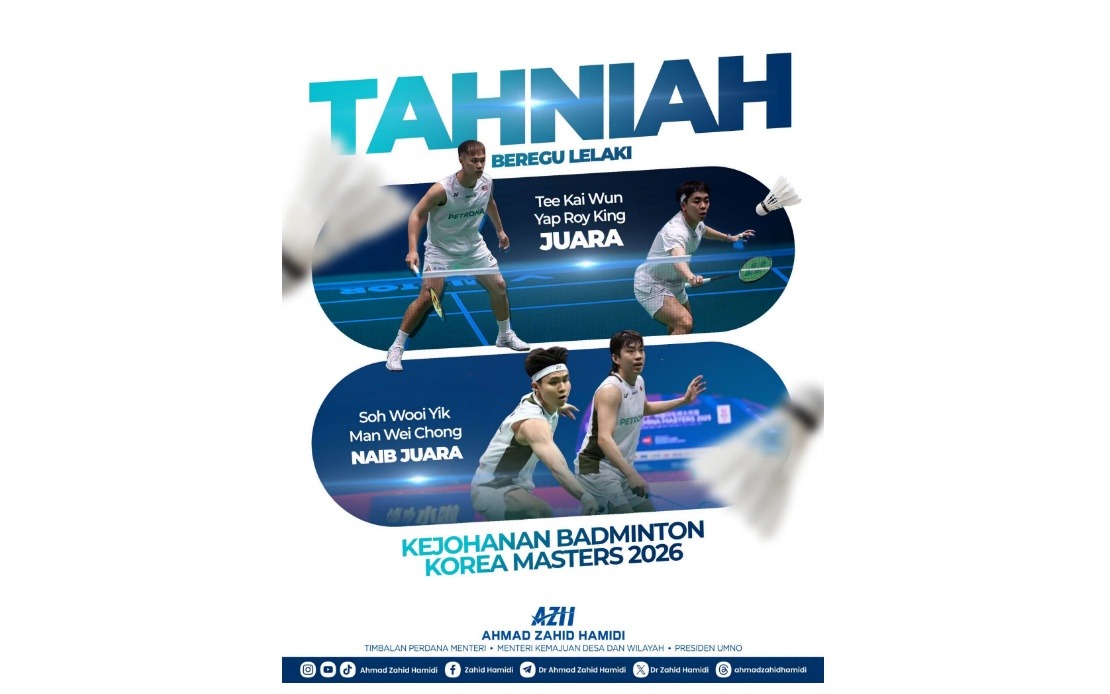
Deputy Prime Minister Datuk Seri Dr Ahmad Zahid Hamidi has lauded Malaysian badminton's impressive showing at the 2026 Korea Masters Badminton Championships, where the nation's men's doubles contingent delivered a standout performance by claiming both the championship and runner-up positions. The dual success represents a significant milestone in Malaysia's continued dominance of international badminton competition and underscores the depth of talent within the national doubles programme.
Tee Kai Wun and Yap Roy King captured the coveted Korea Masters title in their inaugural appearance at the tournament, demonstrating the growing strength of Malaysia's emerging partnership. The pair executed a controlled performance at the Yi Sun-sin Gymnasium in Asan, securing victory with a decisive 21-13, 21-18 scoreline against fellow Malaysians Soh Wooi Yik and Man Wei Chong in just 31 minutes. The commanding nature of their victory, coupled with the commanding margin in both sets, highlighted the tactical maturity and composure the champions displayed throughout the encounter.
The runners-up finish by Wooi Yik and Wei Chong, despite the match loss, represents a strong showing for the pairing and reinforces Malaysia's position as a powerhouse in the men's doubles category. The fact that both finalists hailed from the same nation spoke volumes about the quality and competitive standard that Malaysian badminton has achieved, creating an environment where multiple pairs can contend at the highest levels of international competition. This internal competition often serves as a catalyst for continuous improvement and innovation within the sport.
Ahmad Zahid expressed his confidence that the achievement would serve as a springboard for sustained success on the global badminton circuit. In a Facebook statement, he noted that the thrilling and closely contested nature of the match between the two Malaysian pairs demonstrated the exceptional calibre of play present within the national programme. The Deputy Prime Minister's public acknowledgment of the players' accomplishments reflects the government's commitment to promoting and supporting Malaysia's sporting endeavours.
The victory holds particular significance given the historical context of Malaysia's involvement in the Korea Masters. The triumph represents only the second time a Malaysian pair has captured the men's doubles crown at this prestigious tournament. The previous occasion came in 2024, when Soh Wooi Yik, one of the finalists this year, partnered with Aaron Chia to claim the title. This consistency in medal performances underscores a sustained level of excellence within the Malaysian doubles contingent and suggests that the national coaching structure and player development programmes are yielding tangible results.
For regional badminton enthusiasts, Malaysia's performance at the Korea Masters reinforces the nation's standing as a major force in Southeast Asian and global badminton circles. The country has historically been recognised as a badminton powerhouse, and results like these serve to maintain that reputation and inspire the next generation of aspiring players. The competitiveness between domestic pairs, rather than limiting opportunities, appears to be fostering an ecosystem where talent flourishes and excellence becomes the norm rather than the exception.
The success of Tee Kai Wun and Yap Roy King in their Korea Masters debut carries broader implications for Malaysian badminton's trajectory in international tournaments. First-time champions often struggle to replicate their success at subsequent editions, but the calibre of their performance in Asan suggests they possess the technical and mental fortitude required for sustained competitiveness. How these players develop their partnership and adapt to the heightened expectations following their breakthrough victory will be closely monitored by badminton observers across the region.
Ahmad Zahid's commendation also serves as a reminder of the governmental recognition accorded to sporting achievements, particularly in disciplines where Malaysia has established a longstanding competitive pedigree. The Deputy Prime Minister's public endorsement, while largely ceremonial, underscores the cultural significance attributed to badminton success within Malaysian society and reinforces the narrative that sporting excellence contributes meaningfully to national pride and international standing.
Looking forward, the Korea Masters results will likely influence the global badminton rankings and seedings for upcoming tournaments, potentially opening doors for Malaysian pairs to secure more favourable draws in major competitions. The momentum generated by a Korea Masters title, especially from a newly formed partnership, can establish valuable confidence and psychological advantage heading into the latter stages of the badminton calendar. International tournament victories frequently catalyse increased training opportunities, sponsorship arrangements, and media visibility for successful athletes.
The achievement also highlights the depth of talent available within Malaysian badminton, where players can transition between different partnerships while maintaining competitive standards. This flexibility within the player pool suggests that the national badminton programme has successfully cultivated multiple avenues for excellence, reducing dependency on any single pairing and creating resilience against injuries or unforeseen disruptions to player availability. As Malaysia continues to invest in badminton development and infrastructure, performances like those at the Korea Masters validate the strategic decisions made by sporting administrators and coaching personnel.

