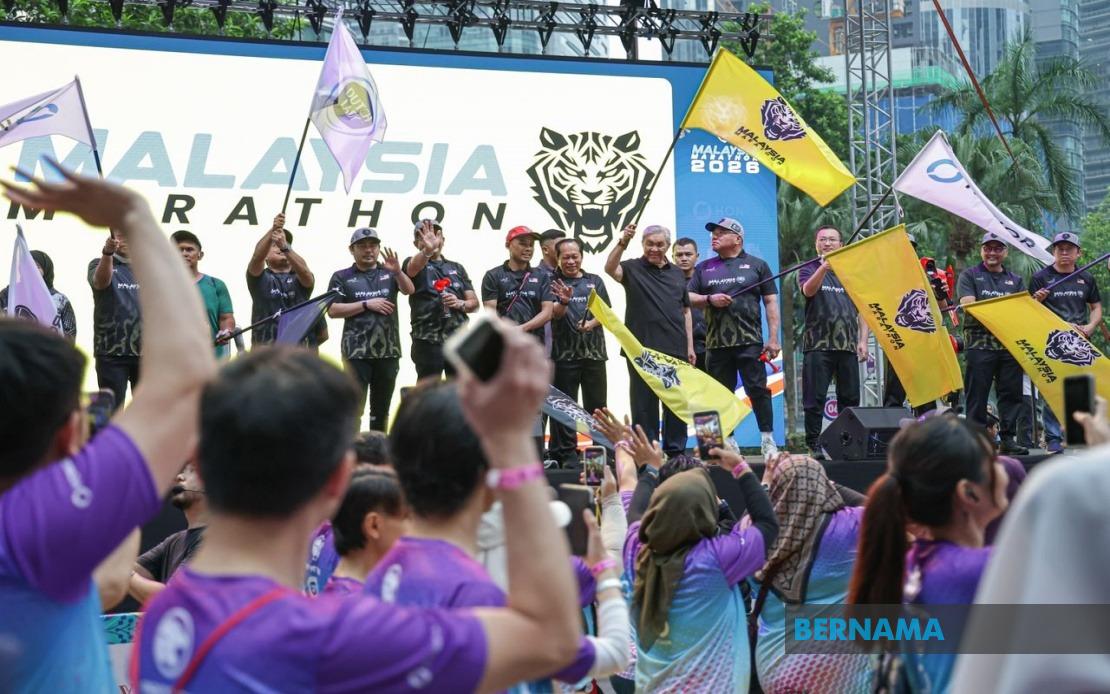
Deputy Prime Minister Datuk Seri Dr Ahmad Zahid Hamidi officially launched the Malaysia Marathon 2026 on Friday, presiding over the ceremonial flag-off of 10,000 participants in the 5-kilometre fun run at the Kuala Lumpur City Centre grounds. The initiative marks a significant step in positioning Malaysia as a premier sporting destination, with the marathon integrated into the nation's 2026 National Day festivities, underscoring the government's commitment to promoting fitness and national pride simultaneously.
The inaugural edition of Malaysia Marathon 2026 achieved notable participation across four competitive categories, attracting a combined field of 25,000 runners from both domestic and international backgrounds. Tourism, Arts and Culture Minister Datuk Seri Tiong King Sing and Deputy Works Minister Datuk Seri Ahmad Maslan attended the ceremony, reflecting the whole-of-government approach to the event. The marathon has already secured recognition from World Athletics, the international governing body for track and field, lending credibility and global legitimacy to Malaysia's inaugural hosting.
The day's proceedings commenced with traditional patriotic elements, including a rendition of the national anthem Negaraku and a performance by the Malaysian Armed Forces band, setting a ceremonial tone befitting a National Day-aligned event. Adding further ceremonial grandeur, the programme featured a one-kilometre Malaysian flag parade comprising 1,000 students from Kolej Poly-tech MARA in Bangi, demonstrating the event's capacity to engage younger generations and instil national consciousness through sporting participation.
The marathon structure spanned multiple distances to accommodate varying fitness levels and competitive aspirations. The 42-kilometre full marathon saw 2,000 competitors, with Tourism Minister Tiong performing the flag-off ceremony at Pavilion Kuala Lumpur. The 21-kilometre half-marathon category drew 8,000 participants, while the 10-kilometre race attracted 5,000 runners. This tiered approach reflects international best practices in mass-participation running events, allowing both serious competitive athletes and recreational enthusiasts to engage meaningfully.
A logistical innovation for this edition involved relocating the finish line from its traditional location at Dataran Merdeka to the KLCC grounds, serving as the unified convergence point for all race categories. This decision streamlines crowd management and consolidates the celebration of finishers across different distances, potentially enhancing the spectator experience and creating a more integrated finish-line community atmosphere. The centrality of KLCC as an iconic Malaysian landmark also amplifies the event's visibility and symbolism.
The Malaysia Marathon 2026 reflects broader Southeast Asian trends toward leveraging sporting events for tourism promotion, urban activation, and soft power projection. Regional counterparts including Singapore, Thailand, and Indonesia have similarly positioned marathons and mass-participation running events as mechanisms for attracting international visitors whilst building domestic sporting culture. For Malaysia specifically, the event contributes to diversifying the nation's sporting calendar beyond established fixtures, potentially establishing an annual marquee event that distinguishes the national sporting identity.
The international participation dimension carries particular significance for Malaysia's post-pandemic tourism recovery strategy. Drawing global runners creates accommodation demand, food and beverage spending, and extended-stay tourism multiplier effects throughout Kuala Lumpur and surrounding regions. The World Athletics recognition ensures the event meets standardised course measurement and competitive integrity protocols, facilitating runner participation from affiliated international athletic clubs and federations who prioritise officially sanctioned events.
National Day integration represents a deliberate thematic choice by policymakers, connecting physical fitness and personal achievement narratives with collective national identity and celebration. This confluence positions sporting participation as patriotic expression, potentially broadening the demographic appeal of marathoning beyond traditional running enthusiast circles. For younger participants particularly, the marathon context offers a structured pathway to National Day engagement beyond ceremonial observance.
The involvement of Technical Education and Skills Development institutions like Kolej Poly-tech MARA underscores the event's educational dimensions, providing experiential learning opportunities for vocational students whilst building their capacity for large-scale event coordination and execution. Such institutional engagement strengthens the knowledge-transfer pipeline for Malaysia's events management sector, critical infrastructure for hosting increasingly complex international-scale competitions.
Looking forward, the Malaysia Marathon 2026 positioning as an inaugural World Athletics-recognised event creates opportunities for programme expansion and international event tourism development. Successful execution of this debut edition establishes foundational credibility for elevating participation targets and competitive calibre in subsequent years. The marathon's integration into National Day celebrations also suggests potential for becoming a permanent fixture in Malaysia's annual sporting and cultural calendar, comparable to established marathons in regional capitals.
For Malaysian sporting participation specifically, large-scale marathons like this initiative potentially catalyse broader fitness culture adoption and recreational running infrastructure development across urban centres. The visibility afforded by Deputy Prime Minister participation elevates running's status within the national sports consciousness, potentially translating into increased community participation in amateur athletics and health-focused recreational activities beyond this event's immediate participants.

