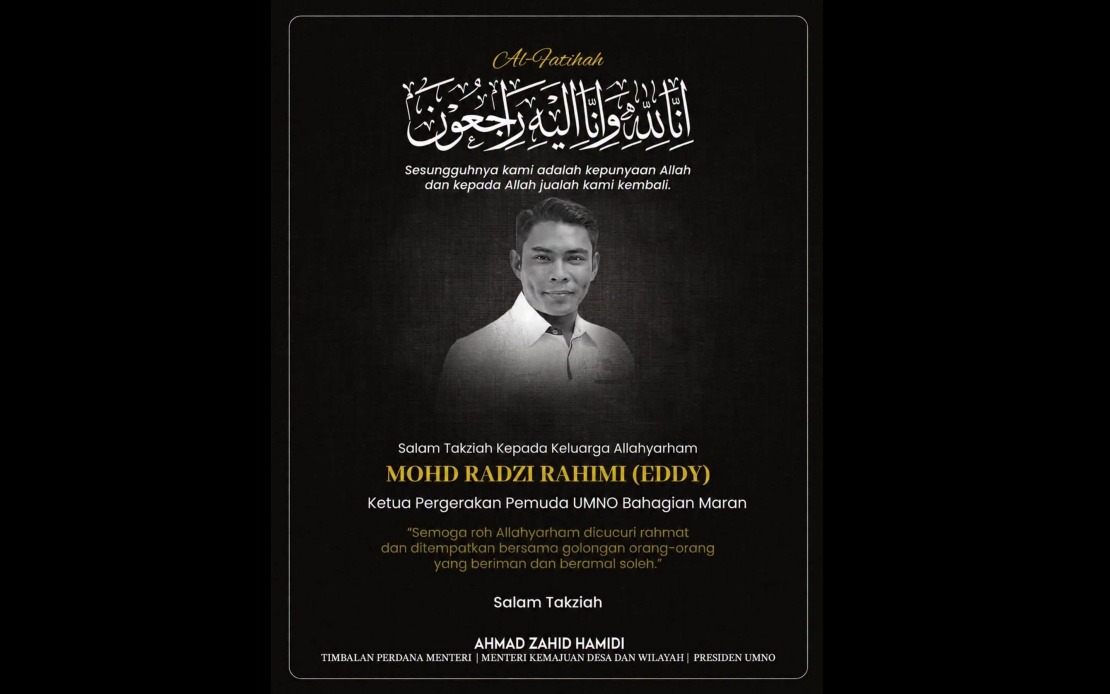
UMNO President Datuk Seri Dr Ahmad Zahid Hamidi has extended his sympathies to the family of Maran UMNO Youth chief Mohd Radzi Rahimi, who died in a tragic accident in Bentong on August 3. The party leader described the loss as significant to the UMNO movement, particularly affecting the youth wing's operations in Maran and across Pahang.
Mohd Radzi, aged 40, perished along with his wife and brother-in-law when a falling tree struck their vehicle. A five-year-old child in the car was also killed in the incident, which occurred in the Bentong district. A twin sibling of the deceased child sustained injuries and was subsequently transported to Bentong Hospital for medical attention.
In his Facebook post, Ahmad Zahid acknowledged the gravity of the tragedy and the immeasurable grief now confronting the bereaved family. He refrained from lengthy commentary, instead focusing on offering spiritual solace through Islamic sentiments. The UMNO president invoked divine strength for the family members as they navigate the immediate aftermath and the prolonged mourning process ahead.
The death of Mohd Radzi represents more than a personal tragedy for a single family; it carries broader implications for UMNO's organisational structure in Pahang. As a youth division chief, he held responsibility for mobilising party members at grassroots level, coordinating political activities, and maintaining party discipline within his constituency. The sudden removal of such a figure typically necessitates urgent succession planning and operational adjustments.
Accidents involving falling trees remain a persistent hazard in Malaysia, particularly during monsoon seasons or in areas with aging vegetation infrastructure. The circumstances surrounding this specific incident underscore the unpredictability of natural occurrences and their devastating potential when lives converge with environmental hazards at critical moments.
The presence of children in the vehicle highlights the indiscriminate nature of such tragedies. Families travelling together face compounded risk, and the survival of one child while siblings perished adds another layer of trauma for relatives processing multiple losses simultaneously. The injured twin's recovery journey will likely demand considerable psychological and medical support.
For UMNO, the loss touches directly upon the party's youth cadre, which serves as a crucial pipeline for future leadership development. Youth chiefs at divisional level like Mohd Radzi typically organise mobilisation campaigns, mentor emerging party members, and serve as intermediaries between grassroots supporters and senior leadership. Replacing such individuals requires identifying successors with comparable organisational capability and credibility.
Pahang, as a key UMNO stronghold, places particular significance on maintaining robust party structures across all administrative levels. The state has historically served as an important political foundation for the party, and disruptions to divisional leadership can ripple through electoral calculations and internal party dynamics during critical periods.
The tragedy also reflects broader conversations about workplace and personal safety in Malaysia. While this incident involves an act of nature rather than human negligence, it reminds the public of environmental risks that persist despite development and modernisation. Tree maintenance in urban and suburban areas remains an underaddressed infrastructure concern.
In the immediate term, UMNO's focus will centre on supporting the bereaved family through funeral arrangements and community grieving processes. Party protocols typically involve senior leadership attendance at funeral rites, public expressions of solidarity with the family, and often the establishment of assistance mechanisms for dependents left behind.
The broader political implications remain understated in Ahmad Zahid's initial response, which appropriately prioritises human compassion over institutional considerations. However, observers monitoring Pahang politics and UMNO's internal structures will likely scrutinise how the party addresses the leadership vacuum and whether the succession process reveals any existing factional tensions within the state party apparatus.
Tragedies of this scale often prompt renewed attention to safety protocols and preventive measures. Whether this incident catalyses broader discussions about tree management standards or vehicle safety in accident-prone areas remains to be seen, though such occurrences frequently inspire family-level precautions rather than systemic policy changes.

