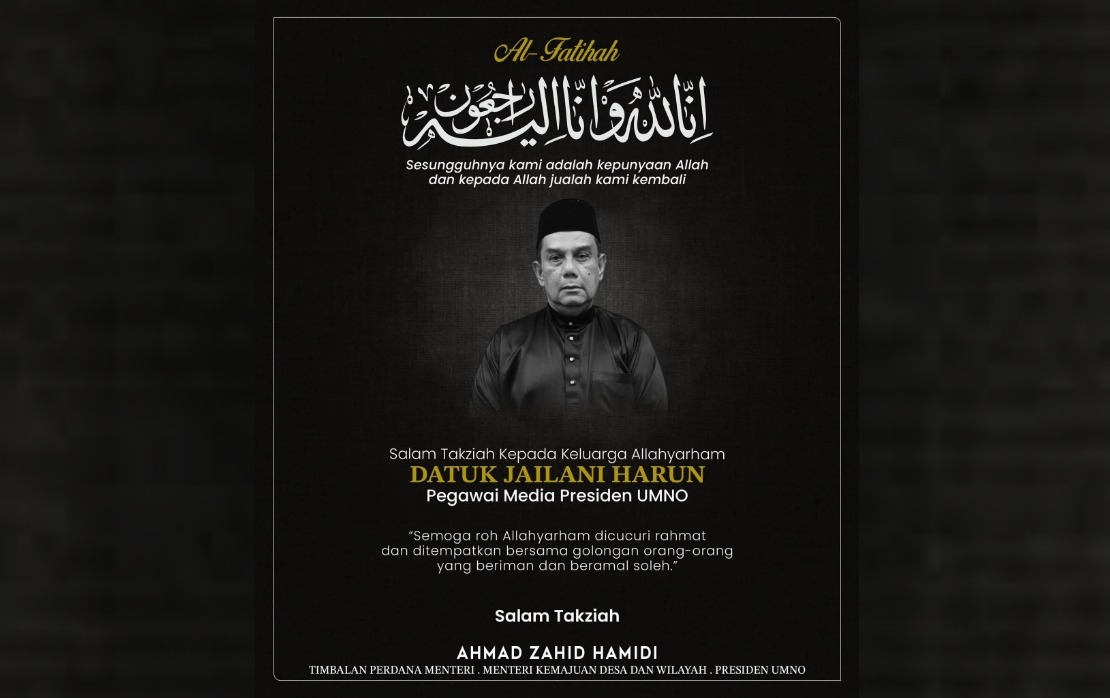
Deputy Prime Minister Datuk Seri Dr Ahmad Zahid Hamidi has conveyed his condolences following the death of Datuk Jailani Harun, a seasoned journalist and media officer who served at the UMNO President's Office. Jailani, aged 66, passed away at Serdang Hospital on July 7, with the UMNO president announcing the loss through a heartfelt Facebook message that highlighted the late media professional's character and contribution to the party's communications efforts.
Ahmad Zahid, who also holds the position of UMNO president, visited Jailani at Serdang Hospital in the early morning hours before his passing, offering a firsthand account of the veteran journalist's final hours. The deputy premier described the visit as an emotionally difficult moment, noting that he had harboured hopes for a recovery even as Jailani's health deteriorated. His presence at the hospital underscored the significance of Jailani's role within the party hierarchy and the personal relationships forged through decades of media work within Malaysia's political establishment.
In his tribute, Ahmad Zahid characterised Jailani as an individual distinguished by kindness, humility, and widespread respect across his professional circles. These qualities, commonly cited in obituaries of long-serving media figures, reflect the esteem in which Jailani was held among colleagues and political leaders alike. For journalists and media officers working within the Malaysian political sphere, such recognition from senior government officials carries particular weight, as it acknowledges contributions that often operate behind the scenes, shaping how parties communicate with the public.
The deputy prime minister's message incorporated Islamic sentiments appropriate to the occasion, praying for divine forgiveness of Jailani's transgressions and requesting that Allah's mercy be bestowed upon him in the afterlife. Ahmad Zahid also sought strength and fortitude for Jailani's family members during what he recognised as a period of profound grief. Such expressions reflect the cultural and religious traditions observed within Malaysia's Muslim-majority political establishment when mourning the loss of prominent figures.
Jailani's death occurred at 11.34 am on July 7 at Serdang Hospital. The timing and location of his passing, along with details surrounding his hospitalisation, remain consistent with official announcements made by party leadership. His age of 66 suggests a career spanning several decades within Malaysian journalism and political communications, a period that encompassed significant transformations in media technology and political discourse.
Funeral arrangements proceeded according to Islamic custom, with Jailani scheduled for burial at the Alam Damai Muslim cemetery in Cheras following asar prayers. This location in the Kuala Lumpur area facilitated attendance by colleagues, friends, and family members who wished to pay their final respects. The timing of funeral rites according to the Islamic prayer schedule reflects standard practices within Malaysia's Muslim communities and ensures that the burial process adheres to religious requirements.
Jailani's long association with UMNO's media operations positioned him at a nexus where journalism and partisan communication intersected. Media officers working for major political parties in Malaysia perform a delicate balancing act, translating party positions for public consumption while maintaining professional journalistic standards. The respect accorded to Jailani throughout his career suggests he navigated these tensions with skill and integrity, earning recognition from both political colleagues and media peers.
The passing of such a figure represents a loss for Malaysia's political communications infrastructure, as individuals with Jailani's experience and established relationships across media and political circles become increasingly difficult to replace. His decades of service would have encompassed multiple electoral cycles, policy announcements, and political controversies, during which he contributed to shaping public understanding of UMNO's positions and initiatives. The institutional knowledge held by long-serving media officers like Jailani—knowledge of how information flows, how journalists operate, and how political messaging can be effectively conveyed—represents a valuable asset within any political organisation.
For the journalism community in Malaysia, Jailani's passing marks the end of an era for a professional who transitioned from journalism into partisan media work, a career path that reflects the sometimes fluid boundaries between independent reporting and political communication in the Malaysian context. His colleagues in media circles would recognise the unique challenges and opportunities presented by such a career trajectory, and his passing prompted reflection on the evolving nature of political journalism in Malaysia.
The public acknowledgment of Jailani's death by the Deputy Prime Minister and UMNO president ensured that his passing received appropriate recognition within political and media circles. Such acknowledgments, delivered through social media platforms like Facebook, have become standard practice for Malaysian political leaders when commemorating the deaths of figures within their orbit. Ahmad Zahid's message thus served multiple purposes: expressing genuine personal condolence, acknowledging Jailani's professional contributions, and marking publicly the significance of his loss to the UMNO party structure.

