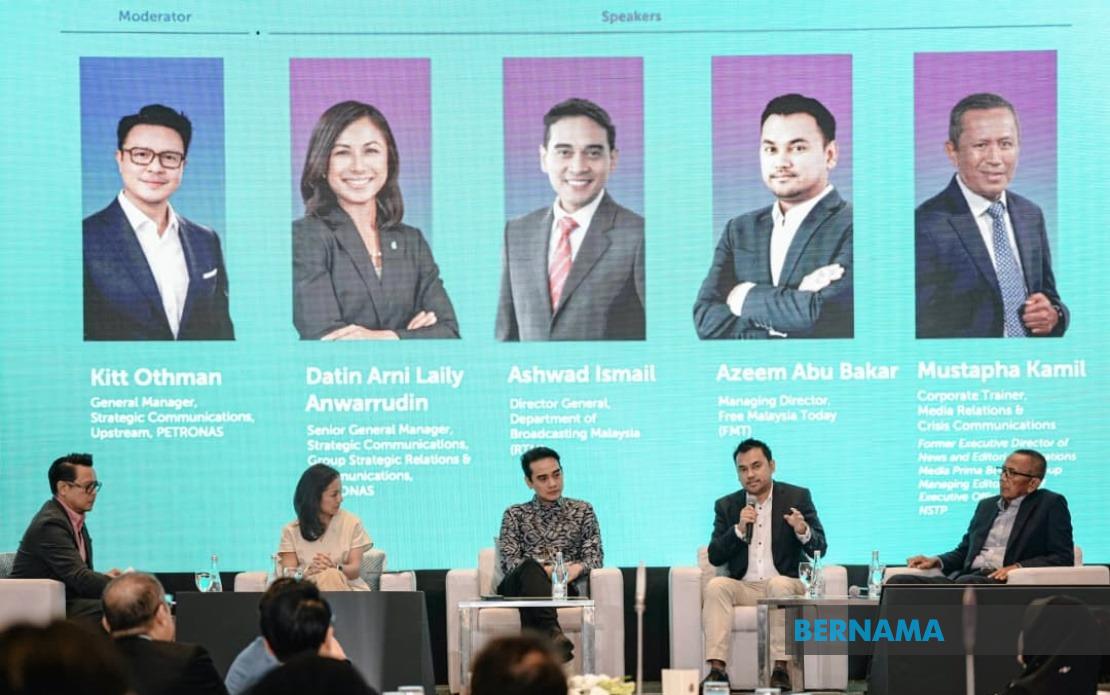
The accelerating pace of artificial intelligence deployment and digital information dissemination is compelling Malaysian corporations and newsrooms to fundamentally reassess how they build and protect credibility during crises. Speaking at the PETRONAS Lunch Escape 2026 programme on media credibility and artificial intelligence, senior business and media figures warned that yesterday's crisis management frameworks have become dangerously obsolete in an environment where falsehoods and partial truths circulate instantaneously across networks that span billions of users.
Datin Arni Laily Anwarrudin, Senior General Manager of Strategic Communications at PETRONAS, articulated a central tension facing modern organisations: the speed at which AI technologies amplify unverified claims now presents an existential threat to corporate brand reputation. No longer can companies allow narrative vacuums to form. When an organisation remains silent or slow to respond, competitors, critics, or bad actors will eagerly fill that communicative void with their own interpretations of events. This dynamic has fundamentally altered the relationship between corporations and the public sphere. The traditional approach of crafting measured statements after deliberation has given way to a new imperative: proactive ownership of corporate narrative or risk watching that narrative be written by external parties with potentially hostile intentions.
Arni Laily emphasised that transparency has transformed from a virtuous corporate practice into a pragmatic necessity. In the AI era, opacity invites suspicion, and suspicion spreads faster than clarification. Organisations that withhold information or appear to hide behind corporate jargon find themselves vulnerable to narratives constructed by those willing to fill information gaps with speculation. This shift has profound implications for Malaysian enterprises operating in highly competitive global markets where reputation damage can spread across borders in seconds. The calculus of disclosure has shifted decisively toward openness, not because corporations have suddenly discovered altruism, but because information scarcity in the digital age creates conditions where misinformation flourishes.
The obsolescence of traditional crisis response timelines has emerged as perhaps the most destabilising factor in corporate communications. For decades, the 16-hour window between incident and publication provided organisations with a structured, almost predictable response period. Crisis teams could convene, gather facts, legal could review statements, and executives could formulate measured responses before the public learned details. That entire temporal architecture has collapsed. Today, an incident occurring at dawn can trend globally before breakfast. Mustapha Kamil Mohd Janor, former managing editor at Media Prima and NSTP Group, stressed that organisations lacking structured media crisis communication teams now face acute vulnerabilities. The immediacy of modern digital platforms means that any delay in responding can itself become interpreted as evidence of wrongdoing, cover-up, or incompetence, regardless of whether the company is actually formulating a thoughtful response.
Yet the acceleration of information cycles introduces a secondary challenge that executives and crisis communicators must navigate carefully: the tension between speed and accuracy. Arni Laily highlighted the critical distinction between reacting quickly and reacting correctly. In their urgency to appear responsive and in control, organisations can inadvertently release statements that later require correction, creating compounding credibility damage. The question crisis teams now must answer is fundamentally different from previous eras: how can we respond swiftly while maintaining the deliberation necessary to confirm facts and establish truth? This dilemma is particularly acute in Malaysia's complex corporate and political environment, where statements made under pressure can ignite regulatory investigations or public backlash that could have been avoided through more careful initial communication.
Media leaders participating in the discussion articulated a parallel evolution occurring within journalism itself. Ashwad Ismail, director-general of Radio Televisyen Malaysia, and Azeem Abu Bakar, managing director of Free Malaysia Today, both acknowledged that their organisations must rethink core journalistic functions in an age where AI can process vast information flows but cannot replicate human judgment. Mustapha Kamil framed journalism's enduring mission in deliberately granular terms: journalists function as searchlights illuminating directions for societal navigation, helping the public make informed decisions about the courses their communities should follow. This metaphor acknowledges that journalism's value in the AI era lies not in information provision—AI can provide information—but in contextualisation, verification, and wisdom about what information matters and why.
Azeem Abu Bakar introduced a concept he termed "SUPER journalists"—practitioners who excel in sources, understanding, pattern recognition, efficiency, and reputation—to describe the human capabilities that artificial intelligence cannot replicate. As AI systems handle data processing, layout, and routine content assembly, newsrooms must attract and develop journalists capable of the investigative digging, source cultivation, contextual analysis, and ethical judgment that distinguishes credible journalism from automated content. This reframing has significant implications for how Malaysian media organisations structure recruitment, training, and career progression. The premium will increasingly be placed on journalists who can ask the right questions, identify emerging patterns across disparate information, and maintain trusted relationships with sources—capacities that require years to develop and cannot be automated.
The convergence of these corporate and journalistic challenges reveals a deeper structural shift reshaping how information credibility operates in Malaysia and Southeast Asia more broadly. The traditional hierarchy where major media outlets vetted information before public circulation has fragmented. Now information circulates first through social networks, AI-amplified platforms, and decentralised sources, then sometimes reaches traditional media for either confirmation or debunking. Malaysian corporations can no longer rely on media gatekeepers to filter falsehoods; they must themselves become media practitioners capable of reaching audiences directly while maintaining credibility. Simultaneously, journalists can no longer assume their published word carries automatic authority; they must constantly earn and re-earn credibility through demonstrated commitment to accuracy and fairness.
The implications for Malaysian enterprises extend beyond crisis response protocols into fundamental business strategy. Organisations that fail to recognise the permanence of this new informational environment risk strategic isolation. Those that invest in communication infrastructure capable of rapid, verified response while maintaining transparency about limitations and uncertainties will find themselves advantaged in reputation management. The threshold question for Malaysian corporate leadership is whether this transition represents an opportunity to deepen public trust through authentic engagement or merely another challenge to be minimised through sophisticated message management. The evidence from panellists at the PETRONAS discussion suggests that successful organisations will be those that embrace transparency as a competitive advantage rather than treating it as a regulatory burden.

