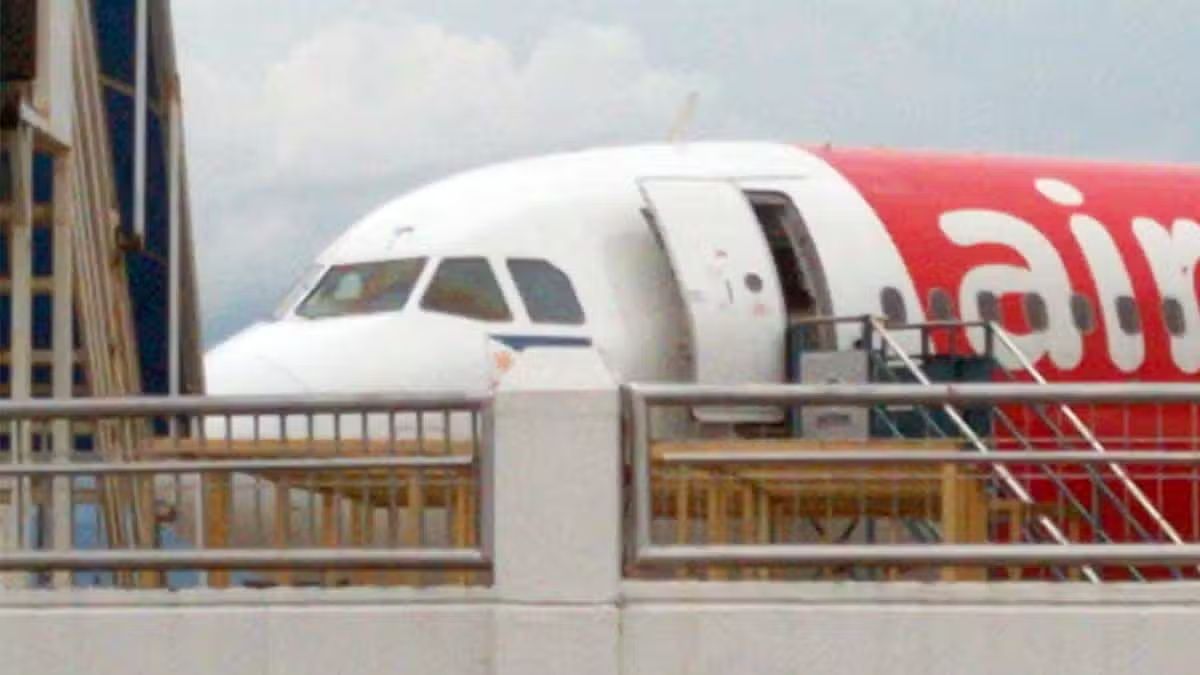
An AirAsia flight heading to Manila from the Philippines' Tacloban City was forced to cancel on Saturday following discovery of a technical fault in the aircraft's landing gear system just before passengers were scheduled to board. The incident at Daniel Z. Romualdez Airport triggered temporary disruptions to ground operations as aviation authorities implemented standard safety protocols, though normal activities resumed by late morning.
Personnel at the Civil Aviation Authority of the Philippines (CAAP) facility in Tacloban identified the landing gear problem at approximately 6am local time. In response, airport management issued a Notice to Airmen (NOTAM) alerting all aviation operators to the ground-level situation and imposing temporary restrictions on the facility's normal flight schedule. The measure was necessary to accommodate emergency towing and technical assessment procedures for the affected aircraft.
The timing of the discovery—before any passengers had boarded and during early morning operations—meant that the incident was contained relatively quickly compared to more complex scenarios. Several flights scheduled to arrive and depart during the morning window experienced minor delays as airport personnel prioritised clearing the runway and moving the AirAsia aircraft to a secure holding area. The situation highlights how rigorous pre-flight safety checks, though sometimes inconvenient, serve as essential safeguards in commercial aviation.
By 9.45am, airport personnel had successfully towed the affected aircraft to the bay area designated for maintenance work. This relocation allowed normal runway operations to resume, and CAAP Tacloban lifted the operational restrictions that had been temporarily imposed. The swift coordination between airport authorities and airline personnel prevented more extensive disruption to the broader flight schedule serving the region.
AirAsia announced that affected passengers would be rebooked on alternative services to Manila, with the airline handling arrangements for revised travel itineraries. The Philippine Information Agency's Eastern Visayas office (PIA-8) confirmed that the carrier was actively assisting passengers whose journeys had been interrupted by the cancellation. Most travellers affected would have experienced delays of several hours rather than complete journey cancellations, depending on seat availability on subsequent flights.
Technical assessments of the aircraft continued throughout Saturday afternoon as both AirAsia's maintenance team and CAAP inspectors conducted thorough examinations of the landing gear system. The nature of the specific malfunction—whether a hydraulic issue, mechanical failure, or sensor problem—remained undisclosed by authorities, as is standard practice during ongoing investigations. Similarly, neither CAAP nor AirAsia released details about passenger numbers or the specific flight designation.
Daniel Z. Romualdez Airport functions as Eastern Visayas' principal commercial aviation hub, serving as the primary connection point between the region and major metropolitan areas. Three carriers—AirAsia, Cebu Pacific, and Philippine Airlines—operate multiple daily services linking Tacloban to Manila, forming the backbone of regional connectivity. For a destination like Tacloban, which lacks alternative major transport connections to the capital, such disruptions carry broader implications for business travellers, families, and commercial operations depending on reliable air service.
For Malaysian readers and Southeast Asian aviation observers, the incident underscores how safety protocols continue to function effectively across the region's diverse airports and operators. Landing gear malfunctions, while serious, are precisely the type of technical issue that modern pre-flight inspection systems are designed to catch. The rapid identification and professional response demonstrated by CAAP and AirAsia personnel reflect established regional standards for aviation safety management.
The incident also reflects the growing traffic pressures on Philippine regional airports as domestic air travel expands. Daniel Z. Romualdez Airport handles substantial daily volumes, and maintaining rigorous safety standards while managing schedule efficiency remains an ongoing challenge for airport operators and airlines across Southeast Asia. Every disruption, though temporary, creates cascading effects through the regional network, affecting connections and passenger confidence.
By Saturday afternoon, normal airport operations had fully resumed, with CAAP maintaining heightened monitoring as technical work proceeded. The quick resolution prevented the kind of extended closures that occasionally affect major hubs when significant issues require extended investigation. AirAsia's customer service response—promptly rebooking passengers rather than leaving them stranded—represents standard industry practice that helps mitigate passenger frustration during technical emergencies.
The occurrence serves as a routine reminder that despite modern aircraft reliability, continuous vigilance by ground personnel remains essential. Pre-flight checks catch numerous minor and major issues daily across global aviation networks, with most never reaching public awareness precisely because they are resolved before affecting scheduled operations. This particular incident, publicly documented through the NOTAM system and media reports, represents the system functioning as designed.

