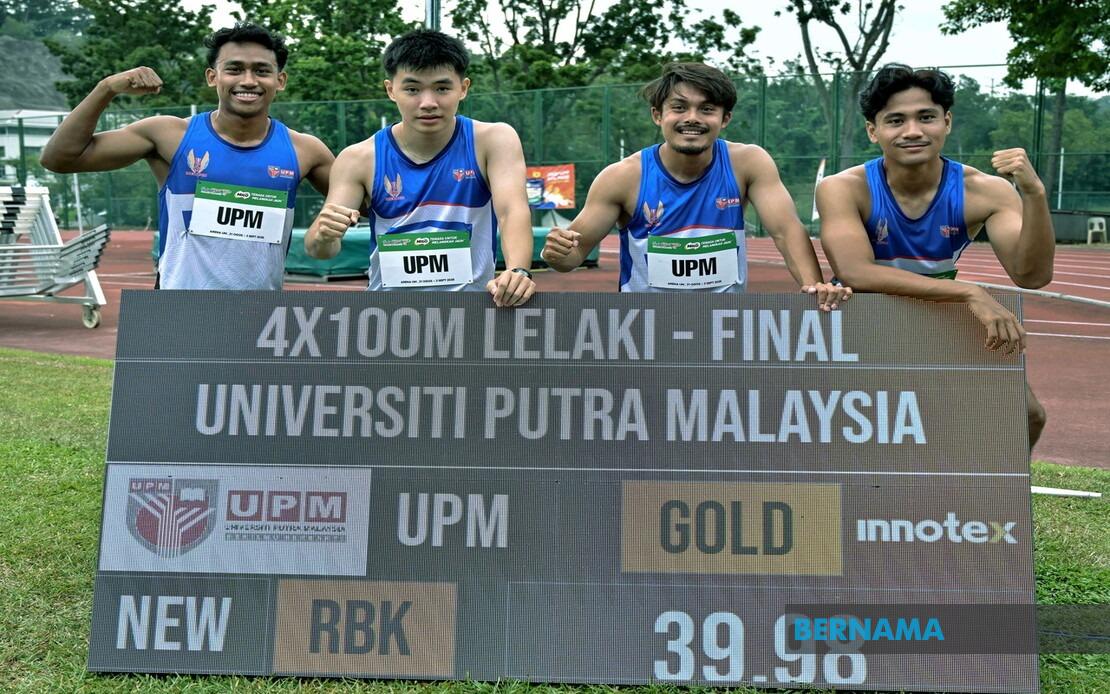
Universiti Putra Malaysia's men's 4x100-meter relay team delivered a landmark performance at the 2026 Higher Education Institutions Sports Games (SUKIPT) on August 31, capturing the gold medal with a time of 39.98 seconds and erasing the previous games record of 40.98 seconds. The achievement underscores the university's ability to maintain its competitive edge in sprint athletics despite navigating a critical transition period marked by the departure of established runners and the integration of junior talent.
The composition of UPM's victorious quartet reflected an ambitious strategic gambit: veteran sprinter Aliff Iman Mohd Fahimi anchored an entirely untested lineup of younger runners making their SUKIPT debut. This mixing of experience and youthful exuberance proved potent, with the squad not merely securing the title but obliterating expectations by dipping under the 40-second barrier—a psychological and technical milestone in university-level relay racing in Malaysia. The breakthrough signifies that UPM's athletics programme has successfully navigated the hand-off of institutional knowledge and competitive standards to the next generation.
Aliff Iman framed his participation as custodial, emphasizing his role in preserving UPM's legacy during his final SUKIPT appearance. Speaking at the UM Arena on the Universiti Malaya campus, he described the victory as a renewal rather than a mere triumph, explicitly noting that his teammates were all first-time competitors at the championships. This distinction matters: in relays, inexperience can compound weaknesses, yet UPM's newcomers executed under pressure, suggesting rigorous preparation and tactical acumen within the coaching structure. Aliff Iman's willingness to position himself as a mentor within the competitive context—wearing wristbands inscribed with 'Papa' and 'Mama' following his return from a six-month injury layoff—conveyed a deliberate cultural message about institutional continuity.
The veteran sprinter acknowledged the weight of custodianship, noting that he bore responsibility for sustaining the legacy forged by marquee predecessors such as Jonathan Nyepa and Zulfiqar Ismail. These names carry resonance in Malaysian university athletics, representing standards of excellence against which new cohorts are inevitably measured. Aliff Iman's explicit invocation of this lineage suggests that UPM views relay success not as isolated achievement but as part of an ongoing narrative of institutional sporting identity. For Southeast Asian readers, this reflects a broader pattern whereby university sports programmes leverage historical achievement and individual exemplars to motivate younger athletes and reinforce organisational culture.
Critically, Aliff Iman attributed the squad's capacity to target sub-40-second performance to granular knowledge of his teammates' individual capabilities. He noted that his confidence rested on familiarity with their respective baseline speeds—averaging 10.4 and 10.5 seconds per 100 meters—and the mathematical extrapolation that aggregating these performances would yield the desired collective time. This methodical approach to relay strategy demonstrates how relay racing at elite university level encompasses not just individual pace but sophisticated tactical planning around baton exchanges, positioning, and cumulative marginal gains. The implication for Malaysian athletics development is that institutional success increasingly depends on coaching infrastructure capable of data-informed preparation rather than talent alone.
Reeve Kua, one of the relay participants, disclosed that he competed whilst recovering from a severe fever, having only recently returned to full health the preceding evening. His decision to compete and contribute to UPM's record-breaking run illustrates the psychological commitment and physical resilience embedded within high-performance university athletics programmes. The incident also speaks to the role of medical support and athlete management within institutions, where rapid recovery protocols and cleared-to-compete decisions enable participation even under suboptimal physiological conditions. For Malaysian universities investing in competitive athletics, such narratives underscore the importance of comprehensive sports science infrastructure.
The relay contest itself carried competitive intensity, with anchor runner Ahmad Amir Aiman Mohd Kamaruddin facing direct pressure from Danish Iftikhar Muhammad Roslee of Universiti Pendidikan Sultan Idris (UPSI), a national-level competitor. Despite this challenge, Kamaruddin executed cleanly, placing complete faith in his preceding teammates' baton handoffs and their accumulated advantage. The psychological architecture of relay racing means that anchor runners inherit both the opportunity and burden of their teammates' efforts; Kamaruddin's clean exchange and final leg exemplified how institutional relay success depends on seamless coordination and individual performers surrendering ego to collective objective.
UPSI's second-place finish with a time of 40.16 seconds, bolstered by the presence of national sprinter Danish Iftikhar, confirms that UPM's record broke through a credible competitive barrier rather than benefiting from weak opposition. Malaysian Polytechnics claimed bronze with 41.75 seconds, establishing a three-tier hierarchy within Malaysian higher education relay racing. This tiered structure suggests that resource allocation, coaching quality, and institutional investment in sprint training create measurable performance gradations—a pattern recognizable across Southeast Asian university sports systems where disparities in funding and infrastructure correlate with competitive outcomes.
From a developmental perspective, UPM's breakthrough matters beyond the immediate result. The successful integration of junior runners into a championship-winning relay squad provides a template for Australian, Singaporean, and other regional university programmes navigating generational transitions. The explicit strategy of pairing a veteran with first-time competitors, coupled with pre-competition confidence grounded in biomechanical analysis, suggests coaching sophistication that extends beyond traditional talent-identification approaches. Malaysian readers invested in university athletics will recognize this as evidence of institutional evolution toward evidence-based athlete development.
The timing of Aliff Iman's departure adds poignancy and purpose to UPM's achievement. His final SUKIPT appearance coincided with the programme's most visible success in navigating succession—a narrative arc that validates his investment and provides psychological closure for a departing athlete. For UPM's athletics administration, the challenge now lies in sustaining this momentum without the stabilizing presence of veteran sprinters. The question becomes whether the junior cohort that delivered 39.98 seconds can mature into anchors for their own protégés, completing the virtuous cycle of institutional renewal.
Looking forward, UPM's record-breaking relay performance signals to other Malaysian universities that sustained competitive excellence requires intentional legacy planning, coaching infrastructure investment, and cultural emphasis on collective achievement. The 39.98-second benchmark also establishes a new aspirational standard within Malaysian higher education athletics—one that will likely drive training intensity and resource allocation across competing institutions. For Southeast Asian universities more broadly, UPM's success offers a replicable case study in how to manage elite sporting transitions whilst maintaining or even elevating competitive standards.
The relay's symbolic weight extends beyond athletics into broader conversations about Malaysian university identity and institutional pride. SUKIPT gold medals carry prestige within campus culture and contribute to overall institutional rankings; athletic success frequently translates into recruitment advantages, alumni engagement, and campus morale. Aliff Iman's carefully calibrated departure—leaving his juniors with a record-breaking standard—exemplifies how individual athletes can become vectors for institutional values and strategic messaging. As Malaysian higher education continues to compete for student talent and international standing, such sporting achievements accumulate into portfolios of excellence that extend far beyond the track.

