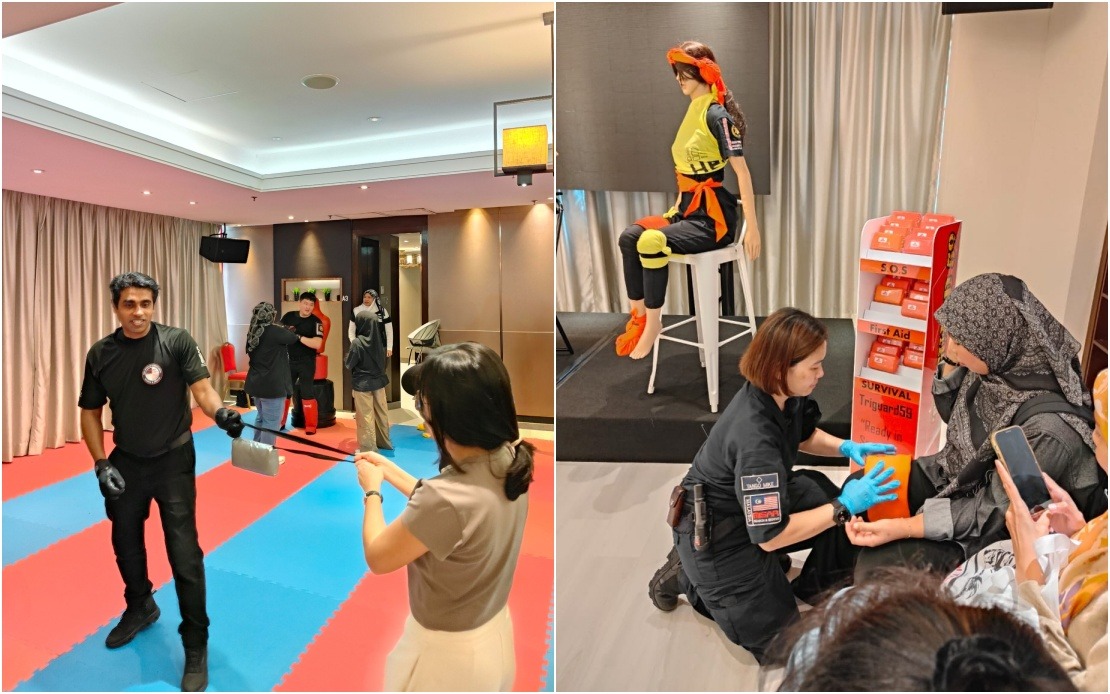
Allianz Malaysia and the Kelab Marshal Keselamatan Jalan Raya Kuala Lumpur (RSMC) have deepened their partnership with the ninth iteration of a community safety programme targeting women, held this month at the Wisma Huazong YTL Hall in Seri Kembangan, Selangor. The initiative, delivered through Allianz Malaysia's corporate social responsibility framework, reflects a sustained commitment to embedding safety awareness within Malaysian communities, particularly among women who remain disproportionately vulnerable to street-level crime and personal security threats.
The programme attracted 200 female participants aged 16 and above, each equipped with practical knowledge spanning a spectrum of real-world safety scenarios. Beyond conventional awareness-raising, attendees received hands-on instruction in self-defence techniques, domestic security measures, and appropriate emergency response protocols. The curriculum deliberately anchored itself in the hazards most likely to affect Malaysian women in urban and suburban environments, encompassing home invasions, bag snatching, vehicular scams, unwanted pursuit, carjacking attempts, and accident management in high-stress situations.
What distinguishes this year's campaign from its predecessors is the introduction of structured dialogue sessions pairing educational content with direct expert consultation. Rather than passively receiving information, participants engaged in facilitated discussions with RSMC specialists, enabling them to contextualise theoretical knowledge against personal experiences and neighbourhood-specific risks. This shift from lecture-based instruction to interactive problem-solving acknowledges a gap frequently identified in community safety initiatives—that knowledge absorption improves markedly when individuals can relate concepts to their immediate circumstances.
Sean Wang, Allianz Malaysia's chief executive officer, signalled that the organisation measures campaign success not merely by attendance figures but by the propagation of safety consciousness beyond the event itself. He noted with particular satisfaction the emergence of community leaders expressing interest in replicating the model within their own localities, suggesting organic demand for such programming. This grassroots uptake reflects a broader Malaysian reality: street safety concerns resonate powerfully across socioeconomic strata, yet structured, credible guidance remains relatively scarce in many residential areas.
Captain K. Balasupramaniam, founder and president of RSMC, framed the campaign's broader purpose as fostering individual agency. Street crime prevention, he argued, transcends the distribution of warning lists; it demands that potential victims develop confidence in their capacity to recognise threats and respond decisively. The involvement of community leaders in championing similar initiatives within their networks positions safety consciousness as a collective endeavour rather than an individualised burden, a reframing with particular relevance for Malaysian family and neighbourhood structures where social cohesion traditionally mediates public concerns.
The partnership between Allianz Malaysia and RSMC sits within a wider ecosystem of corporate engagement on social safety in Malaysia. Insurance companies possess inherent incentives to reduce claims arising from personal crime and accidents, making such outreach aligned with commercial objectives while delivering genuine public benefit. RSMC, an established body focused on road safety and personal security, brings credibility and technical expertise that enhance the programme's practical value beyond marketing messaging.
For Malaysian readers, the campaign carries several implications. First, it underscores the persistence of street crime and traffic-related risks as lived realities affecting daily life, particularly for women navigating urban environments. Second, it demonstrates that institutional players recognise the inadequacy of reactive policing alone and are investing in preventative education. Third, the model's scalability—with community leaders now championing local iterations—suggests potential for grassroots safety culture to deepen without requiring massive government investment, though such initiatives work most effectively when complemented by adequate police resources and urban design improvements that reduce crime opportunity.
The dialogue component introduced this year reflects evolving best practices in community safety communication. Psychological research consistently shows that people retain and act upon information when they have processed it collaboratively and tailored it to their circumstances. By enabling participants to voice their specific anxieties and receive targeted guidance, the campaign moves beyond generic advice and addresses the particularised vulnerabilities experienced by women in different settings—the university student navigating late-night transport, the domestic worker commuting between employers, the elderly widow securing her home, the young professional managing personal security while maintaining independence.
Regional observers should note that Malaysia's approach to community safety through public-private partnerships reflects trends visible across Southeast Asia, where governments increasingly collaborate with corporations and civil society to address crime and accidents. This distribution of responsibility can succeed when genuine expertise is pooled and when corporate participation stems from authentic commitment rather than superficial reputation management. The nine-year continuation of Allianz Malaysia and RSMC's collaboration suggests sustained engagement rather than cyclical cause-washing.
Looking forward, the challenge lies in sustaining momentum and measuring tangible outcomes beyond participant satisfaction. Future iterations might benefit from longitudinal follow-up tracking whether attendees implement learned techniques, experience improved safety outcomes, or successfully transmit knowledge to family members. Such data would strengthen the evidence base for replicating the model elsewhere in Malaysia and the region, transforming anecdotal success into verifiable impact. The emergence of community leaders seeking to bring the campaign to their neighbourhoods provides a natural foundation for such expansion, provided appropriate training and resource infrastructure can be established.

