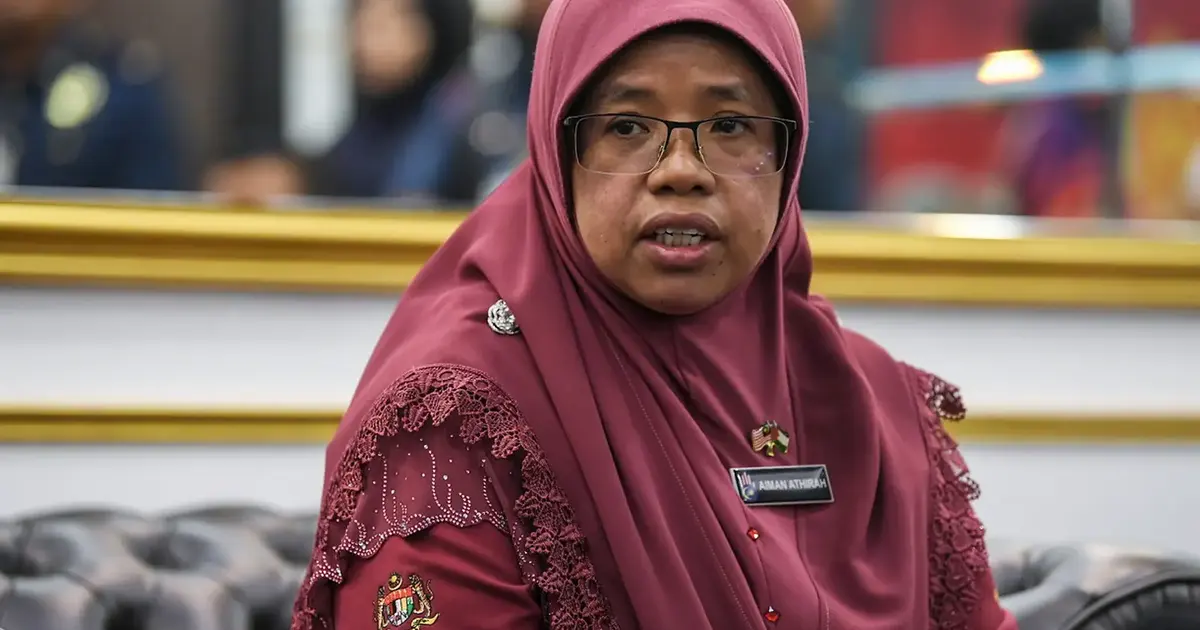
Amanah vice-president Aiman Athirah Sabu has issued a pointed challenge to PAS president Abdul Hadi Awang, demanding he either furnish substantive proof of his allegations against DAP or pursue the matter through the courts. The exchange represents a deepening rift within Malaysia's political landscape over how different coalitions characterise their rivals' positions on religious matters, a perennial flashpoint in the country's plural society.
Aiman Athirah's intervention signals Amanah's willingness to confront the narrative that PAS has been promoting, particularly through its leadership. By calling for either evidence or legal action, she has effectively placed the burden of proof squarely on Hadi, a tactic that reflects broader frustration among opposition-aligned figures with unsubstantiated claims that they view as politically motivated rather than factually grounded. This move also underscores the ideological and strategic divisions that persist between Amanah and PAS, despite both parties having Islamic roots and competing for support within Muslim-majority constituencies.
The challenge carries significance beyond a simple political squabble. In Malaysia's context, allegations regarding Islam and religious opposition carry substantial weight among voters, particularly in Malay-majority and more religious areas. Such claims, when left unchallenged or unverified, can shape public perception and influence electoral outcomes. Aiman Athirah's demand that Hadi move from rhetoric to evidence represents an attempt to reset the terms of debate and prevent such allegations from becoming accepted as fact through repetition alone.
Hadi Awang has long positioned PAS as the principal custodian of Islamic interests in Malaysian politics. His party has frequently critiqued other political players, particularly those in the DAP, through a religious lens. These attacks have intensified during election cycles and at moments of political tension, serving as a way to differentiate PAS from competitors and reinforce its Islamic credentials with core supporters. However, the absence of concrete legal charges or court proceedings to substantiate these claims has allowed room for challengers like Amanah to question their veracity.
DAP, as a secular-oriented party with significant representation in urban areas and among non-Muslim communities, has regularly found itself on the receiving end of such accusations. The party has consistently denied that it seeks to undermine Islam or Islamic institutions. Nevertheless, its secular governance approach and advocacy for religious pluralism have made it a convenient target for those who frame such positions as inherently anti-Islam. The party's coalition-building efforts have sometimes put it at odds with PAS-aligned actors who view their approach to governance and religious matters as fundamentally incompatible.
Amanah's position in this dynamic is particularly instructive. As a party that emerged from PAS itself, it maintains credibility with Muslim voters while also embracing a more inclusive vision of Islam's role in governance. By challenging Hadi directly, Amanah positions itself as a defender of rational discourse and genuine religious values, implying that baseless accusations undermine authentic Islamic concerns. This rhetorical strategy seeks to appeal to voters who may be religiously observant but also value factual accuracy and principled debate.
The broader context of Malaysian politics suggests that such disputes over religious positioning will remain central to electoral competition. The country's complex history of managing religious diversity, combined with Islam's constitutional position, creates space for competing interpretations of what constitutes appropriate respect for Islamic concerns. Different parties exploit these ambiguities to advance their political interests, framing opponents as threats to religious interests and themselves as protectors.
For Malaysian voters and observers, Aiman Athirah's challenge raises important questions about political accountability and the standards of evidence expected in public discourse. When politicians make serious allegations about opponents' stance towards religion, should substantiation be demanded? Should such claims trigger legal consequences if unproven? These questions touch on fundamental issues of how democratic debate should function in a multi-religious society.
The response from Hadi and PAS to this challenge will prove revealing. Proceeding with legal action would represent a significant escalation and would force the party to present documentary or testimonial evidence in court. Conversely, continuing to make allegations without legal backing might reinforce Amanah's characterisation of these claims as mere political theatre. Either outcome will affect how voters perceive the credibility of the various parties involved.
Looking at the Southeast Asian context, Malaysia's experience with political claims about religious opposition reflects patterns seen in other plural democracies in the region. As populations become more diverse and governance approaches more complex, allegations about threats to religious interests often serve as powerful political tools. However, societies that have developed stronger norms of evidentiary standards and accountability have generally found their democratic discourse more resilient and their elections more stable.
For Malaysia's political trajectory, this moment underscores the importance of maintaining standards of evidence and accountability in religious discourse. Whether through Amanah's challenge or through broader democratic mechanisms, the country's political system benefits from mechanisms that separate substantiated concerns from politically motivated allegations. This distinction matters not only for the parties involved but for the broader health of democratic competition.

