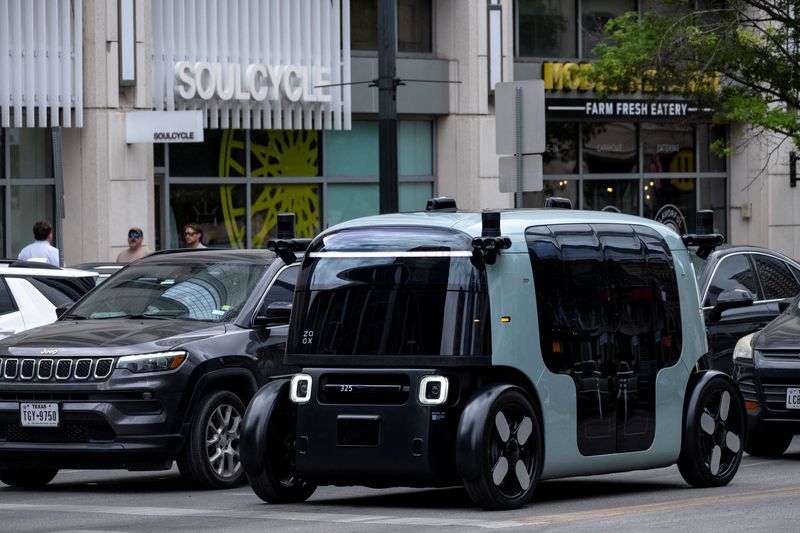
Amazon's autonomous vehicle subsidiary Zoox is stepping into commercial operations this week by beginning paid robotaxi services in Las Vegas, a pivotal moment that underscores how quickly the autonomous ride-hailing market is maturing in the United States. The announcement comes just days after federal regulators granted Zoox approval to deploy its fully driverless vehicles commercially, a landmark decision that positions the company alongside Alphabet's Waymo and Tesla in a competitive landscape where autonomous transportation is transitioning from experimental pilot programmes to revenue-generating services.
Zoox's distinctive electric carriage features inward-facing seating arranged in two rows, a design choice that distinguishes it from retrofitted conventional vehicles used by competitors. Prior to this commercial launch, the company has been operating free demonstration rides across Las Vegas, San Francisco, Austin, and Miami to gather data and refine operations. The transition to paid fares represents validation that the technology has reached sufficient maturity for customers to trust their safety and money to a fully autonomous system without any human operator in the vehicle.
The pricing structure positions Zoox as a premium service within the ride-hailing ecosystem. Fares will be calculated using a base fee combined with time and distance charges, with the company employing route optimization algorithms to determine the most efficient path. Importantly, Zoox has committed to transparency regarding all costs, including destination-specific surcharges for locations such as airports, disclosed before passengers confirm their rides. The "comfort" tier positioning—charging 20 to 40 percent above standard ride-hailing fares—reflects the newness and roominess of Zoox vehicles, positioning the service as an alternative to both conventional taxis and budget ride-sharing options.
The regulatory approval that enabled this launch represents a watershed moment for the autonomous vehicle sector. The National Highway Traffic Safety Administration granted Zoox an exemption from federal requirements mandating human controls in vehicles, marking the first time such approval has been issued to a company developing purpose-built autonomous vehicles rather than adapting existing car designs. This distinction matters because it validates an entirely new category of transportation technology rather than simply iterating on established automotive platforms.
However, the regulatory green light comes with meaningful constraints. NHTSA has capped Zoox's deployment at 2,500 vehicles annually for each of the next two years, a ceiling that reflects the agency's cautious approach to scaling autonomous services. Additionally, the approval mandates enhanced reporting requirements, compelling Zoox to document all incidents including crashes and instances where vehicles stop inappropriately on roadways. These conditions reflect ongoing regulatory concern about autonomous vehicles' performance in complex, unpredictable traffic environments and emergency situations.
Safety remains a persistent challenge for the entire sector. Zoox has issued multiple software updates over the past two years, each addressing specific operational failures detected during testing or service. Most recently, in July, the company pushed out a patch after one of its robotaxis failed to detect dense smoke at an emergency scene—a particularly concerning gap given that first responders and accident scenes represent exactly the kind of complex scenarios where autonomous systems must perform flawlessly. These incidents underscore why regulators maintain restrictive deployment caps and intensified monitoring requirements, even as companies demonstrate incremental improvements.
The competitive landscape surrounding Zoox's commercial entry is intensifying rapidly. Waymo has already established paid driverless services across multiple metropolitan areas, building operational experience that stretches back years. Tesla, meanwhile, has recently begun rolling out autonomous ride-hailing capabilities, leveraging its enormous installed base of vehicles equipped with autonomous driving hardware. The race to scale operations is consequently accelerating, with each company seeking to accumulate the mileage data, operational knowledge, and customer feedback necessary to refine their systems and achieve profitability.
For Southeast Asian observers, Zoox's Las Vegas launch carries particular significance regarding the trajectory autonomous vehicles may follow in the region. While major economies including Malaysia are still in early stages of autonomous vehicle regulation and deployment, the American experience provides a template for how autonomous ride-hailing might eventually integrate into urban transportation networks across Asia. The regulatory progression in the United States—moving from prohibition to limited pilot programmes to constrained commercial operations—likely foreshadows the regulatory pathway that Southeast Asian governments may eventually follow.
The Malaysian context deserves specific attention. Kuala Lumpur and other major Malaysian cities face chronic traffic congestion and ride-hailing demand that could theoretically benefit from autonomous vehicle deployment. However, the safety incidents plaguing autonomous vehicle operators in the United States suggest that introducing such technology in Malaysian cities—with their distinctive traffic patterns, informal transportation arrangements, and varying levels of traffic discipline—presents substantial implementation challenges. Zoox's software recalls and detection failures highlight that even well-funded, technologically advanced companies struggle to anticipate all scenarios that autonomous systems will encounter.
Zoox's stated intention not to charge customers more if the autonomous vehicle takes a longer route than optimal represents a meaningful commitment to algorithmic transparency and customer protection. This pricing model differs from human-driven ride-hailing where drivers select routes and passengers accept the consequences. By guaranteeing fare calculation based on the theoretically optimal route, Zoox removes one source of customer friction and suspicion regarding autonomous vehicles. Whether this commitment holds as the company scales operations and encounters complex urban geography remains uncertain.
The coming months will determine whether Zoox can successfully expand paid operations beyond Las Vegas while maintaining the safety record necessary to justify continued regulatory approval and public acceptance. Each software update, each incident, and each reported crash will influence how regulators in the United States and internationally calibrate their approaches to autonomous vehicle deployment. For Malaysia and other Southeast Asian nations watching this technological and regulatory evolution, these early commercial operations provide crucial real-world evidence about whether autonomous ride-hailing can genuinely complement urban transportation networks or whether the technology remains better suited to controlled environments and restricted deployment zones.

