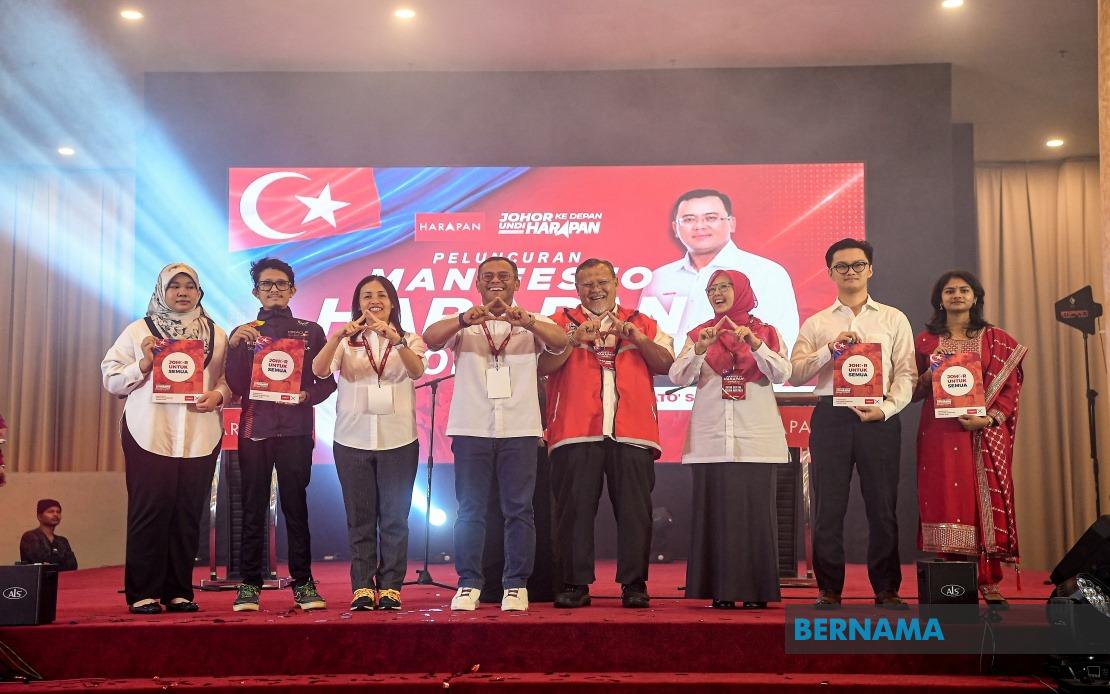
Pakatan Harapan is banking on its demonstrated ability to fulfill electoral commitments as a key selling point to Johor voters ahead of the state election scheduled for July 11. The coalition's Johor chairman Aminolhuda Hassan unveiled this argument during the launch of PH's new "Johor for All" manifesto, arguing that the coalition's previous tenure in the state following the 2018 general election provides solid evidence that it keeps its promises to the electorate.
The political messaging is straightforward: voters burned by unfulfilled pledges from previous administrations should feel confidence placing their trust in Pakatan Harapan because the coalition has already demonstrated the ability to deliver. Aminolhuda pointed specifically to the 100-day manifesto issued after the 14th General Election, emphasizing that PH implemented all ten major initiatives contained within it. This framing transforms the question from whether voters should believe PH's new promises into whether they have reason to doubt an organization with a documented record of performance.
Among the concrete programs completed during PH's previous Johor administration were term limits imposed on the Menteri Besar position, restricting it to two consecutive terms. The coalition also introduced the Johor Health Card, a healthcare initiative designed to expand medical access, and implemented a more transparent tender system for government contracts. These represent significant structural and institutional changes rather than merely rhetorical gestures, suggesting substantive governance reform beyond electoral posturing.
The social welfare initiatives in the earlier manifesto reflected PH's attempt to address immediate household concerns facing ordinary Johoreans. The provision of ten cubic metres of free water monthly to qualifying households addressed a basic utility cost burden. Meanwhile, a takaful scheme extending coverage to senior citizens represented targeted social insurance expansion, while marriage incentives and higher education grants aimed at young people attempted to address affordability barriers to life milestones.
Small business support featured prominently in the earlier package. Licence fee exemptions for street hawkers and food vendors addressed regulatory costs crushing informal economy operators, while a 50 per cent discount on overdue rent payments for residents of People's Housing Project units acknowledged the vulnerability of lower-income urban residents facing housing arrears. These measures, taken together, suggest an administration attempting to calibrate policies toward working-class constituencies and marginal economic groups.
Among the high-profile attendees at the manifesto launch were senior national figures including PH Presidential Council member Amirudin Shari, PKR secretary-general Fuziah Salleh, and DAP's Johor leadership. The prominence of national-level party officials signals the strategic importance Pakatan Harapan places on winning Johor, Malaysia's second-largest state by population and economy. The coalition is contesting all 56 state legislative seats, indicating an all-or-nothing approach to the contest.
Amino Lhuda's confidence about the new manifesto's implementability hinged explicitly on PH retaining control of Johor's state government following the election. He connected the state-level governance directly to Prime Minister Anwar Ibrahim's federal-level leadership, suggesting that continuity and alignment between state and federal administrations would enable greater policy coherence and resource availability. This framing attempts to embed the Johor election within a broader narrative of national governance reform.
The timing of manifesto launches matters significantly in Malaysian electoral politics. Presenting specific commitments with attached accountability mechanisms weeks before voting allows both supporters and skeptics to scrutinize the proposals and make informed judgments. The coalition's decision to highlight prior fulfillment of pledges rather than making entirely new promises represents a different electoral strategy than competitors might pursue, emphasizing continuity and proven governance capacity rather than transformative change.
For Malaysian voters more broadly, the Johor election represents an important test of whether regional state governments led by PH perform differently from those controlled by other coalitions. The state's economic significance and diverse population make it a bellwether for national political trends. Success in Johor could strengthen Anwar Ibrahim's political position heading into future national elections, while losses could embolden opposition forces seeking to regain state-level dominance.
The emphasis on delivery mechanisms reflects broader shifts in Malaysian political discourse. Increasingly, voters appear less impressed by grandiose promises and more focused on whether previous commitments were actually completed. This evolution suggests that election outcomes increasingly depend on governmental performance records rather than purely ideological positioning or personality-driven politics. Parties that can demonstrate concrete delivery of past pledges gain significant electoral advantages.
For Johor residents, the election offers a choice between continuing the current PH-led administration and returning to previous governance arrangements. The coalition's presentation of its track record is designed to remind voters that political promises need not remain mere rhetoric. Whether this strategy proves persuasive depends ultimately on whether voters judge the previous administration's performance and proposed new initiatives as genuinely beneficial and preferable to alternative governance options being offered.

