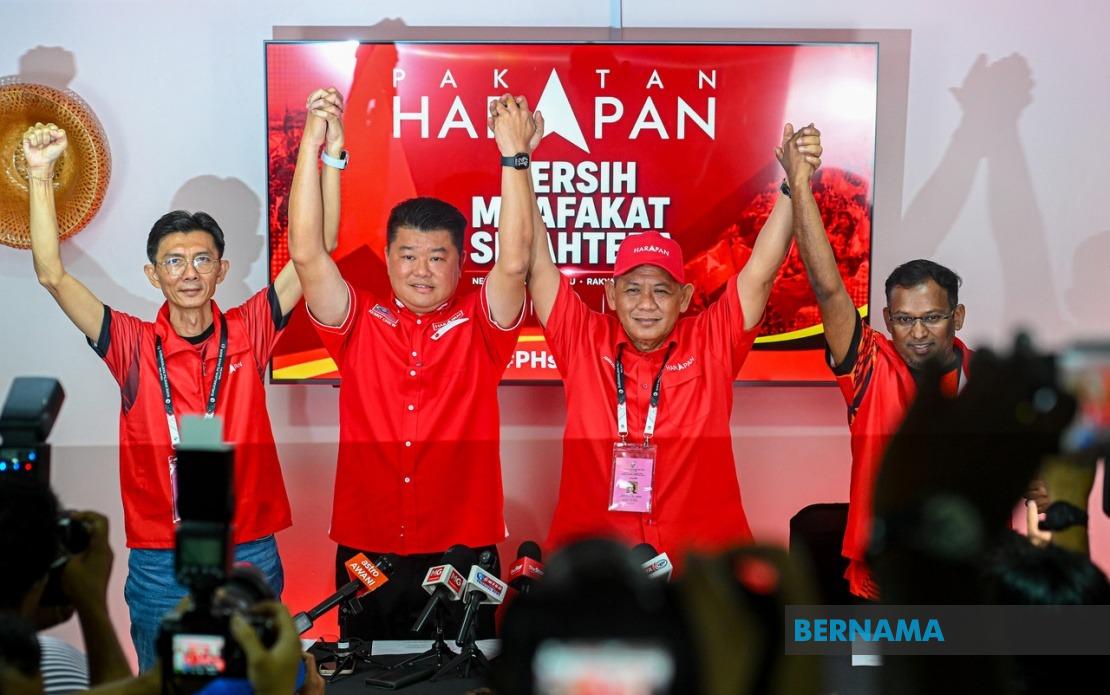
Negeri Sembilan's Pakatan Harapan leadership has moved decisively to counter narrative emerging from social media suggesting fissures within the coalition ahead of the state election. Datuk Seri Aminuddin Harun, the opposition front's state chairman and menteri besar, appeared at a Port Dickson press conference on July 20 to explicitly reject characterizations of discord between senior figures and party machinery operating across the five state constituencies that fall within the Port Dickson parliamentary seat—namely Chuah, Lukut, Sri Tanjung, Bagan Pinang, and Linggi.
The immediate flashpoint centred on the renomination of incumbent Datuk Yew Boon Lye in Chuah, a decision that had sparked online speculation and drawn in Port Dickson PKR deputy division chief Datuk Kenny Chiew Chi Kin. Aminuddin characterized the episode as an internal management matter that has since been resolved through established party channels, suggesting the controversy was being deliberately inflated by external actors seeking to damage the coalition's standing with voters. The menteri besar indicated that Chiew had publicly committed to backing all Pakatan Harapan candidates contesting in the forthcoming election, effectively closing what might have become a more serious wound within the party structure.
In remarks that doubled as a measured rebuke, Aminuddin acknowledged Chiew's long-standing service to PKR and the Port Dickson division, framing the deputy chief's non-selection as a candidate within a broader context of party discipline and organizational necessity. The messaging reflected a common challenge facing opposition coalitions in Malaysia: balancing the disappointment of loyal activists excluded from electoral contests against the need to project organizational unity to the electorate. By publicly thanking Chiew for his willingness to subordinate personal ambition to collective campaign objectives, Aminuddin attempted to transform a potential liability into evidence of mature party governance.
The five state seats under the Port Dickson parliamentary umbrella represent substantial strategic real estate for Pakatan Harapan in Negeri Sembilan, making electoral performance across these constituencies critical to the coalition's overall showing in the state. Aminuddin himself is contesting the Linggi seat, placing him personally at stake in the outcome and lending weight to his assertions that all wings of the campaign machinery are synchronized toward a shared objective. The Port Dickson MP's direct insertion of himself into the dispute resolution process underscored the seriousness with which the leadership treats any intimation of internal conflict during the campaign period.
Yew Boon Lye's position in Chuah carries historical significance that extends beyond the current cycle. In the 2023 state election, the incumbent secured the seat with a commanding 6,298-vote majority over Perikatan Nasional candidate Tang Jay Son, establishing himself as an effective campaigner in a constituency that has emerged as competitive in state politics. This time, however, Yew faces a different challenger in Barisan Nasional's Pau Jeou Ching, introducing a realignment of opposition forces that may explain some of the internal repositioning within Pakatan Harapan's machinery.
The broader context of coalition politics in Malaysia suggests that Aminuddin's public dismissal of rift allegations, while necessary for campaign morale, reflects genuine organizational strains common to multi-party alliances contesting under unified banners. Pakatan Harapan comprises distinct political entities—PKR, DAP, and Amanah—each with its own internal dynamics, membership expectations, and leadership hierarchies. When decisions affect candidate selection and positioning, as occurred with Yew's renomination, these organizational tensions can surface in ways that threaten public perception of unity, even if actual operational coordination remains intact.
The timing of Aminuddin's intervention matters considerably. With early voting scheduled for July 28 and the main polling day set for August 1, the coalition sits in the final stretch of its campaign preparation. Any perception of internal division at this stage risks dampening voter enthusiasm among opposition supporters while providing ammunition to rival camps seeking to exploit weaknesses in the Pakatan Harapan structure. The decision to address the controversy through a public press conference rather than allowing online speculation to circulate unchallenged reflected shrewd political judgment about controlling the narrative in an era where social media narratives can rapidly metastasize into broader perceptions of organizational dysfunction.
For Malaysian observers watching state-level politics, the Port Dickson dynamics offer insight into how opposition coalitions manage the inherent tensions between inclusive party-building and the pragmatic calculus of candidate selection. Every aspiring politician excluded from a slate represents a potential source of friction, yet no coalition can accommodate all ambitions. The manner in which such inevitable disappointments are processed—whether through transparent internal mechanisms or through acrimony that spills into public view—significantly shapes both electoral outcomes and the coalition's long-term institutional health.
Chiew's reported commitment to supporting all Pakatan Harapan candidates, assuming it holds through August 1, demonstrates a workable resolution to what might otherwise have festered into genuine organizational damage. Yet the very fact that such reassurance needed to be publicly articulated suggests underlying discontent that required management. The menteri besar's framing of this as evidence of party discipline rather than suppressed conflict represents a positive interpretation, though observers with institutional memory of Malaysian coalition politics know that apparent unity during campaign season often masks deeper currents of ambition and resource competition.
The electoral stakes extend beyond Negeri Sembilan's local dynamics. Performance in state contests shapes perceptions of opposition viability at the federal level, influences internal coalition power dynamics, and signals to supporters whether Pakatan Harapan possesses the organizational maturity necessary to govern. This makes even apparently localized disputes like the Port Dickson constituency matter in terms of national political trajectories. Aminuddin's effort to contain and contextualize the candidate selection controversy reflects awareness that state elections serve as bellwethers for broader coalition health and electoral competitiveness.

