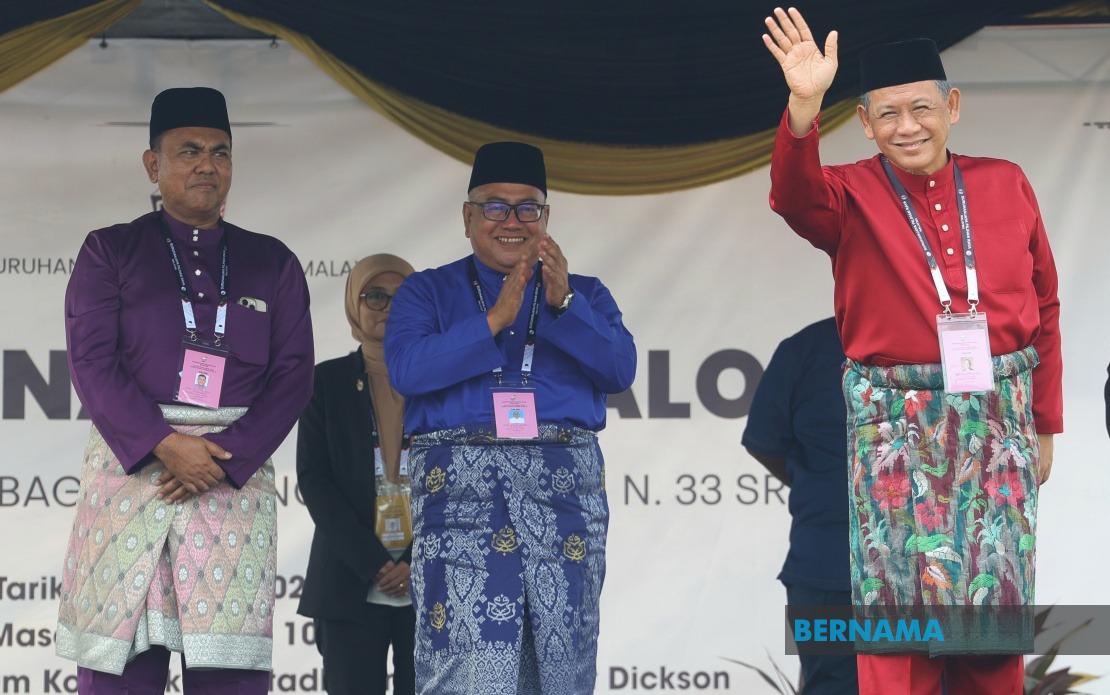
The political battlefield in Negeri Sembilan is shaping up for a fierce three-way clash in the Linggi constituency, where the state's Menteri Besar Datuk Seri Aminuddin Harun will make his bid to retain the seat as the Pakatan Harapan standard-bearer. His challengers include the incumbent Datuk Mohd Faizal Ramli representing Barisan Nasional and political newcomer Datuk Zamri Md Said flying the Bersatu flag. The nomination period concluded on July 18 at the Port Dickson District Administration Complex, with returning officer Nurhazelin Makli officiating the candidate confirmation process at 10 am.
The Linggi contest represents a critical battleground for Aminuddin's political future, as the Menteri Besar seeks to consolidate Pakatan Harapan's control of the state apparatus ahead of the August 1 polling day. The presence of a third contender from Bersatu complicates the electoral mathematics, potentially fragmenting the vote in unpredictable ways. This scenario mirrors broader patterns seen across Malaysian politics, where the three-cornered contests have increasingly become the norm rather than exception, reflecting the fragmentation of the political landscape beyond the traditional two-coalition framework.
Across the state, five constituencies have officially entered the campaign phase following the close of nominations. In Sri Tanjung, the incumbent Dr G. Rajassekaran will defend his Pakatan Harapan seat against Barisan Nasional challenger A. Achutan and Bersatu's Leevineshwaraan Murugan, another three-way contest that underscores the competitive nature of this election. The Lukut seat will witness a different dynamic, with Pakatan Harapan incumbent Choo Ken Hwa facing off against Perikatan Nasional candidate Sathes Kumar Nilameham and independent contestant Teo Seng Lee.
The Bagan Pinang constituency takes on particular significance given that it currently holds a Pas incumbent in Abd Fatah Zakaria, who will now contend against Nasir Raman representing Pakatan Harapan and Sheikh Junaidy Jamaludin of Bersatu. This contest potentially reflects the wider shift in electoral alignments, as Pas maintains its independent trajectory after its exit from the federal government alliance. The Chuah seat presents the only straight fight between Pakatan Harapan incumbent Yew Boon Lye and Barisan Nasional's Pau Jeou Ching, offering a more traditional binary contest that harks back to earlier patterns of Malaysian electoral competition.
The Election Commission's decision to hold polling on August 1, with early voting scheduled for July 28, provides campaign strategists and candidates with a compressed timeline to mobilize voters. The administrative framework reflects the commission's efforts to streamline the electoral process while maintaining safeguards for both security and voter participation. Early voting provisions typically benefit voters in the security and defence sectors, recognizing their operational commitments during election periods.
The electoral register for this state poll encompasses 889,490 eligible voters distributed across the various constituencies. The broader voting population comprises 867,151 ordinary citizens qualified to cast ballots through standard polling procedures, supplemented by 16,884 military personnel and their spouses, plus 5,455 police officers and their family members. This composition demonstrates the significant representation of security sector personnel in Negeri Sembilan's electoral dynamics, a factor that may influence campaign strategies and messaging across different coalitions.
For Pakatan Harapan, the election represents an opportunity to consolidate its governance of the state and validate its stewardship of development and administrative matters since assuming power. The party faces pressure not only from traditional rival Barisan Nasional but also from Bersatu's emergence as a competitive third force in several constituencies. The three-cornered contests demand that Pakatan Harapan maintain strong ground organization and voter turnout operations to prevent vote splitting that could benefit opponents.
Barisan Nasional's strategy in Negeri Sembilan appears focused on reclaiming ground in key constituencies where incumbents maintain reasonable support bases. The presence of Bersatu candidates, however, introduces uncertainty into the opposition's calculations, as both contenders draw from overlapping voter pools and may inadvertently fracture anti-Pakatan Harapan sentiment. The political dynamics reflect national-level tensions between different factions within Malaysia's fractured political ecosystem.
Bersatu's positioning as a third force in multiple Negeri Sembilan constituencies reflects the party's broader strategy to establish itself as an independent political player rather than simply a component of the Perikatan Nasional alliance. By contesting aggressively in select constituencies, Bersatu demonstrates organizational capacity and political ambition, though success will largely depend on local ground dynamics and voter receptiveness to its candidates. The party's entry into these contests adds complexity to what might otherwise have been more predictable electoral outcomes.
The Negeri Sembilan state election assumes broader significance within the context of Malaysian federalism and the evolving balance of power between Pakatan Harapan and its rivals. As a moderately sized state with stable infrastructure and governance, Negeri Sembilan's political trajectory often serves as a barometer for regional sentiment and coalition stability. Results from August 1 will provide insights into voter preferences regarding governance performance, coalition viability, and the appetite for political realignment at the state level.

