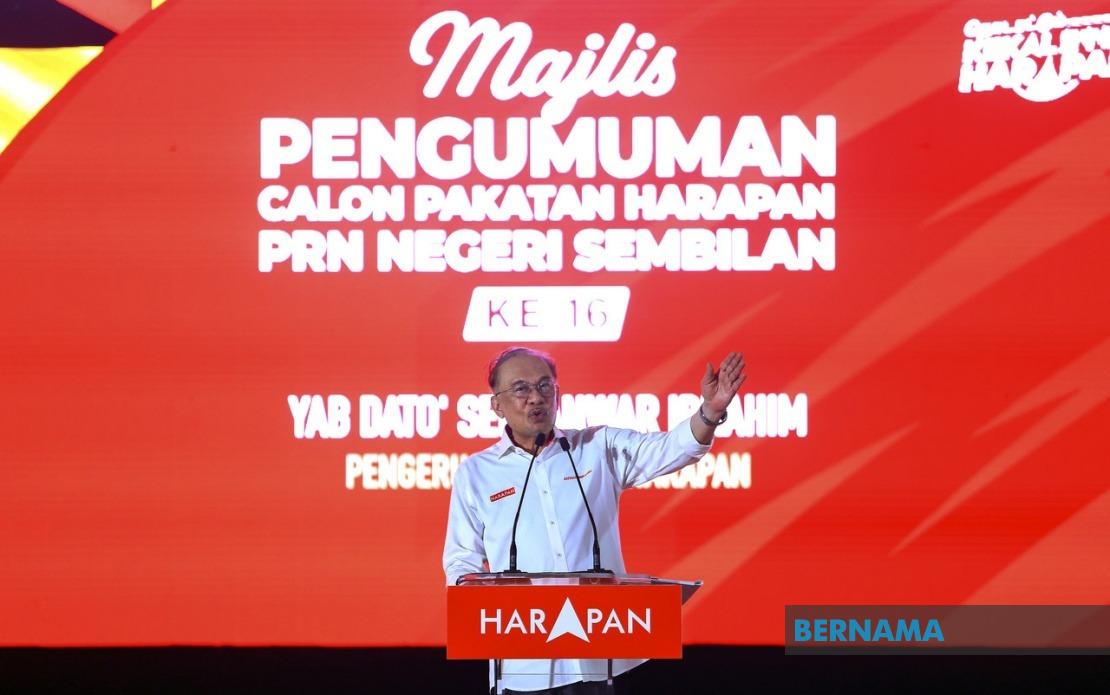
Prime Minister Datuk Seri Anwar Ibrahim has unveiled Pakatan Harapan's lineup for the 16th Negeri Sembilan State Election, tapping Menteri Besar Datuk Seri Aminuddin Harun to lead the coalition's charge in the Linggi constituency. The decision signals PH's confidence in retaining its control over Malaysia's smallest state by population, as Aminuddin transitions from his stronghold in Sikamat where he has served as assemblyman for four consecutive terms stretching back to 2008.
Aminduddin's move from Sikamat to Linggi represents a strategic repositioning within Negeri Sembilan's political landscape. As chairman of the state PH chapter in addition to his role as Menteri Besar, Aminuddin has become the coalition's most recognisable face in the state, making him a natural choice to carry the banner in a seat that PH must defend to maintain its grip on state government. His decision to contest elsewhere underscores the coalition's assessment of the electoral terrain and suggests confidence that his political capital can be effectively deployed in Linggi.
Alongside Aminuddin's candidacy, the coalition has retained DAP secretary-general Anthony Loke in the Chennah seat, where the veteran politician has held sway since 2013. Loke's continued representation reflects DAP's enduring presence in Negeri Sembilan and his personal standing with voters in the constituency. The decision to retain an incumbent of Loke's seniority demonstrates that PH views its existing representation as solid ground worth defending rather than reshuffling unnecessarily.
The formal announcement took place in Kuala Pilah on July 14, delivered by Anwar at a packed ceremony that drew the coalition's senior leadership and thousands of party supporters. The visible show of unity and force underscored PH's determination to contest the Negeri Sembilan election from a position of organisational strength. The gathering itself served as a demonstration of the coalition's mobilisation capacity, important signalling in a state where every seat matters for securing a working majority in the state assembly.
The presence of Amanah president Datuk Seri Mohamad Sabu, along with coalition communications director Datuk Seri Fahmi Fadzil and election director Datuk Seri Amirudin Shari, reflected the multi-party nature of PH and the careful coordination required to manage candidate selection across different party components. These three figures represent the institutional machinery through which PH manages messaging, electoral strategy, and internal party dynamics, making their attendance at the ceremony an affirmation that the candidacy selections had secured consensus among coalition partners.
For Negeri Sembilan specifically, the stakes of this election extend beyond merely maintaining state government control. The state's economic significance as a corridor between Kuala Lumpur and the southern Klang Valley, combined with its agricultural heritage and industrial zones, makes it politically important to the Selangor-centric federal government. A strong showing in Negeri Sembilan would reinforce PH's credibility heading into potential future elections at the federal level.
Aminduddin's transition from Sikamat also hints at careful long-term planning within PH's Negeri Sembilan structure. By moving the Menteri Besar to contest in Linggi, the coalition is signalling that Sikamat remains a safe seat worthy of a successor candidate, while positioning Aminuddin to potentially expand his political base and consolidate state-level influence. This kind of managed succession planning reflects the lessons PH has absorbed about the importance of orderly transitions and retaining institutional memory in state politics.
The Linggi constituency, as a target seat for the Menteri Besar himself, becomes a focal point of PH's campaign machinery. Aminuddin's personal participation in contesting the seat means the entire state leadership's credibility becomes intertwined with the outcome there. Should he retain the seat, it would validate his standing as a capable administrator and political operator. Conversely, any setback would raise questions about his acceptability to voters and his capacity to manage state-level challenges.
Loke's retention in Chennah speaks to DAP's particular strength in certain constituencies within the state. The party has built significant support among certain voter demographics and communities, making incumbents like Loke valuable political assets. His position as DAP secretary-general also means that his continued presence in the state assembly underscores the party's broader relevance within Malaysian politics, providing a platform from which to engage on issues extending beyond Negeri Sembilan's boundaries.
Regionally, the Negeri Sembilan election holds significance as a test case for PH's stability and appeal across different states. The coalition faces persistent questions about internal cohesion, particularly between its more progressive DAP contingent and its Malay-Muslim majority components. A successful election in Negeri Sembilan would demonstrate that PH can manage these internal tensions while still commanding voter support, an important credential as the coalition looks toward broader electoral contests.
The announcement timing itself, with the state election presumably scheduled for the coming months, indicates that PH has moved into active campaign mode. By unveiling candidates well in advance, the coalition provides time for campaign machinery to mobilise ground support and for candidates to build profile and connect with voters. This contrasts with last-minute announcements that leave campaigns rushed and disorganised, a lesson PH has evidently internalised from previous elections.
For Malaysian political observers, the candidacy choices reveal much about how established parties manage succession and strategic positioning in an era of electoral volatility. Both Aminuddin and Loke represent the kind of tried-and-tested politicians that established coalitions typically rely upon, suggesting that PH remains committed to leveraging experience and institutional strength rather than experimenting with untested newcomers. This approach carries both advantages in terms of administrative capability and potential disadvantages if voters desire change and fresh faces.

