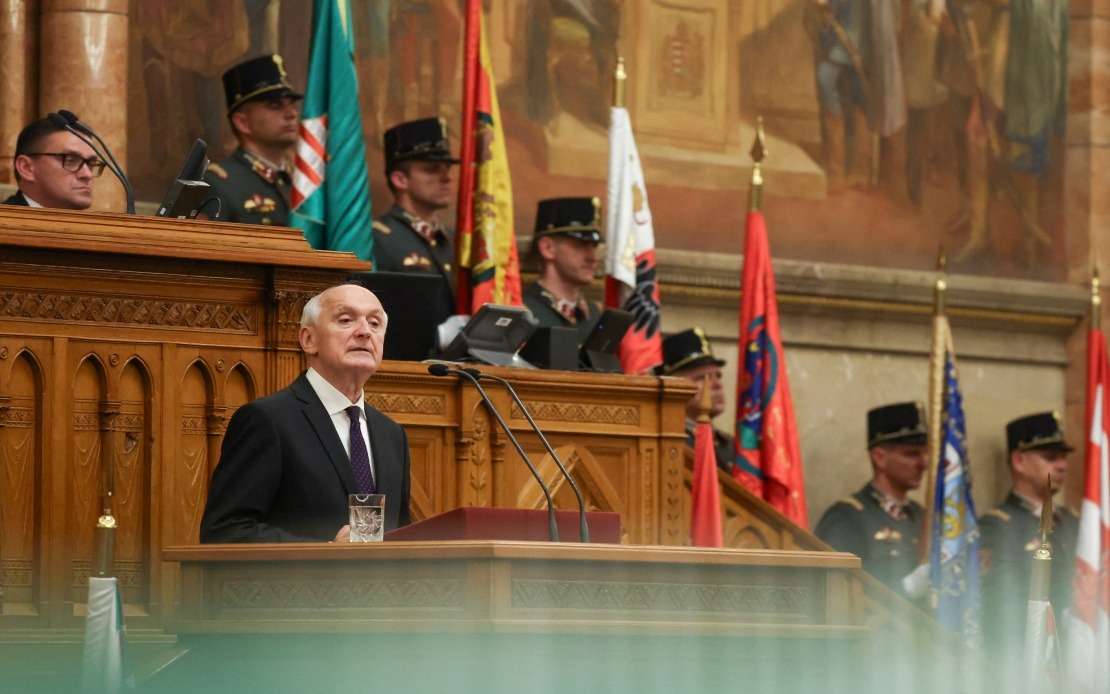
Andras Baka formally assumed the Hungarian presidency on August 19, 2026, marking a significant transition in the country's political leadership. Prime Minister Peter Magyar announced the development through social media, extending wishes for the incoming president's tenure with particular emphasis on humanitarian values in governance. The assumption of office came eight days after the Hungarian Parliament voted to elect Baka during its August 11 session, concluding the formal selection process.
The appointment of Baka represents a notable shift in Hungary's institutional leadership, given his extensive background within the country's judicial system. His previous tenure as Supreme Court president from 2009 to 2011 provided him with substantial experience navigating Hungary's highest legal authority, though his time in that position was marked by significant institutional tension. During his judicial career, Baka also served at the European Court of Human Rights based in Strasbourg, exposing him to international human rights frameworks and comparative legal perspectives across Europe.
Baka's departure from the Supreme Court came as a direct consequence of judicial reforms undertaken during Viktor Orban's earlier tenure as Prime Minister. These restructuring efforts fundamentally altered Hungary's judicial architecture, and Baka's resignation reflected the incompatibility between his position and the reforms being implemented. Rather than departing the judiciary entirely, he transitioned to lead the Hungarian Curia from 2012 to 2020, a body established through the same constitutional restructuring that had prompted his earlier resignation, demonstrating his continued engagement with judicial reform processes.
The path to Baka's presidency was complicated by significant political opposition and constitutional controversy. Major opposition parties, including Fidesz and the Christian Democratic People's Party, collectively boycotted the presidential election as a protest mechanism. Their dissent centred on the removal of the previous president, Tamas Szujok, which they viewed as having been accomplished through constitutional amendments employed inappropriately to alter the normal succession process.
This boycott underscores deeper tensions within Hungarian politics regarding constitutional processes and the appropriate use of parliamentary majorities. The opposition's decision to abstain from voting rather than participate in the election reflects their fundamental objection to the constitutional mechanism that facilitated Szujok's departure. In parliamentary systems, such boycotts carry symbolic weight even when they fail to prevent outcomes, signalling disagreement with procedural legitimacy rather than merely contesting policy positions.
For regional observers in Southeast Asia, Hungary's institutional developments offer instructive parallels regarding judicial independence and constitutional safeguards. Malaysia, like Hungary, has experienced debates about judicial reform, constitutional amendments, and the balance between executive authority and institutional independence. The Hungarian case demonstrates how constitutional change—even when technically procedurally valid—can generate significant political legitimacy questions if perceived as circumventing established norms or protecting specific political interests.
Baka's background bridging domestic and international judicial systems may shape Hungary's approach to human rights and European integration questions. His experience at the European Court of Human Rights potentially positions him to engage thoughtfully with international legal standards while navigating Hungary's complex relationship with European Union oversight and criticism. This duality reflects broader tensions within Central European politics between national sovereignty assertions and international legal commitments.
The timing of Baka's assumption coincides with Hungary's continued navigation of EU relations and internal political division. Magyar's emphasis on "humanism" in Baka's prospective work suggests an intent to position the presidency as a unifying institutional force, particularly important given the significant opposition protests surrounding the transition. Presidential roles in parliamentary systems like Hungary's often carry symbolic significance beyond direct executive power, making the tone and approach of leadership particularly consequential for national cohesion.
Hungary's presidency succession, viewed from a regional Southeast Asian perspective, illustrates how constitutional mechanisms can become flashpoints in polarized political environments. The opposition's boycott, while numerically ineffectual, demonstrates how institutional legitimacy extends beyond procedural compliance to encompass broader stakeholder acceptance. This remains relevant to Malaysian political discussions, where questions about constitutional propriety frequently intersect with substantive policy disagreement.
Baka's judicial background suggests the presidency will likely emphasize legal and constitutional considerations in public discourse. His resignation from the earlier Supreme Court role on principle suggests someone willing to stand against institutional pressures deemed incompatible with judicial independence—a characteristic potentially significant during contentious constitutional moments. Whether this independence orientation will translate into a presidency that mediates or deepens institutional tensions remains to be determined as his term progresses.
The broader Hungarian political context features substantial divisions between the government coalition supporting Magyar and substantial opposition forces. Baka's role as ceremonial head of state in this fractious environment carries genuine significance for symbolic reconciliation and institutional legitimacy, particularly given the constitutional controversy surrounding his predecessor's removal. His performance in this moderating capacity will likely influence perceptions of whether the presidential transition represents genuine institutional renewal or continued partisan contestation through constitutional mechanisms.

