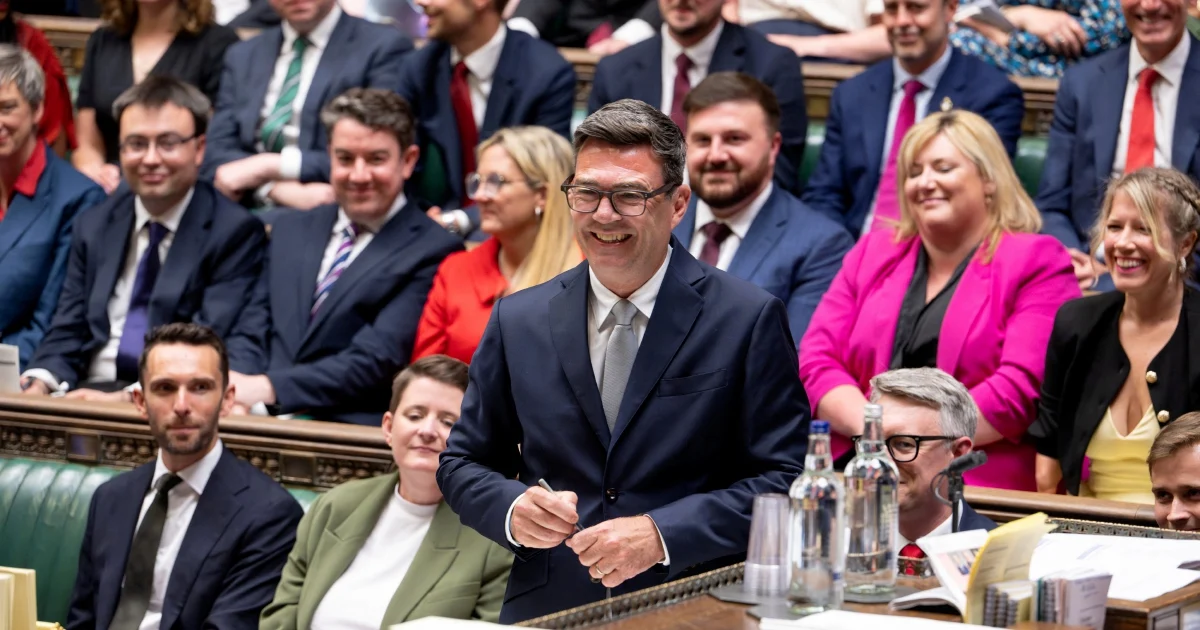
Andy Burnham, the Mayor of Greater Manchester, has emerged as the frontrunner to replace Keir Starmer as leader of Britain's Labour Party and potentially the nation's next prime minister. The development came on Monday in parliament when Starmer formally announced his resignation, following weeks of mounting political pressure within his party. Burnham's subsequent reception in the chamber signalled broad backing from Labour colleagues across various factional lines, positioning him as perhaps the most viable unifying figure available to the party at this critical juncture.
The 57-year-old politician's ascent to serious contention for the party's top job represents a remarkable consolidation of power within the Labour movement over the past decade. Once viewed as a reliable but unremarkable backbencher and minister, Burnham has deliberately cultivated a reputation as the voice of Britain's economically neglected regions, particularly northern England. His strategy of championing devolved power and regional investment has resonated with party members frustrated by Westminster's perceived indifference to communities beyond London and the southeast. This regional positioning has given him credibility that transcends the typical divisions that often paralyse Labour during leadership transitions.
Burnham's most consequential period has come during his tenure as Mayor of Greater Manchester since 2017. In this role, he secured a groundbreaking devolution deal from the Conservative government, bringing substantial fiscal autonomy and investment into the region. More significantly, he positioned himself as the champion of public health and economic equity during the COVID-19 pandemic, frequently clashing with the national government over funding and policy. His willingness to publicly criticise the Conservatives from a position of genuine local responsibility built his credibility as someone operating outside the traditional Westminster bubble, a quality increasingly prized by an electorate weary of conventional politics.
The contrast between Burnham and the outgoing Starmer reflects deeper tensions within the Labour Party. Starmer, a former prosecutor who governed as a centrist technocrat, struggled to energise the party base while attempting to distance Labour from its Jeremy Corbyn years. His approach, emphasising competence and stability, failed to overcome doubts about his strategic direction and his perceived remoteness from party activists. Burnham, by contrast, maintains deeper roots in traditional Labour constituencies through his work in local government and his willingness to engage directly with grassroots concerns about inequality and regional neglect.
For Malaysian and Southeast Asian observers of British politics, Burnham's potential rise carries implications for international relations and trade policy. His emphasis on regional development and public investment suggests a government potentially more protective of state investment in strategic industries, contrasting with the more liberalised approach favoured by recent Conservative administrations. This could affect ongoing negotiations over post-Brexit trading arrangements and investment flows, matters of direct concern to Malaysian companies and the Malaysian government's economic strategy in Europe.
Burnham's leadership would also signal a potential shift in Labour's approach to issues of nationalism and localism. His repeated emphasis on breaking Westminster centralisation and empowering regional authorities aligns with contemporary concerns about democratic legitimacy and unequal development. This platform has particular resonance for Southeast Asian audiences grappling with their own questions about centre-periphery relations and equitable growth. His model of devolved governance, though operating within a unitary British state, offers lessons about how national parties can accommodate regional aspirations without fracturing.
The timing of Burnham's emergence is crucial. The Labour Party faces not merely a leadership vacancy but a fundamental crisis of electoral credibility. The party entered office in 2024 with genuine enthusiasm after years of Conservative governance, yet within months it confronted dissent from its own membership over various policy decisions. A leader capable of rebuilding internal cohesion while simultaneously appealing to voters in post-industrial heartlands and neglected urban areas represents precisely what the party requires. Burnham's track record suggests he can navigate these treacherous political waters more adeptly than rivals who lack his combination of local credibility and national profile.
Yet significant obstacles remain before Burnham can claim the leadership definitively. The Labour Party's mechanism for selecting a new leader involves both parliamentary colleagues and party membership voting, creating multiple checkpoints where alternative candidates might consolidate support. Other senior figures, including Rachel Reeves and other senior cabinet members, retain resources and constituencies that could materialise as rival campaigns develop. Nevertheless, Burnham's early parliamentary reception and his apparent ability to command respect across Labour's fractious wings suggest he possesses genuine momentum as the contest unfolds.
The international dimension of Burnham's potential leadership extends beyond trade and investment questions. His positioning as a defender of public services and critic of austerity could reshape Britain's approach to development aid and international cooperation. Countries in Southeast Asia that have increasingly sought direct government-to-government partnerships rather than engagement through private sector intermediaries may find a Burnham-led government more receptive to state-directed approaches. His emphasis on public health, demonstrated during the pandemic, might also influence British strategies in global health diplomacy, an area where Malaysia and other regional partners have growing interests.
As the Labour Party machinery prepares for its leadership election process, Burnham represents not merely a generational shift but potentially a substantial reorientation of the party's governing philosophy. His rise from provincial mayor to potential prime minister encapsulates contemporary democratic movements favouring leaders perceived as operating outside traditional elite circles. Whether he can successfully translate his regional popularity into a compelling national vision for all of Britain, and whether he can stabilise the Labour Party internally whilst presenting a credible alternative to Conservative governance, will determine whether his parliamentary welcome on Monday proves the beginning of his path to Downing Street or merely a moment of recognition for an accomplished regional politician.