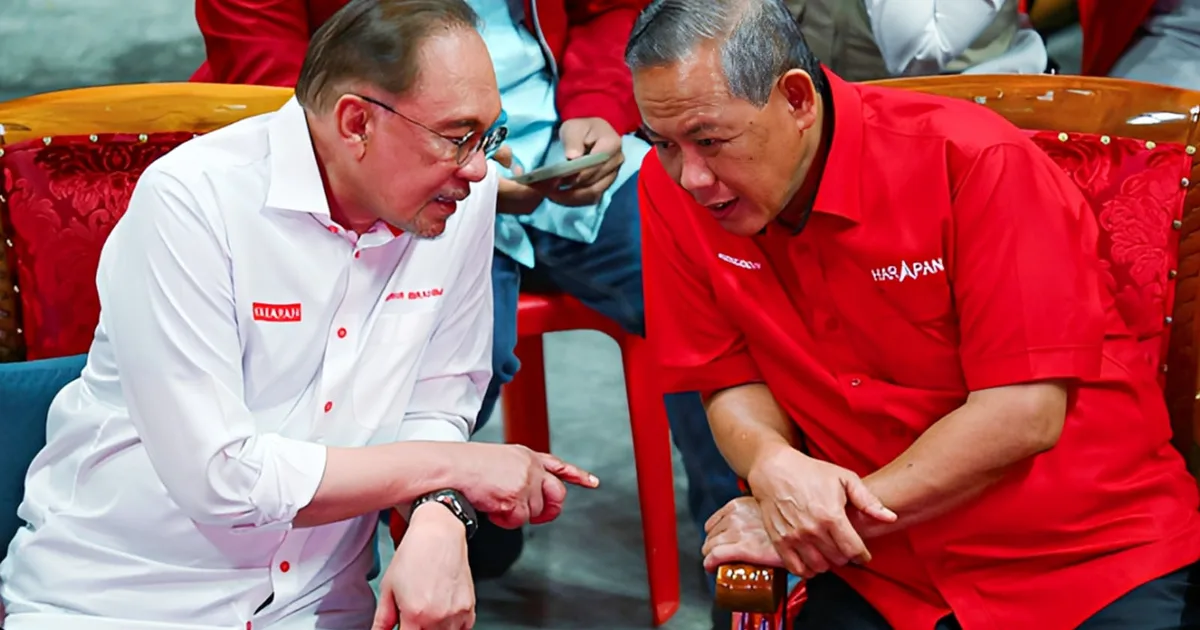
Prime Minister and PKR president Anwar Ibrahim has underscored the continued importance of Aminuddin Harun, the former Negeri Sembilan menteri besar, in nurturing the next cohort of party leadership. Anwar's remarks come amid ongoing discussions about Aminuddin's role within PKR following significant changes in the party's state-level representation across Malaysia.
Anwar emphasised that Aminuddin's approach to handling electoral setbacks merits particular attention from PKR members at all levels. Rather than engaging in recriminations or scapegoating colleagues when facing defeat, Aminuddin demonstrated a measured response that prioritises party unity and personal accountability. This measured temperament, Anwar suggested, should become a model for how party cadres navigate disappointment and political reversals.
The PKR president's endorsement reflects a broader concern within the party about maintaining institutional stability during periods of transition. Across the Southeast Asian region, political parties increasingly recognise that experienced figures who can impart both tactical and ethical lessons play invaluable roles in preventing organisational fractures. In Malaysia's context, where coalition politics frequently demands compromise and mutual respect among partners, such steady voices become particularly valuable.
Aminuddin's tenure as Negeri Sembilan menteri besar exposed him to the complexities of running a state government while balancing multiple stakeholder interests. This practical experience, combined with his demonstrated composure during political transitions, positions him as someone capable of guiding younger PKR members through similar challenging situations. The wisdom derived from such exposure cannot be easily replicated through formal training alone.
The emphasis on Aminuddin's mentoring capacity also reflects PKR's strategy to prepare future candidates and office-holders for leadership roles. As Malaysian political dynamics continue evolving, with voters demonstrating increasing selectivity in their electoral choices, parties need individuals who can communicate effectively the values and principles underpinning their political platforms. Aminuddin's reputation for straightforward conduct without public blame-shifting makes him a credible instructor in this regard.
The timing of Anwar's statement carries additional significance given ongoing restructuring within PKR's organisational hierarchy. The party faces pressure to demonstrate that it can renew its leadership ranks while retaining institutional memory and ethical standards. By affirming Aminuddin's value, Anwar signals that PKR values continuity alongside generational transition, a delicate balance that many Malaysian political organisations struggle to achieve effectively.
For younger party members and aspiring politicians in Malaysia, exposure to leaders like Aminuddin offers lessons that extend beyond conventional political science. His willingness to accept electoral outcomes without deflecting responsibility or creating internal scapegoats demonstrates a maturity that contributes to democratic health. In polarised political environments, such restraint becomes increasingly rare and therefore more valuable as a teaching moment.
The retention of experienced figures in advisory or mentoring capacities also addresses a persistent challenge across Southeast Asian political parties: the tendency to discard experienced personnel after electoral setbacks. This practice often leads to institutional knowledge loss and repetition of historical mistakes. Anwar's recognition that Aminuddin's services remain beneficial suggests a more strategic, long-term approach to managing party talent and succession planning.
From a broader Malaysian political perspective, the emphasis on gracious defeat and ethical conduct reflects concerns about maintaining acceptable standards in electoral competition. As political discourse becomes increasingly heated across social media and traditional outlets, examples of leaders who maintain dignity while acknowledging defeat serve important symbolic functions. They demonstrate to party activists and the general public that political disagreement need not preclude mutual respect.
Aminuddin's prospective role in mentoring also connects to PKR's responsibilities as a major component of the federal ruling coalition. The party's stability and the ethical standards demonstrated by its members affect not only PKR's internal dynamics but also broader governance legitimacy. By ensuring that emerging PKR leaders absorb appropriate lessons about accepting setbacks and maintaining party cohesion, Anwar works to strengthen the coalition's overall institutional resilience.
The recognition of Aminuddin's mentoring potential additionally underscores that political value extends beyond holding executive office. In Malaysian politics, where electoral fortunes shift periodically and careers span decades, individuals who can transition into advisory and developmental roles often achieve greater long-term influence than those who view electoral loss as terminal. This understanding represents a maturing perspective within PKR about how to maximise the contributions of experienced cadres across different contexts.

