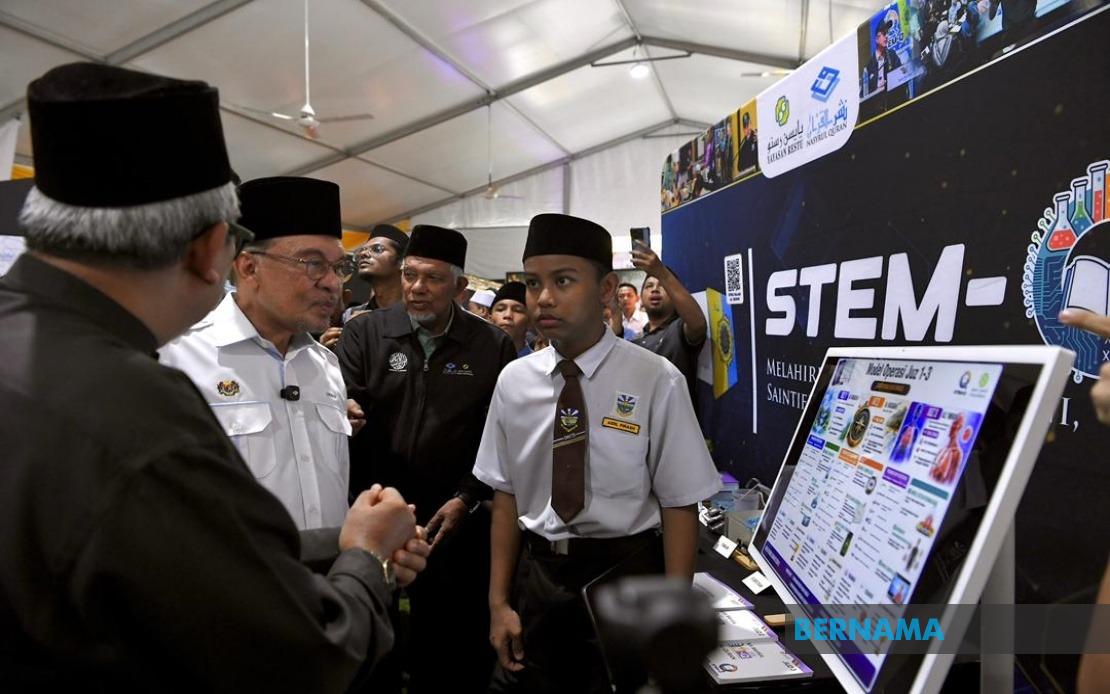
Prime Minister Datuk Seri Anwar Ibrahim has committed RM4.6 million in additional funding this year for infrastructure improvements at 27 Islamic educational institutions throughout Penang, signalling the government's deepening investment in religious education across the northern state. The substantial allocation represents a significant acceleration of support, nearly doubling the RM2.11 million that was channelled to 11 similar facilities in the preceding year, underscoring the administration's priorities in strengthening the institutional backbone of Islamic learning beyond urban centres.
Anwar, who concurrently holds the portfolio of Finance Minister, disclosed the funding arrangement while addressing attendees at the National Tadabbur Perdana and Maidah Wanita MADANI Permatang Pauh programmes held at Masjid Muhajirin in Butterworth. The expansion of the funding envelope reflects a deliberate policy shift to broaden the reach of government support for grassroots religious educational infrastructure, moving beyond the narrower focus of the previous financial year.
The RM4.6 million injection will address a diverse spectrum of infrastructure requirements at these institutions, encompassing structural upgrades such as the construction and reinforcement of perimeter walls and fences, renovation and modernisation of madrasah facilities, improvements to school buildings, construction of new kindergarten structures, and expansion of tahfiz academy capacity. This comprehensive approach suggests the government recognises that effective religious education requires not merely curriculum development but also physical environments conducive to learning and practise.
The acceleration in funding towards Islamic educational infrastructure in Penang reflects broader national ambitions to standardise facilities across different states and regions. By substantially increasing allocations year-on-year and expanding the number of beneficiary institutions, the government appears intent on ensuring that religious education remains a priority even as Malaysia navigates competing budgetary demands across health, infrastructure, and social services. For Penang specifically, the decision carries particular significance given the state's diverse religious and cultural landscape, where such investments carry implications for community cohesion and interfaith understanding.
Beyond the immediate infrastructure concerns, Anwar articulated a vision for Islamic education that extends into emerging technological domains. He stressed that educational institutions must not remain static in their pedagogical approaches but should embrace technological advancement, particularly artificial intelligence applications in Quranic and Islamic studies. This acknowledgment reflects a recognition that tomorrow's religious scholars and practitioners will operate in an environment saturated with digital tools and algorithmic systems.
However, Anwar's framing of artificial intelligence adoption carries an important caveat that resonates across Malaysia's pluralistic society. He emphasised that technological deployment cannot be morally neutral, insisting that artificial intelligence systems must be grounded in ethical principles and values-based frameworks rather than functioning as purely instrumental tools for knowledge transfer. This perspective suggests the government wishes to ensure that modernisation of Islamic education does not inadvertently strip away the moral and spiritual dimensions that characterise traditional religious learning.
The Prime Minister's comments on artificial intelligence in religious contexts carry broader implications for how Malaysia approaches the integration of technology across its education system. As artificial intelligence increasingly shapes information landscapes globally, ensuring that such systems operate within ethical and cultural guardrails becomes essential, particularly in religiously sensitive domains where misapplication could generate community tensions or distort religious understanding. The emphasis on values-embedded technology suggests a deliberate rejection of technological determinism.
Anwar further encouraged ordinary Malaysians to take fuller advantage of the freedoms available within the country's constitutional framework to organise and conduct religious programmes independently. He specifically highlighted the value of maintaining continuous engagement through Quran study circles, tadabbur sessions dedicated to deep reflection on Islamic teachings, and public religious discourses. This emphasis on grassroots religious programming complements the government's infrastructure investment by recognising that physical facilities must be activated through consistent, community-driven spiritual and educational activities.
The focus on continuous religious education programming reflects a broader recognition within government circles that institutional capacity—whether in the form of buildings, facilities, or technological systems—remains inert without robust engagement from practitioners and participants. By encouraging communities to leverage available freedoms to sustain religious programming, Anwar appears to be positioning religious education as a distributed responsibility shared between government, institutions, and civil society rather than a centralised, top-down enterprise.
For Malaysian stakeholders engaged in education policy, this allocation and accompanying rhetoric signal a government committed to positioning religious education not as peripheral to national development but as foundational to the nation's social fabric. The increased funding trajectory, combined with explicit guidance on technology integration and grassroots engagement, suggests a strategic vision where religious institutions become nodes within a broader ecosystem of learning and moral formation. This approach carries implications for how federal-state relations might evolve around religious affairs and education funding in coming years.

