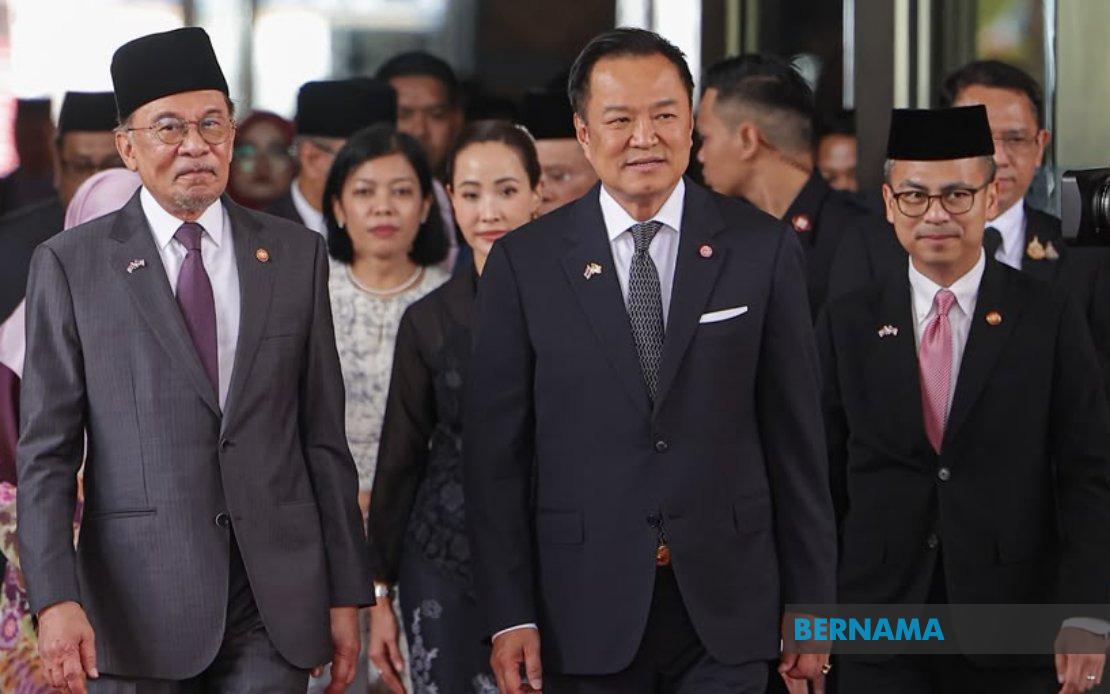
Prime Minister Datuk Seri Anwar Ibrahim and Thailand's Prime Minister Anutin Charnvirakul convened for high-level talks at the Perdana Putra Complex in Putrajaya on July 9, marking a diplomatic engagement aimed at deepening bilateral relations between Malaysia and Thailand. Anutin, travelling on a two-day official visit at Anwar's invitation, was formally received at the Bunga Raya Complex at Kuala Lumpur International Airport before the two leaders proceeded directly to the Prime Minister's office complex for their formal meeting.
The agenda encompassed a broad spectrum of shared interests reflecting the two nations' interlocking economies and security concerns. Trade and investment featured prominently, alongside discussions on border connectivity—a perennially significant issue given the two countries' substantial land frontier and the movement of goods, services, and people across shared checkpoints. Security cooperation, agriculture, tourism promotion, and educational exchange formed additional pillars of the conversation, underscoring the multifaceted nature of modern bilateral relations in Southeast Asia.
Beyond immediate bilateral concerns, both leaders were scheduled to address regional and international developments of mutual interest, particularly within the framework of ASEAN and related regional mechanisms. This emphasis on multilateral context reflects how Malaysia and Thailand, as mid-sized ASEAN powers, navigate their relationship against the backdrop of evolving geopolitical dynamics, ranging from China's regional influence to maritime security challenges in the South China Sea and broader Indo-Pacific considerations.
The Malaysian delegation reflected the whole-of-government approach to the engagement, bringing together key economic and security portfolios. Deputy Prime Minister and Minister of Energy Transition and Water Transformation Datuk Seri Fadillah Yusof participated alongside Foreign Minister Datuk Seri Mohamad Hasan, signalling the diplomatic importance of the visit. Transport Minister Anthony Loke and Minister of Agriculture and Food Security Datuk Seri Mohamad Sabu underscored sectoral cooperation, while Home Minister Datuk Seri Saifuddin Nasution Ismail's presence highlighted security and cross-border dimensions. Minister of Investment, Trade and Industry Datuk Seri Johari Abdul Ghani, Human Resources Minister Datuk Seri Ramanan Ramakrishnan, and Economy Minister Akmal Nasrullah Mohd Nasir rounded out a comprehensive cabinet representation.
Thailand's delegation matched this comprehensiveness, indicating Bangkok's commitment to substantive engagement. Thailand fielded Deputy Prime Minister and Minister of Foreign Affairs Sihasak Phuangketkeow; Deputy Prime Minister and Minister of Transport Phiphat Ratchakitprakarn; Deputy Prime Minister and Minister of Finance Ekniti Nitithanprapas; along with sectoral ministers covering tourism, defence, agriculture, and labour. This multi-layered Thai representation suggests both countries view the relationship as requiring coordinated action across multiple government agencies rather than a purely diplomatic exercise.
A tangible outcome of the bilateral meeting was the scheduled signing of a Memorandum of Understanding on agricultural cooperation, a development that carries significance for both economies. Malaysia's agricultural sector, facing labour shortages and evolving climate challenges, stands to benefit from enhanced collaboration with Thailand, a major regional agricultural producer. For Thailand, deepening agricultural ties with Malaysia offers opportunities for market access and knowledge exchange, particularly in value-added agricultural products and food processing technologies where Malaysian companies have developed expertise.
The agricultural MOU represents more than symbolic gesture; it addresses practical concerns affecting both nations. Cross-border agricultural trade, pest management coordination, and the movement of agricultural labour are issues that require formal frameworks and regular consultation mechanisms. Enhanced cooperation in these areas can help stabilise prices, improve food security across the region, and create more predictable trading conditions for farmers and agribusinesses on both sides of the border.
Border connectivity discussions hold particular weight given the strategic importance of the Malaysia-Thailand frontier. The two nations share multiple land crossings, with Bukit Kayu Hitam and Sungai Petani serving as major gateways for commerce. Enhancing the efficiency of these crossing points—through improved customs procedures, infrastructure upgrades, and digital systems integration—can significantly reduce transaction costs for traders and manufacturers operating supply chains across both countries. This matters enormously for regional manufacturing competitiveness, particularly in automotive, electronics, and textile sectors.
Security cooperation constitutes another critical dimension of the bilateral relationship, often discussed more quietly than trade matters but equally consequential. The two nations face shared challenges including transnational organised crime, human trafficking, drug trafficking, and maritime piracy in the Andaman Sea and the Strait of Malacca. Intelligence sharing, joint operations, and harmonised enforcement approaches require sustained high-level political commitment, which formal bilateral meetings such as this help reinforce and operationalise.
Tourism cooperation carries economic significance for both nations, particularly as Southeast Asian travel rebounds post-pandemic. Malaysian and Thai operators have complementary offerings—Thailand's established beach and cultural tourism infrastructure pairs well with Malaysia's increasingly sophisticated experiential and luxury tourism products. Joint promotion in key source markets, simplified visa arrangements, and coordinated hospitality standards can amplify visitor numbers and spending across the region, benefiting both economies.
The people-to-people exchange component reflects recognition that bilateral relations rest ultimately on cultural understanding and human connection. Student exchanges, cultural programmes, and civil society interactions build long-term goodwill and create networks that facilitate cooperation at all levels. For Malaysia's significant Thai expatriate community and Thailand's Malaysian residents, enhanced official recognition of these populations can translate into improved services, legal protections, and social integration.
Anwar's hosting of an official luncheon for Anutin and his delegation provides opportunity for informal engagement supplementing formal negotiations, allowing leaders to build personal rapport and explore issues outside structured agendas. Such interpersonal dynamics, while difficult to quantify, often prove decisive in bilateral relations, influencing the political will necessary to implement agreements and overcome obstacles to cooperation.
Looking forward, the visit establishes momentum for concrete follow-through on announced cooperation initiatives. Implementation committees and working groups typically establish timelines and accountability mechanisms, transforming political declarations into tangible outcomes. For Malaysia and Thailand, deepening economic integration while managing sensitive border issues requires sustained diplomatic attention and institutional coordination—precisely the kind of high-level engagement that bilateral prime ministerial visits activate and reinforce.

