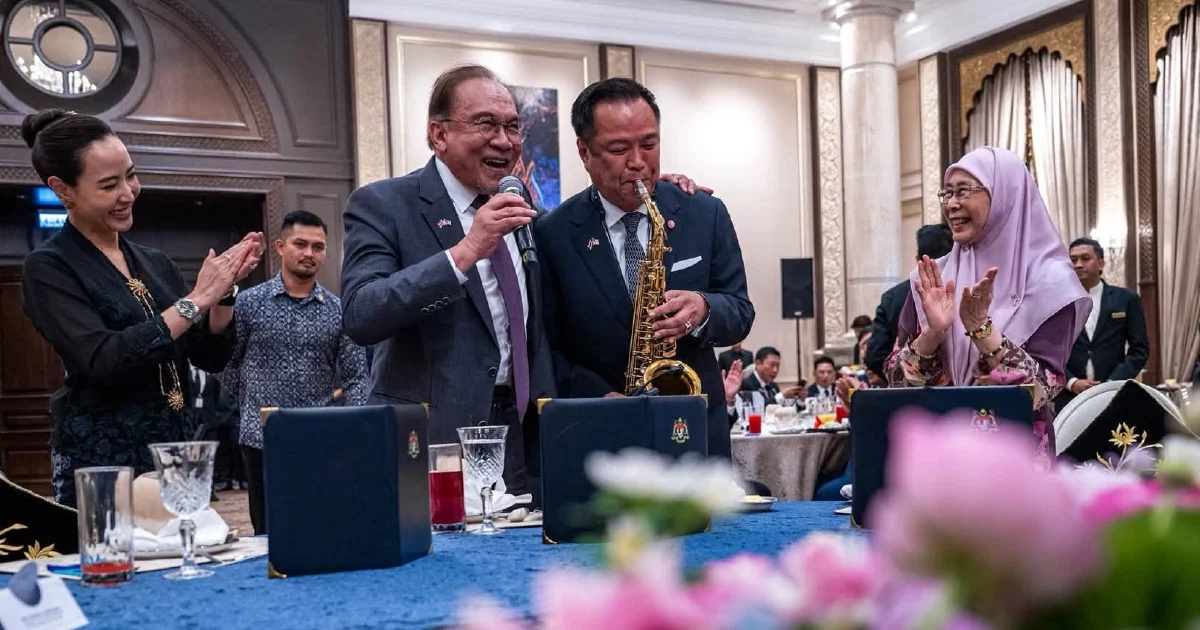
Prime Minister Datuk Seri Anwar Ibrahim and his Thai counterpart Anutin Charnvirakul put aside the formality of diplomatic protocol to share a musical moment at an official luncheon in Putrajaya, performing an unrehearsed duet of Frank Sinatra's classic 'My Way'. The spontaneous performance came after the two leaders concluded bilateral talks, offering a rare glimpse into the personal chemistry that exists between Malaysia's and Thailand's chief executives.
The impromptu entertainment underscores a significant shift in how contemporary Southeast Asian leaders approach diplomatic engagement. Rather than confining interactions to the conventional parameters of formal meetings and press conferences, both Anwar and Anutin demonstrated a willingness to inject moments of levity and shared cultural appreciation into high-level government functions. Such gestures, while ostensibly informal, serve an important function in building rapport and humanising the relationship between nations that share complicated historical ties and contemporary interdependencies.
Frank Sinatra's 'My Way' carries particular symbolic weight in diplomatic contexts. The song's themes of independence, resilience, and charting one's own course resonate across cultures and generations. For two Southeast Asian leaders to select this particular number suggests a shared understanding of national sovereignty and the desire to chart their own path through regional geopolitical challenges. The choice transcends mere entertainment, embedding itself within the broader narrative of how Malaysia and Thailand seek to navigate their respective roles in an increasingly multipolar Asia.
Anutin's decision to accompany the vocal performance with saxophone playing adds another dimension to the cultural exchange. The instrument's association with jazz—itself a music born from cross-cultural fusion and improvisation—mirrors the kind of collaborative diplomacy that contemporary Southeast Asian nations must embrace. Thailand's deputy prime minister-turned-prime minister has cultivated an image as a relatively unconventional political figure, and his willingness to participate in such moments suggests an approach to governance that values human connection alongside institutional protocol.
For Malaysia, the bilateral relationship with Thailand encompasses numerous complex issues ranging from trade and economic cooperation to cross-border security matters and regional strategic alignment. Moments like the luncheon performance contribute to the intangible but crucial element of trust and goodwill that lubricates diplomatic machinery. When leaders can share a laugh and a song, they create psychological space for more substantive negotiations on contentious issues, potentially making compromise and collaboration more achievable.
The incident also reflects broader trends in how Southeast Asian political communications have evolved in the age of social media and digital documentation. The notation that the performance was available to watch suggests that Malaysian and Thai authorities recognised the diplomatic value of sharing such moments with public audiences. Rather than keeping the interaction confined to official circles, making it viewable to citizens of both nations humanises the leadership and reinforces narratives of positive bilateral relations.
Thai-Malaysian relations have historically been characterised by cooperation interspersed with periodic tensions. The two nations share a maritime border, engage in substantial bilateral trade, and coordinate on numerous regional and international platforms. Thailand's role as a bridge between mainland Southeast Asia and the maritime world, combined with Malaysia's position as a key player in the ASEAN community and Indian Ocean region, makes their relationship strategically significant. When bilateral relations operate smoothly, as evidenced by such cordial official functions, the benefits extend beyond government circles to encompass business, tourism, and people-to-people exchanges.
The musical performance also arrives at a moment when Southeast Asia faces multiple overlapping challenges—from economic uncertainties and climate change to geopolitical tensions in adjacent regions. For regional leaders to present an image of camaraderie and shared purpose, however informal the setting, sends reassuring signals to their respective populations and international observers. The subtext communicates that despite inevitable differences and competing interests, there remains sufficient common ground and mutual respect for leaders to engage on a human level.
Anutin Charnvirakul, who has served in various ministerial capacities in Thailand and currently holds significant political influence, brings his own brand of pragmatic populism to Thai politics. His participation in the impromptu musical interlude aligns with his persona as a leader willing to transgress traditional diplomatic boundaries. Similarly, Anwar Ibrahim has consistently projected an image of inclusivity and openness throughout his political career, characteristics that presumably extended to his willingness to participate in the spontaneous performance.
The luncheon in Putrajaya served as the context for substantive bilateral discussions, but it is precisely these lighter moments that often shape how diplomatic relationships are remembered and characterised by both official and public spheres. The fact that officials released footage of the performance suggests intentional messaging about the warmth and mutual respect characterising the Malaysian-Thai engagement at this particular juncture.

