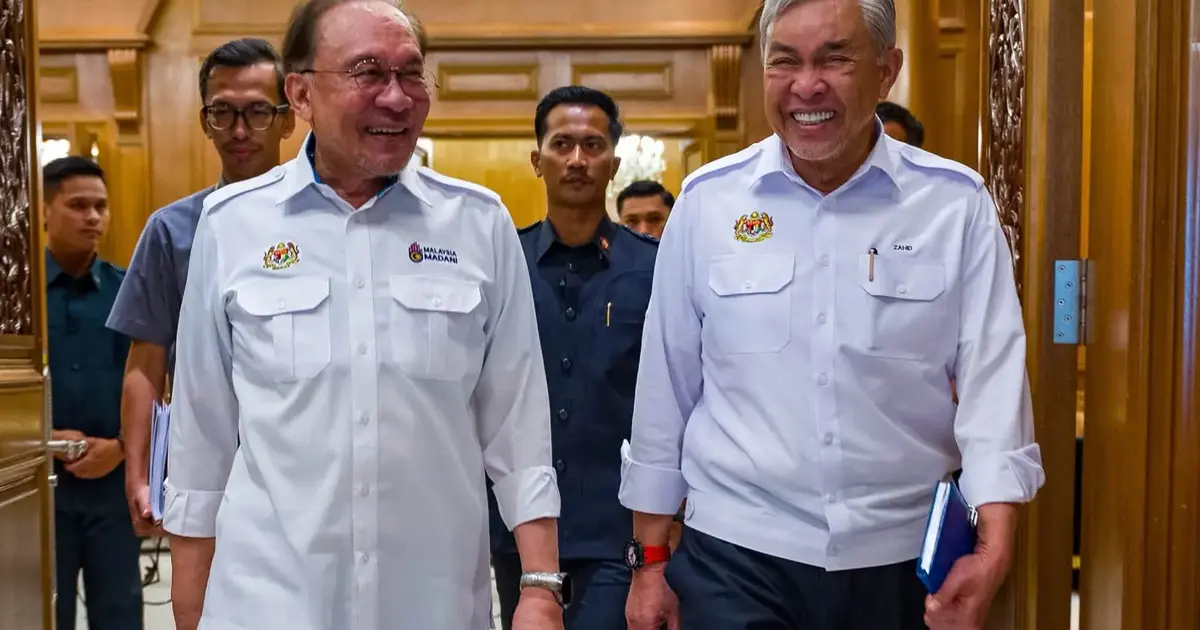
The apparent rupture between Prime Minister Anwar Ibrahim and Barisan Nasional chairman Ahmad Zahid Hamidi has been smoothed over following a confrontational exchange that threatened to expose cracks in Malaysia's governing coalition. The two leaders were seen together in a display of cordiality that sought to reassure both their parties and the broader political establishment that their partnership remains intact despite underlying disagreements over the distribution of ministerial posts.
The immediate trigger for the tension had surfaced a day earlier when Zahid publicly suggested that Anwar possessed the authority to dismiss the eight BN ministers currently serving in the cabinet, should he find their performance or presence objectionable. The statement, delivered with apparent sharpness, carried unmistakable undertones of frustration and was widely interpreted as a challenge to Anwar's leadership style within the coalition government. Such language, emanating from the head of the largest component party in the alliance, represented a significant signal of discontent with how portfolios and decision-making authority have been allocated since the formation of the administration.
The substance behind Zahid's remarks touches on longstanding tensions within Malaysia's coalition-based political system, where the balance of power and influence between senior partners must be carefully calibrated. BN, despite its reduced parliamentary representation following electoral setbacks in recent years, maintains substantial leverage within government formations, given its historical dominance and entrenched organisational structure. The presence of eight BN ministers in cabinet positions reflects this residual strength, yet the manner in which they operate within the broader executive structure has evidently become a point of friction between the coalition partners.
Anwar's position as prime minister, secured through a multiparty alliance that includes PH, BN, and various other groups, requires him to manage competing demands from multiple stakeholders while maintaining cabinet cohesion and governmental effectiveness. The allocation of ministerial roles, their scope, and the degree of autonomy granted to individual office-holders inevitably become focal points for inter-party negotiation and occasionally conflict. When senior figures like Zahid feel that their party's interests are not being adequately represented or when ministers face perceived constraints on their authority, grievances can quickly surface in public statements that risk destabilising the coalition.
The timing of Zahid's comments, delivered with what appeared to be deliberate provocation, suggested that BN frustrations had been accumulating. Whether the dissatisfaction stemmed from specific ministerial decisions, perceived marginalisation in key policy areas, or broader concerns about the distribution of power within government remained partly opaque. However, the willingness to air such tensions publicly rather than resolving them through private coalition mechanisms indicated that the issue had reached a threshold where BN felt compelled to register its discontent visibly.
Anwar's response strategy involved moving quickly to restore the appearance of unity, recognising that prolonged conflict between coalition partners could undermine governmental stability and invite criticism from opposition groups eager to exploit any signs of internal fracture. By appearing alongside Zahid in a composed, cordial manner, the prime minister signalled that the episode represented a momentary disagreement rather than a fundamental breakdown in the alliance. Such visual diplomacy serves an important function in Malaysian politics, where optics matter considerably to both party loyalists and the broader electorate in judging whether governments possess the cohesion necessary to function effectively.
The smiling reconciliation also carried messages directed at each party's internal structures and supporters. For BN, Zahid's willingness to engage Anwar directly and the subsequent display of unity suggested that the party retained sufficient leverage to press its concerns at the highest levels of government. For PH and allied partners, it reassured them that the administration maintained control of coalition dynamics and would not be held hostage by ultimatums from BN. Both interpretations were necessary for the coalition to function smoothly and for each partner to maintain credibility with their respective bases.
The incident illuminates the inherent fragility of Malaysia's coalition governments, which depend on sustained negotiation and compromise among parties with sometimes divergent interests. Unlike single-party governments, where internal disagreements can often be resolved through party mechanisms, coalition administrations must manage disputes that carry both organisational and political dimensions. When a party chairman questions whether the prime minister should retain certain ministers, he effectively challenges the PM's prerogatives while simultaneously asserting his party's right to influence cabinet composition and operations.
Looking forward, this episode likely represents just one in an ongoing series of negotiations between Anwar and Zahid over the terms under which BN participates in government. The underlying issues—questions of ministerial authority, policy influence, and resource allocation—remain unresolved. The smile-filled public appearance suggested a temporary de-escalation rather than a comprehensive settlement, indicating that future disagreements are probable unless the coalition establishes clearer protocols for managing intra-alliance disputes and defining each party's sphere of influence within the executive branch.
For observers monitoring Malaysia's political stability, the incident served as a reminder that despite the apparent durability of the current government, significant work continues behind the scenes to maintain the coalition's functionality. The willingness of both Anwar and Zahid to project unity publicly, despite evident tensions, demonstrates the commitment both leaders maintain to preserving the current political arrangement. However, the frequency and intensity of such disputes could gradually erode the coalition's resilience if deeper structural issues around power-sharing and decision-making authority remain unaddressed.

