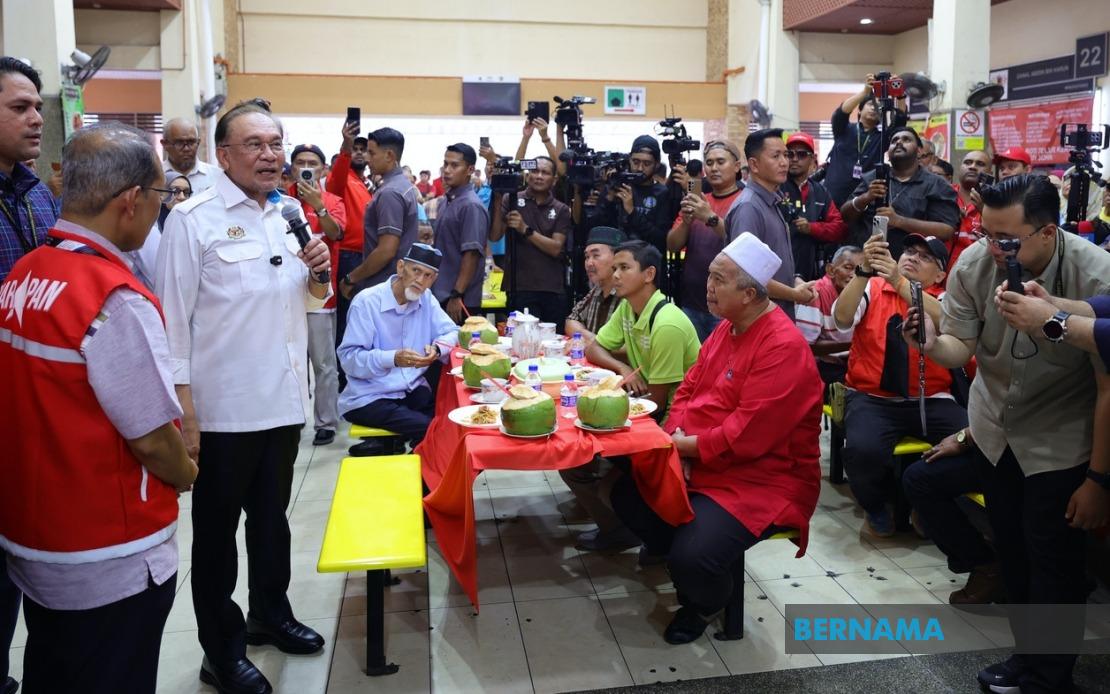
Prime Minister Datuk Seri Anwar Ibrahim used a campaign visit to Seremban to make a direct appeal to Negeri Sembilan voters: extend their confidence in Pakatan Harapan ahead of the state election. Speaking as both PH chairman and the nation's chief executive, Anwar framed the upcoming polls not merely as a choice between political parties, but as a referendum on whether the state should maintain the collaborative governance structure that has defined its administration since the coalition assumed power.
The timing of Anwar's intervention underscores how critically the federal leadership views the Negeri Sembilan contest. While state elections are conventionally the domain of local party machinery, the Prime Minister's personal presence signals that Kuala Lumpur perceives the race as consequential to the broader political alignment that has underpinned the stability Malaysia has enjoyed since the 2022 general election. His emphasis on synchronisation between state and federal governments reflects a pragmatic governing philosophy: development schemes and social programmes execute more smoothly when partisan alignment reduces friction across administrative layers.
Central to Anwar's messaging was the track record of Menteri Besar Datuk Seri Aminuddin Harun, the incumbent PH leader whom Anwar credited with stewarding Negeri Sembilan through a three-year tenure marked by relative political equilibrium. This focus on performance rather than rhetoric represents a subtle but significant rhetorical shift in Malaysian political discourse. Rather than appealing to tribal loyalties or ideological abstraction, the Prime Minister anchored his case in tangible administrative outcomes—a strategy that suggests confidence in the current government's ability to point to concrete achievements.
Yet Anwar's remarks also contained an implicit acknowledgement of vulnerability. His statement that state governance was "not perfect" and his invitation for voters to provide feedback signals awareness that PH cannot claim unanimous satisfaction across Negeri Sembilan's electorate. This candour serves a strategic purpose: by conceding imperfection whilst requesting continued support, Anwar attempts to preempt accusations of arrogance whilst positioning PH as responsive to public concern. The formula—"give us your feedback, and our candidates will make improvements"—invites voters into a collaborative narrative rather than demanding blind loyalty.
The composition of PH's candidate slate reflects careful coalition management. By fielding 16 PKR candidates, 11 from DAP, and nine from Amanah across all 36 state seats, the coalition has attempted to balance internal party interests whilst maintaining geographic and demographic representativeness. This distribution matters beyond mere seat allocation; it signals to each component party that their organisational capacity and electoral viability are recognised, reducing the internal grievances that might otherwise motivate sabotage or half-hearted campaigning.
The Election Commission's scheduling—with polling day set for August 1 and early voting on July 28—establishes a compressed campaign window that favours incumbents with established machinery over challengers requiring rapid mobilisation. For PH, this timeline offers an advantage, though it also concentrates the attention span of voters and media. The early voting provision, meanwhile, reflects Malaysia's evolving approach to electoral accessibility, permitting those engaged in essential services or unable to vote on the main day to participate earlier.
From a Malaysian political economy perspective, the Negeri Sembilan election functions as a barometer of post-2022 stability. The state, positioned geographically between Kuala Lumpur and the Klang Valley, occupies a significant if often overlooked role in national infrastructure and investment patterns. Its governance complexion influences investor confidence and federal resource allocation. A comfortable PH victory would reinforce the impression that the 2022 coalition arrangement has acquired legitimacy and durability. Conversely, significant losses or a hung assembly would resurrect speculation about political fragility and embolden opposition forces across other states preparing for their own electoral tests.
Anwar's campaign intervention also reflects the heightened importance Malaysia's federal leadership attaches to state-level performance. Unlike systems where central governments view sub-national contests as peripheral, the Malaysian federation increasingly demonstrates interdependence between layers of governance. The federal government's ability to execute national development blueprints depends partly on cooperative state administrations. This reality explains why a Prime Minister would personally invest time in what might superficially appear a parochial state election.
The opposition's positioning remains significant context. While the original source material does not detail opposition party messaging, the PH campaign strategy—emphasising stability, development, and administrative competence—implicitly targets voters concerned about chaos or frequent political upheaval. This framing suggests opposition challengers are perceived as representing instability or untested governance, a perception PH seeks to exploit through its incumbent status and Anwar's personal appeal.
For Southeast Asian observers and investors monitoring Malaysian political trajectories, the Negeri Sembilan election offers insight into whether PH's 2022 coalition survival reflects genuine public endorsement or merely temporary exhaustion with alternatives. A strong PH showing would suggest the coalition has moved beyond the provisional arrangement of the immediate post-2022 period toward consolidated electoral positioning. This evolution matters not only for Malaysian domestic politics but for regional calculations regarding which political forces are likely to shape policy across the coming years.
Anwar's statement that voters should "keep our politics stable, remain united with a common purpose" articulates a vision of governance premised on predictability and purposefulness. Whether this appeal sufficiently motivates Negeri Sembilan voters to return PH with enhanced numbers remains to be determined, but the emphasis itself reveals a federal leadership anxious to consolidate political ground before potentially more challenging electoral contests loom elsewhere.

