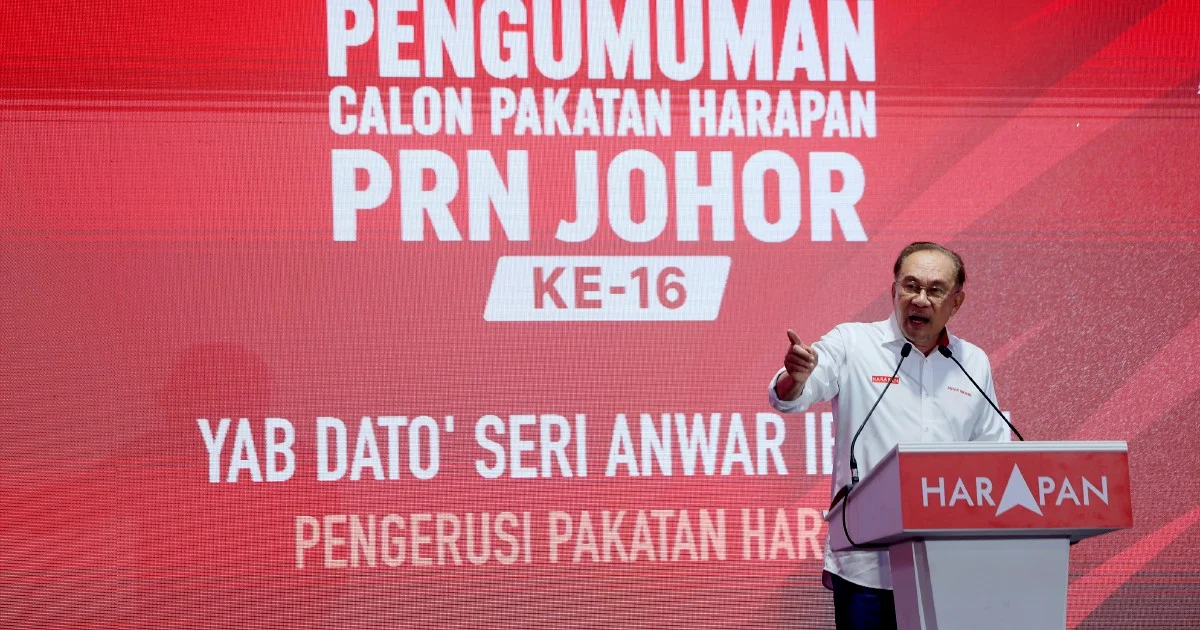
Prime Minister Datuk Seri Anwar Ibrahim has instructed Johor's state leadership to critically examine historical grievances regarding federal revenue distributions to the state, specifically targeting the track records of the Barisan Nasional and Perikatan Nasional administrations that preceded the current federal government. Speaking in Tangkak, Anwar emphasised the importance of holding previous administrations accountable for their fiscal arrangements with the state, signalling a shift towards greater transparency in federal-state financial relations.
The statement represents a notable moment in the ongoing political realignment within Malaysia's federal system, where questions about resource allocation have become increasingly central to state-level governance debates. Johor, as one of the nation's most economically significant states, has historically negotiated its share of federal revenue with varying degrees of success depending on the political alignment between state and federal governments. The implication of Anwar's remarks is that certain revenue distributions to Johor may have been inequitable or disadvantageous under previous administrations, a claim that carries substantial political weight given Johor's economic importance and its electoral significance.
The historical context of federal-state revenue sharing in Malaysia is complex and multifaceted. The system involves various mechanisms including the allocation of duties and taxes collected by the federal government, grants for specific purposes, and development funding. Different states have lobbied intensively for greater shares, with the outcomes often reflecting political considerations and negotiating power rather than purely technical formulae. Johor, with its significant petroleum resources and manufacturing base, has particular leverage in these negotiations, yet may have faced reduced bargaining power during periods when its state government and the federal administration were politically opposed.
Under the Barisan Nasional's long rule prior to 2018, Johor maintained political alignment with the federal government, which theoretically could have positioned it favourably in revenue negotiations. However, the state's actual allocation outcomes relative to its economic contribution remain subjects of dispute and analysis. The subsequent Perikatan Nasional government, formed in 2020, introduced further complications to this landscape. When Johor switched political allegiance at both state and federal levels in 2022 through electoral and defection dynamics, the revenue arrangement question took on new urgency as the state government sought to assess whether it had been adequately compensated under the previous federal administration.
Anwar's direction to state executive councillors suggests that the current federal administration wishes to establish a public record of any grievances regarding historical underfunding, potentially justifying future corrective measures or framing past decisions as errors requiring rectification. This approach serves multiple political purposes simultaneously: it can strengthen the federal government's relationship with Johor's leadership by appearing sympathetic to the state's interests, it positions the current administration as more attentive to state concerns than its predecessors, and it creates political cover for any subsequent decisions about revenue reallocation or special funding programmes directed towards Johor.
For Malaysian observers and analysts tracking federal-state dynamics, this intervention highlights the degree to which fiscal federalism remains intertwined with electoral politics. States that maintain political alignment with the federal government often enjoy advantages in negotiating resource allocation, while those in opposition face greater difficulties in securing funding for development projects or obtaining favourable revenue-sharing terms. The competitive nature of Malaysia's federal system means that such arrangements are constantly subject to renegotiation as political configurations shift.
The implications for other states are also significant. If Johor successfully uses examination of historical revenue claims to secure enhanced allocations under the current federal administration, other states may feel compelled to conduct similar reviews of their own revenue histories. This could precipitate a broader reckoning with the equity of federal resource distribution across Malaysia, potentially leading to demands for systematic reforms to revenue-sharing mechanisms. States governed by political parties aligned with the federal government might press their claims with renewed vigour, while opposition-governed states may face greater difficulty in articulating comparable grievances.
Anwar's emphasis on holding previous administrations accountable reflects broader themes in contemporary Malaysian politics regarding governance transparency and rectification of perceived past injustices. Since 2018, successive administrations have frequently characterised themselves as correcting errors or addressing misconduct of predecessors, though the political motivations underlying such narratives remain subject to legitimate scrutiny. The specific focus on revenue allocation to Johor provides a concrete, measurable dimension to these broader accountability claims, as revenue distributions can theoretically be compared against formulae or precedents.
The Johor state executive council, upon receiving Anwar's directive, will face the practical challenge of determining exactly what constitutes adequate revenue allocation and establishing measurable baselines for comparison. This requires technical expertise in fiscal analysis and political judgement about which claims to emphasise and which to downplay. The exercise may reveal genuine disparities in funding relative to demographic and economic factors, or it may demonstrate that Johor's allocation was broadly proportionate to standard formulae, depending on what comparative frameworks the state government ultimately applies.
Moving forward, this issue will likely feature prominently in Johor's governance agenda and in broader federal-state negotiations over the coming budget cycles. The state government has been given implicit permission to press revenue claims with greater force, potentially backed by federal support should politically expedient to provide additional resources. This establishes a precedent for state-level scrutiny of federal resource distribution and may catalyse similar investigations in other state legislatures, particularly those governed by parties in coalition with the federal government.

