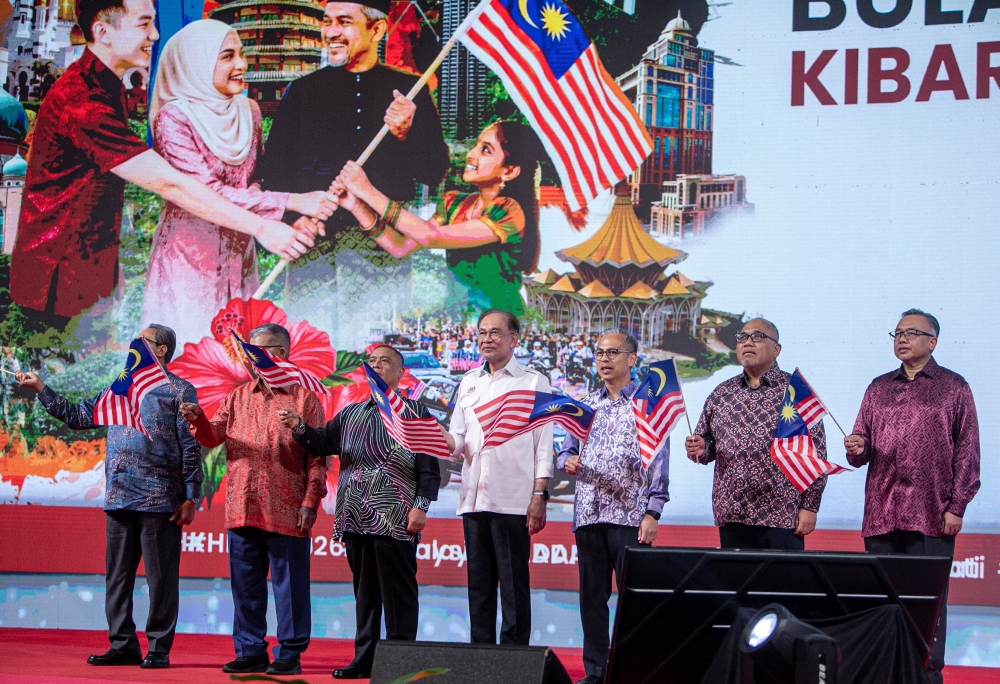
Prime Minister Datuk Seri Anwar Ibrahim has issued an earnest appeal to Malaysia's youth to retain a living memory of the independence movement and the decades-long struggle that preceded the nation's emergence as a sovereign state in 1957. Speaking in Ipoh on July 19, Anwar emphasized that the contemporary generation must not allow historical consciousness to fade as earlier witnesses to that transformative era pass away, warning that indifference to the past threatens to undermine the foundations upon which modern Malaysia stands.
The Prime Minister's remarks reflect growing concern among senior political figures that younger Malaysians, particularly those born decades after independence, risk losing touch with the hardships and sacrifices that defined the liberation movement. This generational disconnect carries implications beyond mere historical nostalgia—understanding the complexity of Malaysia's path to independence provides crucial context for grappling with contemporary challenges of national cohesion, institutional development, and democratic governance. Anwar's intervention suggests that the government views civic education and historical awareness as essential components of nation-building in a rapidly modernizing society.
The struggle for Malaysian independence involved diverse communities—Malays, Chinese, Indians, and other groups—negotiating complex constitutional arrangements and political structures during the final years of British colonial rule. The process was neither simple nor inevitable. It required negotiation, compromise, and the forging of cross-communal consensus at moments when divisive forces threatened to fragment the independence movement itself. The Merdeka Constitution, finalized in 1957, represented a delicate balance between competing interests and visions for the new nation. Contemporary Malaysians benefit from that hard-won settlement even as they debate how to evolve and improve upon inherited institutions.
Anwar's emphasis on remembrance carries particular weight given Malaysia's experience of communal tensions and the periodic resurfacing of historical grievances in political discourse. By grounding national identity in shared memory of collective struggle against external domination, political leaders seek to reinforce the idea that Malaysians—regardless of ethnicity or religion—share a common stake in the nation's success and stability. This framing attempts to transcend parochial identifications and appeal to a broader sense of belonging to a Malaysian political community. The historical narrative becomes a unifying resource rather than a source of division.
Young Malaysians today encounter a vastly different world from that of their grandparents. They are digital natives operating within globalized economic networks, pursuing education and careers across borders, and engaging with transnational social movements and causes. Their sense of historical time may be compressed or fragmented, shaped more by social media currents than by sequential narrative. Against this backdrop, deliberate efforts to connect younger citizens to national history require careful pedagogical thought. Simply invoking sacrifice and struggle risks alienating audiences who perceive such appeals as disconnected from their lived experiences and contemporary concerns.
The institutional mechanisms through which historical memory is transmitted—school curricula, public commemorations, family narratives, media representation—all require ongoing renewal and adaptation. Malaysia's education system includes history components, but debates persist about how independence narratives are framed, whose perspectives are centered, and how colonial-era events are contextualized for students encountering them in the twenty-first century. Anwar's call implicitly acknowledges that passive inheritance of historical knowledge is insufficient; active engagement and meaningful transmission are required to prevent knowledge erosion across generations.
Regional context further illuminates why Malaysian political leaders emphasize historical consciousness. Southeast Asia's post-colonial nations continue navigating questions about sovereignty, cultural identity, and democratic development. Malaysia's relatively stable trajectory over six decades provides valuable lessons, though not without complications. The independence generation's ability to forge constitutional consensus despite deep differences stands as a model worth understanding, particularly for younger Malaysians contemplating how their nation might address contemporary governance challenges and social fragmentation. Historical perspective offers resources for imagining future possibilities.
Anwar's remarks also reflect his own positioning within Malaysian politics. As a figure who has been imprisoned, exiled, and rehabilitated within Malaysia's political system, he embodies a particular narrative of struggle and perseverance. His appeals to historical memory invoke not only pre-independence liberation but also more recent episodes of political contestation and reform within independent Malaysia. By connecting contemporary generations to the independence struggle, he implicitly situates ongoing political debates about democracy, accountability, and justice within a longer historical arc.
The timing of such appeals carries significance as Malaysia approaches its seventh decade of independence. The passage of time means that living witnesses to the independence era are aging, making their testimonies and knowledge increasingly precious. Oral histories, archival research, and deliberate preservation efforts become urgent. Universities, think tanks, and cultural institutions have roles to play in ensuring that the independence generation's experiences and insights are documented and made accessible to younger researchers and citizens. This archival and educational work sustains historical memory when familial transmission alone proves insufficient.
For Malaysian youth specifically, Anwar's exhortation represents an invitation to view themselves as heirs to a particular political project and as stewards responsible for its continuation and refinement. This framing acknowledges that younger citizens are not merely passive recipients of history but active participants in shaping how national narratives are interpreted and how founding principles are applied to contemporary circumstances. Understanding independence history becomes a foundation for informed participation in ongoing debates about Malaysia's direction and future development.
The broader implication of Anwar's intervention is that in an era of rapid social change, technological disruption, and shifting global alignments, deliberate cultivation of historical consciousness represents a form of political investment. Nations risk losing coherence and direction when citizens lack shared historical anchors or common understanding of foundational experiences. By urging Malaysian youth not to forget, Anwar advocates for a form of patriotic pedagogy grounded in genuine engagement with the past rather than mere ceremonial remembrance, challenging younger generations to derive meaning and lessons from independence history that illuminate present challenges and future possibilities.

