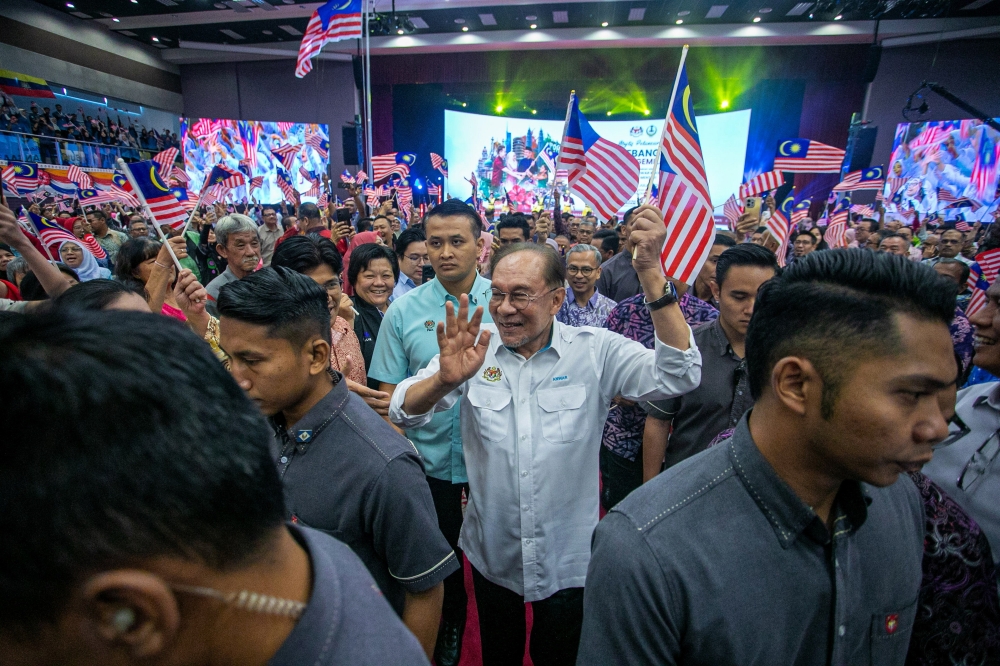
Prime Minister Datuk Seri Anwar Ibrahim has issued a carefully calibrated warning to individuals occupying positions within Malaysia's government apparatus, signalling that while political participation remains a fundamental right, such activities must remain tethered to the boundaries established by law and constitutional propriety. The message, delivered during remarks in Ipoh on July 19, underscores the administration's determination to balance democratic engagement with institutional integrity—a delicate equilibrium that becomes increasingly critical as Malaysia navigates periods of heightened political mobilisation.
Anwar's pronouncement reflects an understanding deeply rooted in Malaysian constitutional practice: elected officials and appointed government personnel occupy positions of public trust that distinguish them from ordinary citizens. The leverage inherent in holding state power creates opportunities for misuse that democratic systems must actively guard against. By explicitly articulating these boundaries rather than allowing ambiguity to persist, the Prime Minister has sought to establish clear expectations without resorting to heavy-handed restriction of legitimate political expression.
The timing of this guidance proves particularly significant given Malaysia's current political landscape. The country has experienced multiple episodes of electoral competition and institutional tension over recent years, with campaigns occasionally straying into territory that complicated governance and public administration. References to government resources being deployed for partisan advantage, while not uncommon in Malaysian political discourse, represent precisely the kind of conduct that erodes public confidence in institutions and diverts official machinery from its primary mission of serving all citizens regardless of political affiliation.
Anwar's position reflects international best practice observed across mature democracies, where strict separation between government operations and party political machinery remains non-negotiable. Civil servants in particular occupy a special category—they are expected to maintain neutrality regardless of personal political sympathies, ensuring that administrative capacity serves the state rather than partisan interests. Government ministers and leaders occupy a more complex position, as they necessarily combine policy implementation with party representation, yet even this group faces constraints that ordinary party members do not.
The practical implications of maintaining these boundaries extend across numerous dimensions of governance. Government vehicles should not become campaign transport; official budgets should not subsidise partisan messaging; and the state apparatus should not channel citizens' cooperation through party structures. These may appear technical matters, yet they form the infrastructure that prevents democratic systems from deteriorating into patronage networks where access to services depends on political alignment.
Malaysia's experience with breaches of these principles has proven instructive. Past instances where government resources appeared deployed for party advantage generated public criticism and undermined confidence in administrative impartiality. By preemptively establishing clear parameters, Anwar has attempted to forestall such recurrence and to position his administration as one that takes institutional integrity seriously. This positioning carries electoral significance—voters increasingly reward governments perceived as reasonably competent and relatively uncorrupted, while punishing those associated with systematic institutional abuse.
The challenge for government officials receiving this guidance lies in the interpretive space between what is clearly permissible and what crosses into impropriety. A minister attending a party event in their capacity as a member can reasonably be expected; that same minister using their official position to pressure subordinates to attend represents a different proposition entirely. Drawing these distinctions in real-time, with political career considerations and party expectations creating pressure in the opposite direction, requires institutional commitment and personal integrity.
Anwar's message also carries implicit recognition that Malaysia operates within a competitive political environment where multiple coalitions vie for power. Neither Barisan Nasional, Pakatan Harapan, nor other significant political formations can assume permanent governance. This reality makes protection of institutional neutrality a matter of enlightened self-interest—the rules one establishes today may be applied against one's own interests tomorrow. By insisting on proper conduct now, Anwar has invested in norms that, once established, benefit whichever coalition holds power.
The broader Southeast Asian context provides additional perspective. Democratic backsliding in the region has frequently involved the gradual erosion of institutional boundaries separating governance from partisanship. Countries that have witnessed significant democratic deterioration often trace the process to precisely this kind of boundary-crossing—initially presented as necessary or exceptional, eventually normalised as standard practice. Anwar's insistence on maintaining these lines represents a conscious choice to resist this trajectory.
For Malaysian civil society and independent observers, the true test of this guidance will lie not in its articulation but in its implementation. Whether government officials demonstrating campaign enthusiasm receive gentle reminders when they transgress, or whether such instances are overlooked entirely, will determine whether Anwar's words represent genuine institutional commitment or merely rhetorical positioning. The consistency with which these standards are applied across different levels of government and different political factions will similarly prove determinative.
Moving forward, this emphasis on campaign conduct within proper boundaries establishes a framework against which the government's own performance can be evaluated. Ministers and officials facing pressure to stretch these limits can now reference the Prime Minister's explicit guidance; simultaneously, citizens and oversight bodies have been equipped with clearer criteria for identifying and criticising any deviations. In this sense, Anwar's pronouncement functions not merely as internal guidance but as a public commitment that invites scrutiny.

