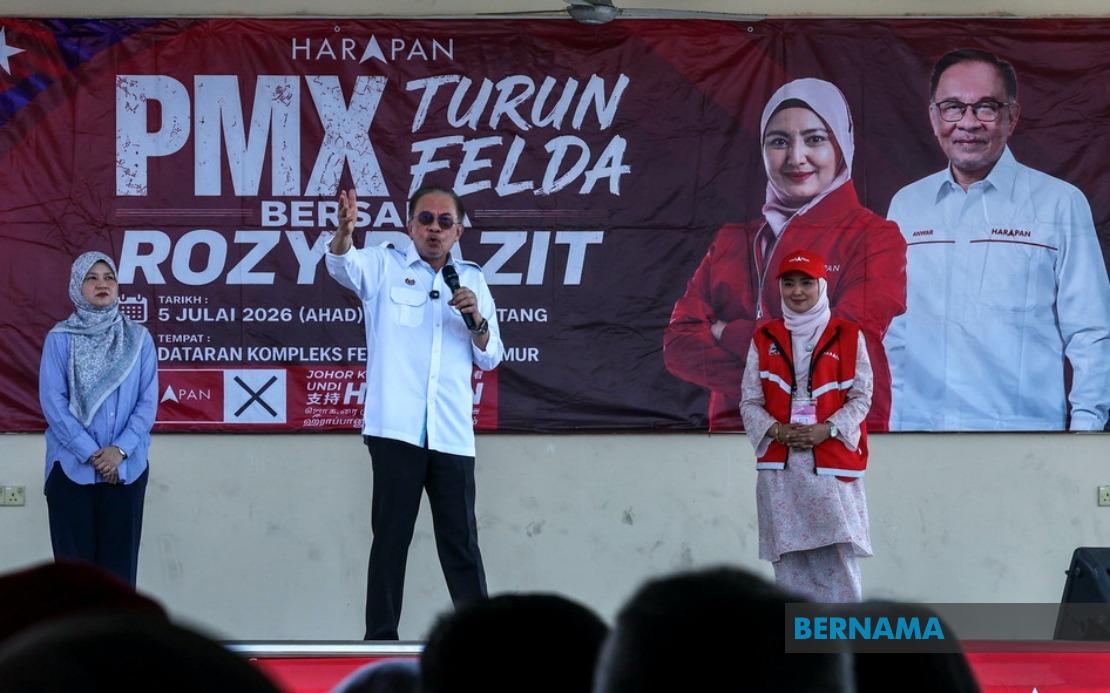
Prime Minister Datuk Seri Anwar Ibrahim has renewed his government's commitment to resolving a decades-old housing shortage that has affected the children and grandchildren of FELDA settlers across the country. Speaking at a public gathering in Segamat today, Anwar stressed that finding permanent housing solutions for this marginalised community represents a priority for his administration, one that he personally intends to see through before his tenure ends.
The FELDA Second-generation housing problem represents one of Malaysia's most persistent rural development challenges. Since the Federal Land Development Authority began settling families on agricultural schemes in the 1950s, the original settlers—many now elderly—have secured land and shelter through the programme. However, their descendants, who comprise a substantial population across FELDA schemes nationwide, have been largely excluded from similar benefits. This structural gap has created generations without secure land tenure or housing guarantees, leaving families vulnerable to displacement and economic instability.
At the Dataran Putra Felda Palong Timur event in the Buloh Kasap constituency, Anwar articulated the government's policy direction clearly: creating protective measures and guarantees that would secure housing allocations for this second generation. He acknowledged that while the political will exists at federal level, the pathway to implementation is complicated by Malaysia's constitutional framework. Land administration and infrastructure development fall squarely within state jurisdiction, meaning Kuala Lumpur cannot unilaterally impose solutions regardless of funding or policy intent.
This federalism constraint explains why Anwar has emphasised the necessity of coordinating with state governments, particularly those administered by his own coalition partners. The complexity intensifies when considering that FELDA schemes operate across multiple states with differing governance capacities, budgetary priorities, and political landscapes. A one-size-fits-all approach would inevitably encounter resistance from administrations focused on competing developmental agendas.
The Prime Minister indicated that his office is working closely with the relevant minister overseeing FELDA affairs to operationalise these commitments. This suggests a structured approach involving inter-agency coordination and likely cabinet-level oversight—signalling that the issue has finally been elevated to the highest echelons of decision-making. The participation of senior government figures at today's event, including Selangor Menteri Besar Amirudin Shari and Education Minister Fadhlina Sidek, underscores the cross-portfolio nature of the problem and the need for integrated solutions spanning housing, land, and infrastructure.
For FELDA communities, this represents both hope and cautious optimism. Previous administrations have made similar pledges without translating them into concrete outcomes. The second generation, now spanning middle-aged adults with families of their own, has waited for decades while their parents' generation gradually retired from agricultural work. Many have migrated to urban centres seeking employment, effectively abandoning FELDA schemes where no economic opportunity or housing security awaits them. This rural-to-urban drain has weakened FELDA's viability as a development model while creating social fragmentation within settled communities.
The issue carries profound implications beyond individual hardship. FELDA settlements represent significant land holdings under federal authority—roughly 729,000 hectares across 112 schemes. Without successful mechanisms to transmit these benefits to subsequent generations, the entire model faces obsolescence. Young people see no inheritance prospects and therefore no incentive to remain engaged with agricultural livelihoods or maintain community cohesion. Rural depopulation intensifies, leaving FELDA schemes economically stagnant and demographically skewed towards pensioners.
From a broader policy perspective, resolving the second-generation housing challenge could provide a template for addressing similar intergenerational equity issues across other federal development schemes. If Anwar's government can demonstrate success here, the model might be adapted for other rural constituencies facing comparable land tenure and succession problems. Conversely, failure would perpetuate a pattern of unfulfilled commitments that has eroded public confidence in government pledges regarding rural development.
State cooperation remains the critical unknown variable. Menteri Besar Amirudin's presence suggests Selangor is prepared to engage constructively, but other states housing FELDA schemes may not prioritise this agenda when facing competing budget demands. The federal government would need to consider incentive structures—possibly enhanced development funding—to motivate state participation. Without such inducements, rhetoric about resolving the issue may once again dissipate into bureaucratic processes that stretch across years without tangible outcomes.
Anwar's explicit statement that he wants these decades-old grievances settled during his premiership adds temporal pressure to the commitment. This timebound pledge distinguishes his pronouncement from earlier vague assurances, though sceptics might note that Malaysian politicians have previously made similar personal commitments that ultimately succumbed to institutional inertia. The second generation of FELDA settlers, having endured prolonged neglect, will be watching closely for concrete policy announcements and implementation timelines in coming months.

