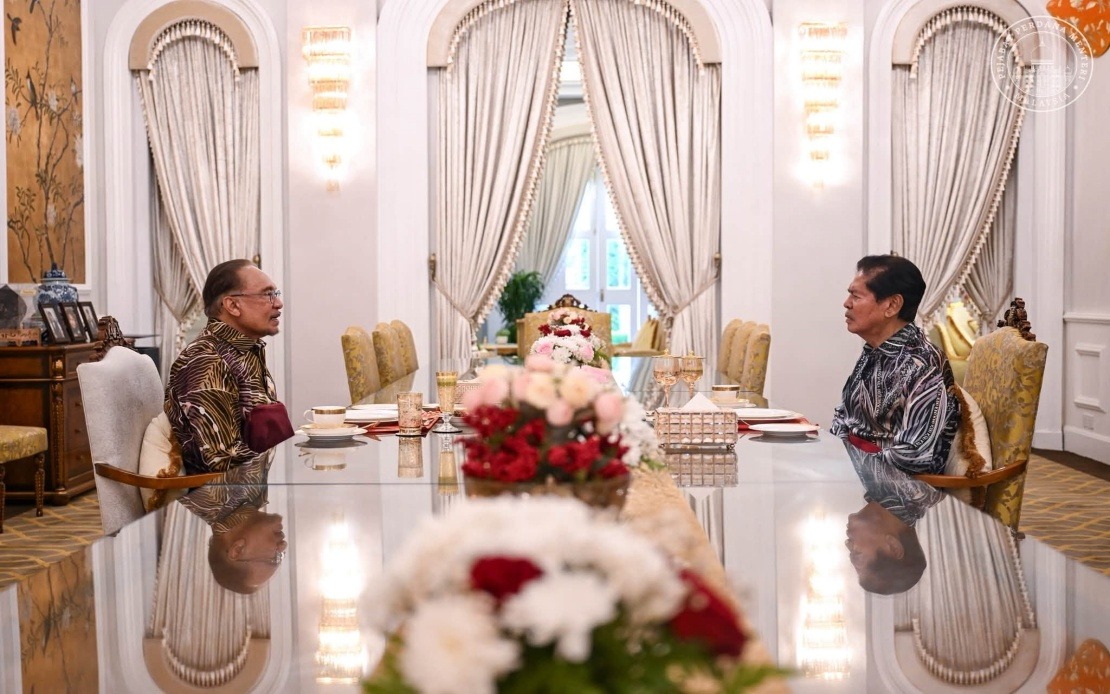
Prime Minister Datuk Seri Anwar Ibrahim brought his intensive two-day working visit to Penang to a close on August 29 with an afternoon tea reception at the official residence of Governor Tun Ramli Ngah Talib, Seri Mutiara. The engagement served as a capstone to a particularly demanding schedule that underscored the significance Putrajaya continues to place on the state's development agenda and regional standing within the federation's economic framework.
In a social media announcement, Anwar characterised the reception as a further manifestation of the deepening working relationship between federal and state administrations. He emphasised that the encounter had reinforced their mutual dedication to advancing Penang's prosperity and ensuring the wellbeing of its residents—a statement that reflects ongoing efforts to maintain harmony between Kuala Lumpur and state capitals as Malaysia navigates competing developmental priorities across its thirteen states and federal territories.
Governor Ramli responded to the Prime Minister's visit with appreciative remarks, viewing the occasion as a valuable platform for discussion on matters of joint concern affecting both Penang and the broader Malaysian landscape. Such high-level exchanges between federal leaders and state representatives serve as critical moments for addressing governance challenges, resource allocation, and policy coordination that characterise Malaysia's constitutional federal system.
Ramli's public comments revealed a more personal dimension to the formal interaction, with the Governor noting that his grandson, Aldrey Alfi, had been present during the reception and had engaged the Prime Minister with questions. The younger generation's participation in such diplomatic moments, while often seen as informal touches, carries subtle symbolic weight in Malaysian political culture, where intergenerational connection and accessibility are valued rhetorical elements in public leadership.
The Governor expressed genuine gratitude for Anwar's willingness to visit Seri Mutiara as part of his departure from the state, emphasising the value placed on such personal gestures in cementing relationships between senior government officials. In Malaysia's political ecosystem, where personal rapport between leaders substantially influences policy outcomes and resource flows to states, such courtesy calls carry pragmatic as well as symbolic significance.
Anwar's visit to Penang had encompassed far more than the concluding reception, reflecting the administration's commitment to direct engagement with economic and social development initiatives at the grassroots level. The Prime Minister's itinerary had included participation in the Permatang Pauh Entrepreneur Revival Programme, an initiative targeting business development and economic revitalisation in one of Penang's key constituencies, demonstrating federal support for local entrepreneurial ecosystems that have historically struggled against competition from larger urban centres.
The 15th Malaysia Scout Jamboree featured prominently among Anwar's Penang engagements, indicating the government's continued prioritisation of youth development and character-building programmes that align with the broader MADANI framework—the administration's stated development philosophy centring on prosperity, unity, and sustainability. Scout movements across Southeast Asia have traditionally served as reservoirs of civic participation and national identity-building, and the federal government's attendance at such events signals investment in this institutional space.
Anwar's participation in the MADANI Sahabat 2026 National Day Countdown Programme underscored the administration's forward-looking approach to celebrating national identity and civic engagement. This particular initiative, scheduled well in advance of the 2026 national observance, suggests calculated efforts to build momentum for patriotic narratives and community participation in ways that transcend traditional top-down commemoration.
The concentration of such diverse engagements within a single two-day visit reflects a broader pattern of Malaysian federal leadership making use of state visits for maximal media visibility and policy promotion. Each programme touched upon distinct constituencies—entrepreneurs, youth, general citizens—enabling Anwar to project responsiveness across demographic segments and policy domains simultaneously.
For Penang specifically, which has long occupied an outsized role in Malaysia's political imagination as both an economic powerhouse and a contentious electoral battleground, such high-profile federal presence carries electoral and developmental implications. The state has shifted between opposition and government control multiple times in recent decades, and continued federal investment—both symbolic through visits and material through programmes and funding—remains crucial to maintaining federal government relevance and support networks within the state electorate.
The transition from substantive policy engagement to the more ceremonial tea reception at the Governor's residence also reflected established protocols in Malaysian governance, where formal state-level hospitality provides occasions for frank private discussion insulated from public scrutiny, while public events serve transparency and communication functions. These layered interactions constitute the practical machinery through which federal-state coordination occurs in Malaysia's system.
As Anwar returned to Kuala Lumpur following the reception, his Penang visit would likely be assessed within the administration's broader performance narrative—demonstrating presidential-style engagement with regional concerns and direct stewardship of developmental programmes. For Governor Ramli and the Penang state government, the visit represented validation of their partnership with the federal administration and potential leverage for future resource allocation and policy support critical to the state's continued prosperity.

