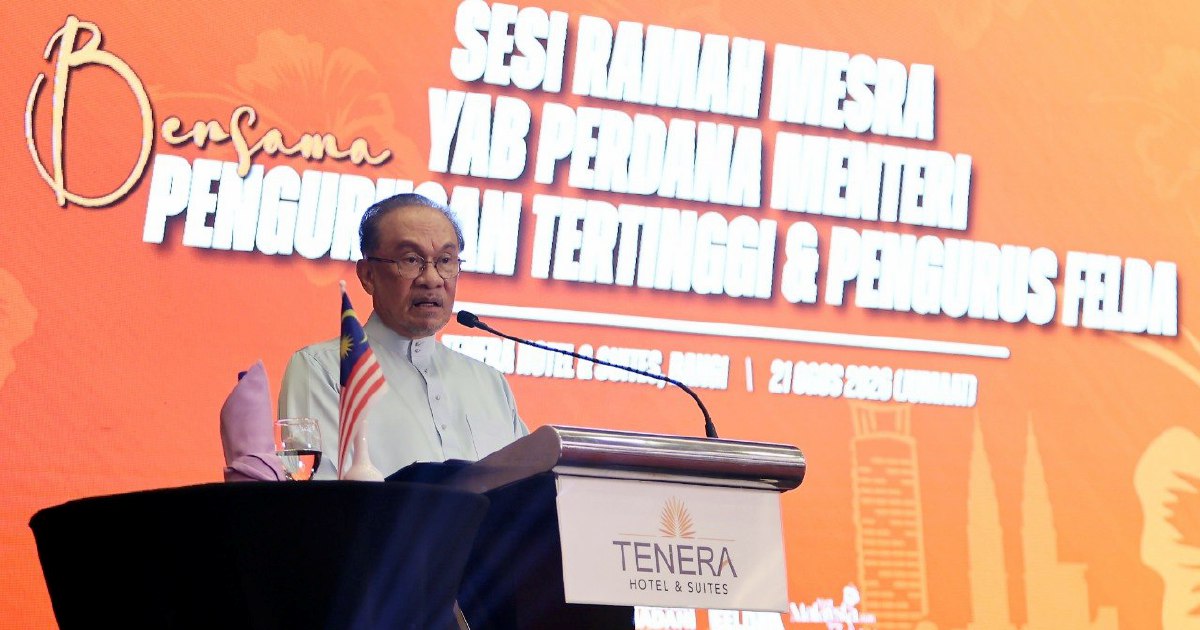
Prime Minister Datuk Seri Anwar Ibrahim declared that a task force established to examine longstanding concerns within the Federal Land Development Authority (Felda) has begun its investigative work in earnest. Speaking in Bangi today, Anwar indicated that the special committee would conduct a thorough examination of the issues plaguing the authority and deliver comprehensive findings upon conclusion of the inquiry.
The formation of this task force signals a renewed governmental commitment to addressing institutional problems at Felda, an agency that has been under scrutiny for mismanagement and governance lapses in recent years. The authority, established decades ago as a flagship rural development scheme, has faced mounting criticism regarding financial irregularities, land allocation transparency, and the welfare of settler families who comprise its beneficiary base. The task force's establishment underscores government recognition that systemic reform at the agency requires dedicated investigative capacity and independent scrutiny.
Anwar's statement comes at a time when stakeholders across Malaysia's agricultural and rural development sectors have increasingly called for accountability measures at Felda. The authority manages vast tracts of agricultural land and administers schemes affecting hundreds of thousands of settler families throughout the country, making governance quality at the organisation a matter of considerable public interest. Poor management practices in past years have eroded confidence among settlers and raised questions about the agency's ability to fulfil its original mandate of promoting rural prosperity.
The timeline for the task force's work remains unspecified, though Anwar's comments suggest the government recognises the complexity of the investigation ahead. Determining whether issues stem from administrative inadequacy, deliberate misconduct, or structural design flaws will require methodical examination of records, operations, and decision-making processes across multiple years and departments. The investigation's scope and the expertise of task force members will prove crucial in determining whether findings lead to meaningful reform or surface-level corrections.
For Malaysian investors and stakeholders in agricultural enterprises, the task force's conclusions could have significant implications. Felda's operational efficiency directly affects productivity levels at one of the nation's largest land-management institutions, influencing commodity output and export performance in sectors like palm oil and rubber. Improved governance and transparency at the authority could restore confidence in the organisation's capacity to manage resources effectively and generate returns for settlers and government alike.
Regionally, Malaysia's approach to reforming large state-owned development agencies carries symbolic weight. Neighbouring countries managing similar agricultural settlement schemes watch how established authorities address governance challenges. The success or failure of Felda's reform efforts will influence perceptions of Malaysia's commitment to institutional accountability and may shape policy approaches elsewhere in Southeast Asia.
Settler communities, whose livelihoods depend directly on Felda operations, represent another critical constituency affected by the task force's work. Many settler families have experienced income pressures and service delivery concerns in recent years. A thorough investigation that identifies root causes of organisational dysfunction could pave the way for reforms that genuinely improve living conditions and economic prospects for these communities. However, investigations alone carry limited value without corresponding commitment to implementing recommendations and allocating resources for substantive change.
The government's transparency in announcing the task force's commencement demonstrates a shift toward more open governance practices, though the true measure of institutional commitment will emerge in how findings are received and acted upon. Malaysian media and civil society organisations have maintained sustained attention on Felda governance issues, reflecting broader public expectations that state institutions operate with integrity and accountability. The task force's investigation thus occurs within a context of elevated public consciousness regarding institutional reform.
Anwar's assurance that findings will be publicly announced upon completion addresses legitimate concerns about governmental accountability. Withholding or selectively releasing investigation results would undermine public confidence and suggest political considerations supersede institutional integrity. Full disclosure of the task force's conclusions will enable informed public discussion about necessary reforms and provide a basis for measuring the sincerity of government commitment to addressing systemic problems.
The coming weeks and months will reveal the task force's investigative pace and rigour. Whether the body prioritises comprehensive examination over expedient conclusions will significantly influence the credibility and utility of its eventual findings. Malaysian observers and Felda stakeholders will closely monitor progress to assess whether this initiative represents genuine institutional reform or primarily serves political optics.

