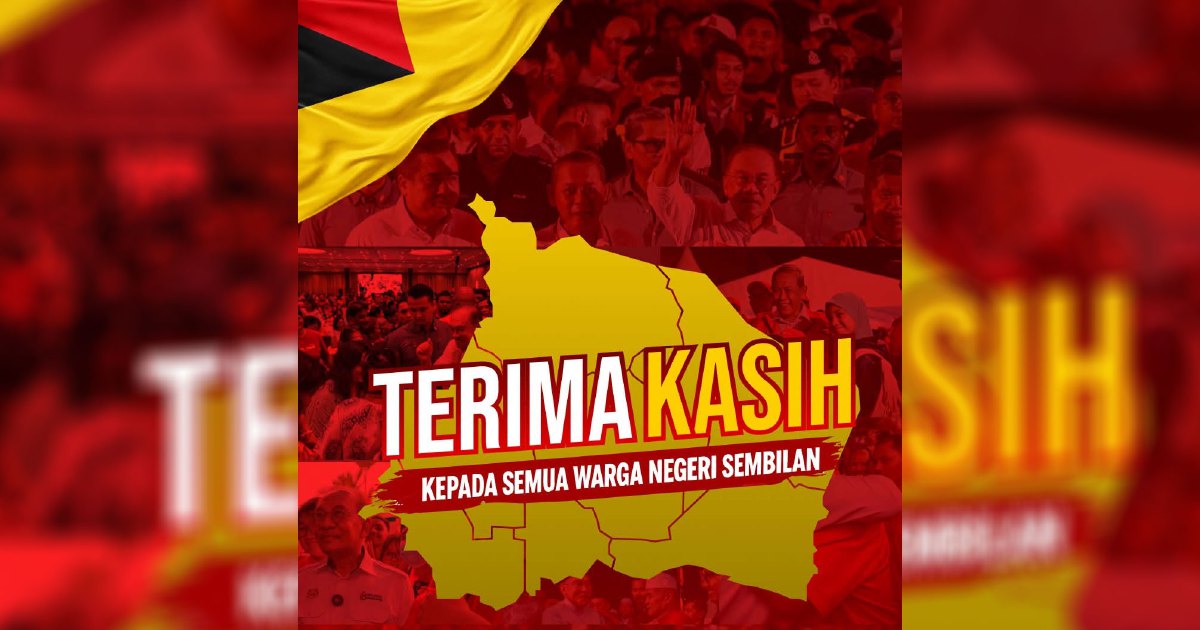
Prime Minister Datuk Seri Anwar Ibrahim extended formal congratulations to Barisan Nasional following the coalition's triumph in the Negri Sembilan state election, signalling the federal government's commitment to working collaboratively with the newly elected administration. The gesture underscores the ongoing political alignment between the federal leadership and BN, which has formed the backbone of Malaysia's governing coalition since the 2022 general election.
Anwar's acknowledgment of the electoral outcome carries particular significance within Malaysia's decentralised federal structure, where state elections typically reflect the evolving preferences of regional constituencies while simultaneously shaping the broader political landscape. Negri Sembilan's result provides important momentum for BN as the coalition seeks to consolidate its position across multiple state assemblies ahead of the next general election cycle. The state has historically served as a bellwether for peninsular voting patterns, making its electoral dynamics relevant to national political observers.
The Prime Minister's pledge of federal backing extends beyond ceremonial recognition, committing the resources and administrative apparatus of the national government to facilitate BN's policy objectives at the state level. This approach reflects the practical interdependence between federal and state governments in Malaysia's system, where infrastructure development, development budgets, and sectoral initiatives often require coordinated action across both levels. Federal ministries can accelerate approval processes, unlock targeted funding streams, and provide technical expertise to state-led initiatives—advantages that become particularly valuable when implementing ambitious regional development programmes.
From the perspective of Malaysian political economy, BN's performance in Negri Sembilan merits contextualisation within the coalition's broader resurgence following its dramatic defeat in the 2018 general election. The coalition's recuperative trajectory has depended significantly on strategic electoral consolidation in states where it retains traditional support bases and administrative infrastructure. Negri Sembilan, with its mixed urban-rural composition and moderate-sized electorate, represents the demographic and geographic profile where BN has attempted to rebuild credibility and recover lost ground to opposition coalitions.
The federal government's willingness to mobilise resources behind a BN-led state administration reflects confidence in the coalition's capacity to deliver governance outcomes that satisfy constituent demands. This gambit carries implications for Malaysia's fiscal federalism framework, where state governments increasingly depend on federal grants and revenue-sharing arrangements. By offering enhanced federal support, Anwar's administration signals that political alignment with the centre yields tangible development benefits—a message with significance beyond Negri Sembilan's borders, as other state governments weigh the political calculus of opposition versus coalition alignment.
For Southeast Asia more broadly, Malaysia's continuing evolution as a multi-level democratic system remains instructive. Electoral competition occurring simultaneously across federal and state arenas creates complex dynamics where national coalitions must manage heterogeneous state-level interests while maintaining internal cohesion. BN's performance in Negri Sembilan contributes to the coalition's ongoing effort to demonstrate that it remains the most capable vehicle for stable, resource-backed governance across Malaysia's varied states.
The practical mechanisms through which federal support will materialize remain subject to specification, but historically such commitments translate into accelerated infrastructure allocation, facilitated regulatory approvals for state-initiated projects, and senior-level intergovernmental coordination. Within Malaysia's context of elevated infrastructure expectations and competing demands for public investment, such federal backing typically shapes the trajectory of state development budgets and influences which projects advance to implementation within compressed timeframes.
Anwar's statement also reflects the institutional realities facing Malaysian prime ministers, who must maintain coalition discipline and reward electoral performance among coalition partners. BN's constituent parties—UMNO, MCA, MIC, and various smaller formations—derive legitimacy partly from their capacity to translate electoral success into material benefits for supporters. Federal backing for BN-led state governments thus serves dual purposes: demonstrating that coalition participation delivers governance effectiveness while simultaneously cementing BN's internal cohesion and party leadership accountability.
The timing and tone of the Prime Minister's congratulations matter insofar as they set expectations for inter-governmental relations and signal the political status of the newly elected administration within Malaysia's wider governance hierarchy. Early federal engagement and resource commitment can accelerate the state government's capacity to implement priority programmes, potentially generating visible governance dividends that enhance its legitimacy with constituents heading toward the subsequent election cycle. This dynamic interweaves national and subnational electoral competition, creating incentive structures where state governments benefit from federal alignment while the federal government gains from demonstrating effective intergovernmental management.
Moving forward, the sustainability of the federal-state collaborative framework will depend partly on whether the BN government can translate federal support into tangible improvements in service delivery, infrastructure quality, and economic opportunity within Negri Sembilan. Such outcomes, in turn, influence how voters across other states perceive the relative advantages of supporting coalition versus opposition administrations—dynamics that will remain consequential as Malaysia navigates successive electoral contests at both levels.

