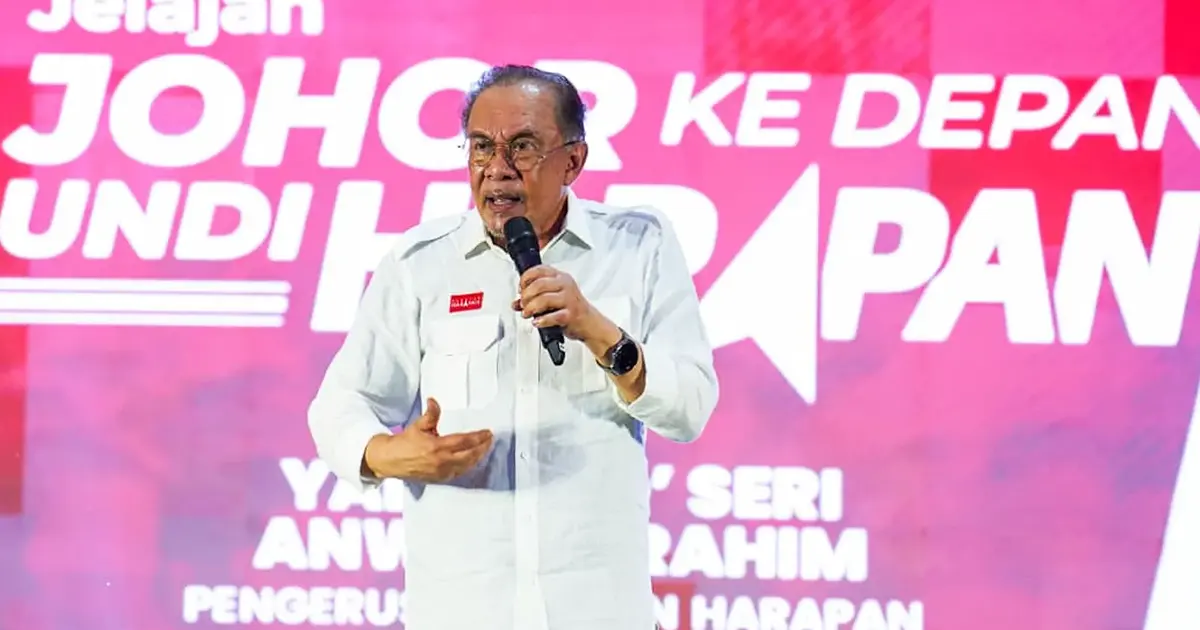
Prime Minister Anwar Ibrahim has pushed back against suggestions that Kedah receives differential treatment from the federal government, reaffirming that development initiatives are allocated fairly regardless of which political party controls a state. In remarks that appear directed at Kedah Menteri Besar Muhammad Sanusi Md Nor, Anwar questioned whether the PAS leader fully understands the extent of federal government assistance flowing into the northern state, signalling potential friction within the broader political landscape even as the ruling coalition maintains operational stability.
Anwar's comments reflect a carefully calibrated position on federal-state relations during a period when Putrajaya must balance competing political interests across the country. The prime minister's assertion that development benefits should extend to all regions regardless of their political complexion addresses a persistent concern in Malaysian politics: the perception that federal resources might be channelled preferentially towards states governed by coalition partners or penalised if controlled by opposition parties. This tension has long shaped state-level politics, influencing both infrastructure investment decisions and the distribution of development funds.
Kedah's governance structure adds particular complexity to this dynamic. As a state led by PAS, which operates within the federal coalition framework despite maintaining its own political identity, questions about resource allocation carry deeper implications for how the ruling alliance manages its diverse membership. The Perikatan Nasional component within the broader government coalition has occasionally articulated concerns about parity in development spending, and Kedah's leadership may be sensitive to any suggestion that its state receives less support than others.
The federal government's development approach typically targets infrastructure, education, healthcare, and economic initiatives nationwide, with allocation decisions ostensibly based on objective criteria including population size, existing development levels, and identified needs. However, the actual distribution of resources has historically been subject to political considerations, and state governments often perceive—or claim to perceive—that rivals receive preferential treatment. Anwar's assertion that the federal administration does not apply different standards suggests an attempt to position his government as above such partisan calculations, even if implementation on the ground tells a different story.
Anwar's implicit question about Sanusi's awareness of federal assistance to Kedah carries a subtle message: that the state leadership may not fully appreciate the support already being provided, or that public communication about such assistance has been inadequate. This rhetorical positioning allows the prime minister to simultaneously defend federal commitment to Kedah while subtly suggesting that the state menteri besar should be more vocal in acknowledging such support. In Malaysian politics, credit-claiming and narrative control around development projects often matter as much as the projects themselves, and Anwar appears to be addressing both substantive and perceptual dimensions of this issue.
The timing and tenor of these comments occur against the backdrop of Malaysia's complex coalition politics, where maintaining unity among partners with distinct electoral bases and policy preferences requires constant negotiation. PAS operates with considerable autonomy in states it governs, while still being part of the federal coalition, creating an inherent tension between state-level interests and national unity. Anwar's need to simultaneously defend federal performance while questioning a coalition partner's awareness suggests underlying strains that require careful management.
For Malaysian readers and particularly those in Kedah and surrounding states, these comments underscore how federal resource allocation remains deeply politicised despite official rhetoric about meritocratic distribution. The federal government's investment patterns across states, from transportation networks to educational facilities, frequently reflect political calculations alongside genuine development needs. Anwar's intervention in this discussion reflects recognition that perception gaps between state and federal leadership can undermine both governance effectiveness and political cohesion.
The broader implication of Anwar's remarks extends to how coalition governments function in Malaysia when they encompass parties with significant territorial bases and political independence. The ruling coalition's stability depends partly on its ability to demonstrate that all component parties receive fair treatment and that state governments—regardless of which coalition partner leads them—can access federal resources on equivalent terms. Anwar's assertion of equitable treatment serves this stabilising function, even as the detailed mechanics of resource distribution likely involve complex political negotiations.
Looking forward, the federal government's approach to Kedah and other coalition-governed states will continue reflecting the delicate balance required in Malaysia's multi-party coalition environment. The implicit challenge embedded in Anwar's remarks—questioning whether Sanusi fully appreciates federal support—may prompt the Kedah menteri besar to more visibly acknowledge such assistance, which could enhance perceptions of federal responsiveness while strengthening political credit for the prime minister's government. In Malaysian politics, such narrative management is as important as the substance of policy decisions themselves.

