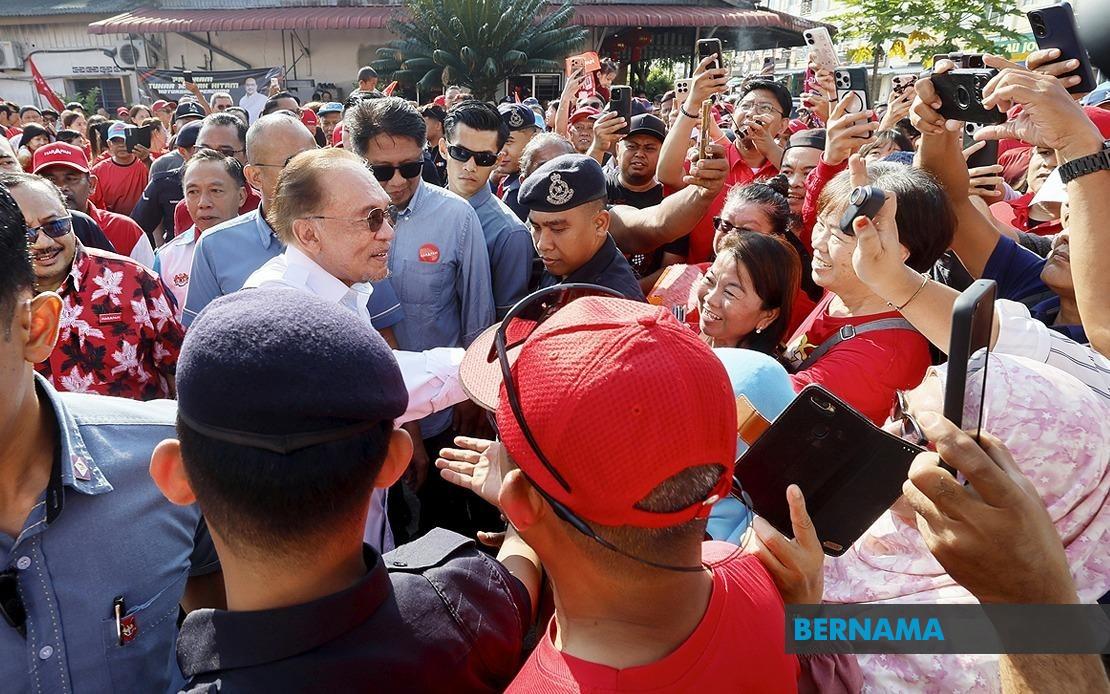
Prime Minister Datuk Seri Anwar Ibrahim has pushed back against suggestions that the federal government favours states controlled by his Pakatan Harapan coalition, insisting that developmental support and welfare initiatives are distributed fairly across the nation irrespective of which party holds power at the state level. Speaking at a campaign event in Batu Pahat on July 9 during the run-up to the 16th Johor state election, Anwar underscored his government's commitment to even-handed treatment of all regions and communities, emphasizing that federal resources are allocated based on need rather than electoral advantage.
The Prime Minister's remarks came as part of a broader defence of the government's governance record, which has faced criticism from opposition parties claiming that non-Pakatan Harapan states receive less attention and funding. Anwar sought to counter this narrative by highlighting what he characterized as tangible evidence of the federal administration's willingness to invest in states outside the coalition's direct control. He stressed that this approach represents a departure from what he characterized as election-focused governance, where political parties make promises during campaign seasons only to abandon them once votes have been cast.
Anwar specifically cited Johor as a beneficiary of federal investment, pointing to the development of the Johor-Singapore Special Economic Zone as a flagship project that demonstrates serious long-term commitment to the state's economic growth. The JS-SEZ represents a significant infrastructure initiative aimed at bolstering regional competitiveness and creating economic opportunities through enhanced regional integration. This project carries broader implications for Southeast Asian trade and investment flows, positioning Johor as a critical node in the regional economy.
Beyond flagship infrastructure, the Prime Minister emphasized the federal government's substantial financial commitments to flood mitigation efforts in Johor districts vulnerable to seasonal inundation. He noted that billions of ringgit have been allocated for such projects in Segamat and Muar, areas that have historically suffered significant economic and social disruption from flooding. These investments in climate resilience and disaster management infrastructure reflect growing recognition among policymakers that adaptation to environmental risks requires sustained federal-level resource deployment, particularly in vulnerable regions.
The timing of Anwar's remarks is significant, occurring during the Johor state election campaign when the coalition is seeking to regain or consolidate control of the state. By emphasizing the federal government's support for Johor regardless of political considerations, Anwar aimed to appeal to voters on grounds of demonstrated competence and material benefit rather than partisan loyalty alone. This approach reflects broader trends in Malaysian politics where incumbent governments increasingly attempt to ground campaign messaging in concrete development outcomes rather than abstract ideological positioning.
The campaign event in Senggarang also featured other senior Pakatan Harapan figures, including Communications Minister Datuk Fahmi Fadzil, alongside coalition candidates contesting seats in that area. The presence of multiple tiers of party leadership signaled the importance the coalition placed on the Johor contest, which is viewed as a bellwether for broader national electoral trends. The constituencies of Senggarang, Semerah and Penggaram represent diverse demographic and socioeconomic constituencies within Johor, and their outcomes could significantly influence perceptions of the coalition's viability in peninsular Malaysia's most populous state.
Anwar's emphasis on impartial federal treatment of states reflects a conscious strategy to position the national government as technocratic and development-focused rather than narrowly factional. This messaging strategy is particularly important given Malaysia's federal structure, where state governments exercise considerable autonomy over matters including land, Islamic affairs, and local development. A federal government perceived as punishing opposition-controlled states risks not only electoral backlash but also potential governance complications arising from intergovernmental coordination challenges and reduced institutional cooperation on cross-cutting issues.
The issue of development equity across states with different political leadership remains contentious in Malaysian public discourse. Opposition parties and certain state governments have periodically alleged that the federal administration diverts resources preferentially toward Pakatan Harapan-controlled territories, particularly regarding federal funding allocations and project approvals. Such claims, whether substantiated or not, can undermine public confidence in institutions and fuel perceptions of political discrimination. Anwar's public assertions of impartiality are therefore part of a deliberate effort to delegitimize such criticism and reinforce narratives of institutional neutrality.
The development initiatives cited by Anwar also carry implications for Malaysia's broader economic trajectory. The Johor-Singapore Special Economic Zone initiative, for instance, represents an attempt to deepen economic integration with Singapore and enhance regional value chain participation. Successful execution of such projects could position Malaysia advantageously within evolving regional economic structures. Similarly, investment in flood mitigation infrastructure addresses not merely local concerns but contributes to national resilience in the face of climate-related challenges that increasingly threaten economic stability across Southeast Asia.
For Malaysian readers evaluating the credibility of Anwar's claims regarding federal impartiality, assessing actual disbursement patterns across states remains essential. While the Prime Minister pointed to specific projects and funding allocations, comprehensive analysis of federal expenditure across different state administrations over time would provide clearer perspective on whether development resources are genuinely distributed according to need or reflect political considerations. Such analysis would require detailed examination of both headline infrastructure projects and the more routine federal allocations that form the backbone of state-level service delivery and development provision.

