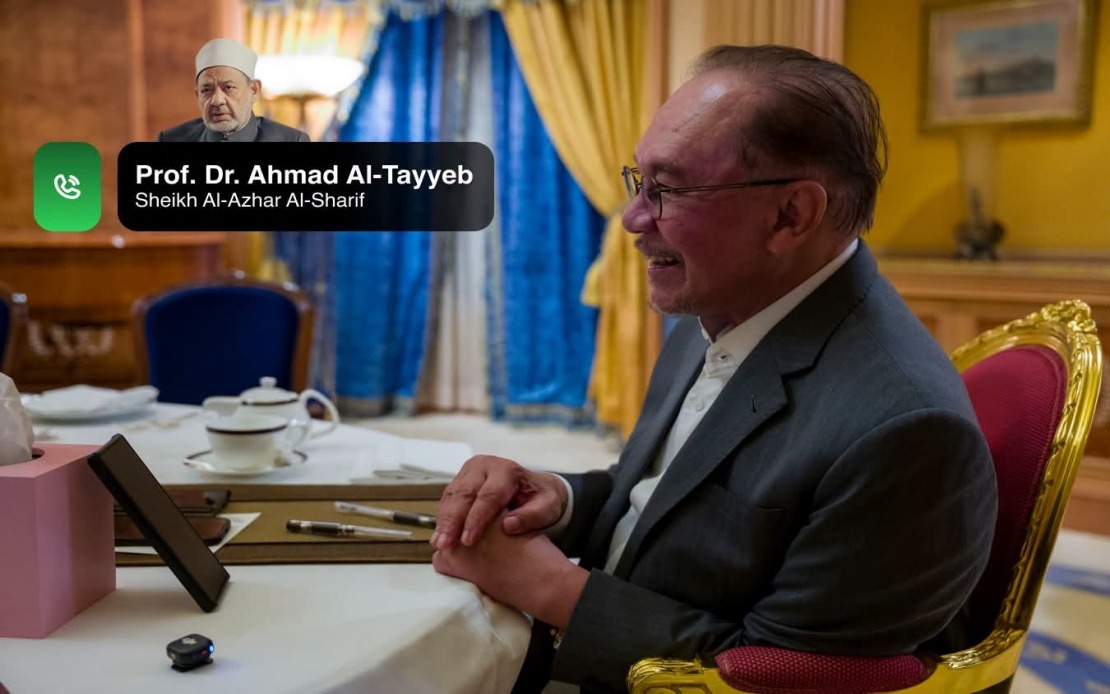
Prime Minister Datuk Seri Anwar Ibrahim has engaged in substantive conversations with two prominent Islamic leaders about expanding religious scholarship and missionary efforts across Malaysia and the broader Muslim world. The discussions came as Anwar continues his recovery from recent surgery, with both Sheikh al-Azhar al-Sharif Prof Dr Ahmad al-Tayyeb and Mohamed Abdelsalam, Secretary-General of the Council of Muslim Elders, reaching out to check on his wellbeing and extend their prayers.
The phone conversation between Anwar and Sheikh al-Azhar al-Sharif, one of Islam's most influential institutional voices, centred on the continuation of dakwah activities and deepening Islamic understanding across different communities. Anwar expressed his appreciation for the spiritual support offered by the renowned cleric and provided updates on his surgical recovery, noting that both the procedure and subsequent healing have progressed favourably. Beyond personal matters, the two leaders steered their dialogue toward longer-term collaborative initiatives that could benefit Malaysia's Islamic intellectual landscape.
In his public account of the exchange, Anwar emphasised how Sheikh al-Azhar al-Sharif's previous visit to Malaysia had made a lasting impact on the local Muslim population. This earlier visit appears to have established a foundation for ongoing collaboration between Malaysian leadership and Al-Azhar, the historic Cairo-based institution that serves as a primary centre for Islamic learning and theological authority in the Muslim world. The Prime Minister signalled Malaysian interest in deepening these institutional connections, reflecting a strategic approach to positioning Malaysia within global Islamic intellectual networks.
Anwar expressed optimism about future in-person meetings with Sheikh al-Azhar al-Sharif, suggesting that such encounters could occur in either Cairo or Kuala Lumpur. These proposed visits would serve as platforms for advancing dakwah initiatives and facilitating the exchange of knowledge that both nations regard as beneficial to their respective communities. The framing suggests that Anwar views engagement with Al-Azhar as part of a broader diplomatic and religious strategy, one that extends beyond ceremonial exchanges to substantive collaboration on matters of Islamic education and interpretation.
A parallel conversation occurred between Anwar and Mohamed Abdelsalam, the head of the Council of Muslim Elders, an organisation that brings together senior Islamic scholars and leaders from multiple nations. Like his counterpart at Al-Azhar, Abdelsalam extended get-well wishes to the Prime Minister. The discussion between these two figures also covered Sheikh al-Azhar al-Sharif's intention to return to Malaysia, alongside broader efforts to strengthen institutional relationships between Malaysia and Al-Azhar. The scope of these conversations reveals a coordinated effort among Malaysia's Islamic leadership to forge closer ties with Egypt's premier Islamic institution.
Within the substance of these discussions lies an implicit vision of what form Islamic advancement should take. Both Anwar and his interlocutors appear committed to what he describes as a "simple, free and authoritative Islam." This formulation reflects an approach that seeks to balance Islamic authenticity and scholarly rigour with accessibility and openness. The emphasis on these characteristics suggests an attempt to position Islamic learning as neither rigid nor divorced from contemporary realities, but rather as an evolving discipline capable of addressing modern challenges while remaining grounded in traditional scholarship.
Anwar's characterisation of his wife, Datuk Seri Dr Wan Azizah Wan Ismail, as an exemplary woman deserving appreciation for her steadfastness demonstrates how personal family narratives are woven into the broader political and religious messaging. Her role in supporting Anwar's long political journey and continued public service is presented as integral to the collective endeavour of advancing Islamic knowledge and societal benefit. This public acknowledgment reflects cultural and political norms that frequently intertwine family narratives with state-level initiatives.
The timing and content of these exchanges carry significance for Malaysia's regional role. Al-Azhar's institutional authority extends across the Muslim world, particularly among Sunni communities. Malaysia's cultivation of closer relations with this centre of learning positions the country as a bridge between Southeast Asian Islam and the broader Islamic intellectual establishment centred in the Middle East. For Malaysian readers, these developments suggest that their Prime Minister is actively seeking to enhance the country's standing within global Islamic networks while simultaneously promoting a particular vision of Islam suited to Malaysia's multicultural context.
The focus on dakwah and Islamic education also reflects domestic policy considerations. In a nation where Islam holds constitutional and social significance, initiatives that enhance religious scholarship and expand Islamic understanding serve both spiritual and political functions. They signal to Malaysian Muslim constituencies that their government is committed to deepening Islamic knowledge and practice, while simultaneously projecting Malaysia's role as a credible voice in global Islamic affairs. This dual positioning represents a carefully calibrated approach to domestic and international Islamic engagement.
Moreover, the emphasis on collaborative efforts between Malaysian leadership and internationally recognised Islamic institutions addresses a persistent question within Malaysian Islam: how to maintain doctrinal authenticity while engaging with modern complexities. By aligning itself with Al-Azhar and the Council of Muslim Elders, Anwar's administration demonstrates a commitment to grounding Malaysian Islamic policy within respected international scholarly frameworks. This approach potentially inoculates domestic Islamic initiatives against accusations of theological innovation or departure from Islamic tradition.
Looking forward, the proposed institutional strengthening between Malaysia and Al-Azhar could yield tangible outcomes in academic exchanges, collaborative research programmes, and coordinated religious teaching initiatives. For Malaysian observers, the significance extends beyond diplomatic niceties; enhanced cooperation with Al-Azhar could influence how Islamic knowledge is transmitted within Malaysian educational and religious institutions. Whether through visiting scholars, curriculum development, or joint publications, such partnerships shape the contours of Islamic intellectual life within the country.

