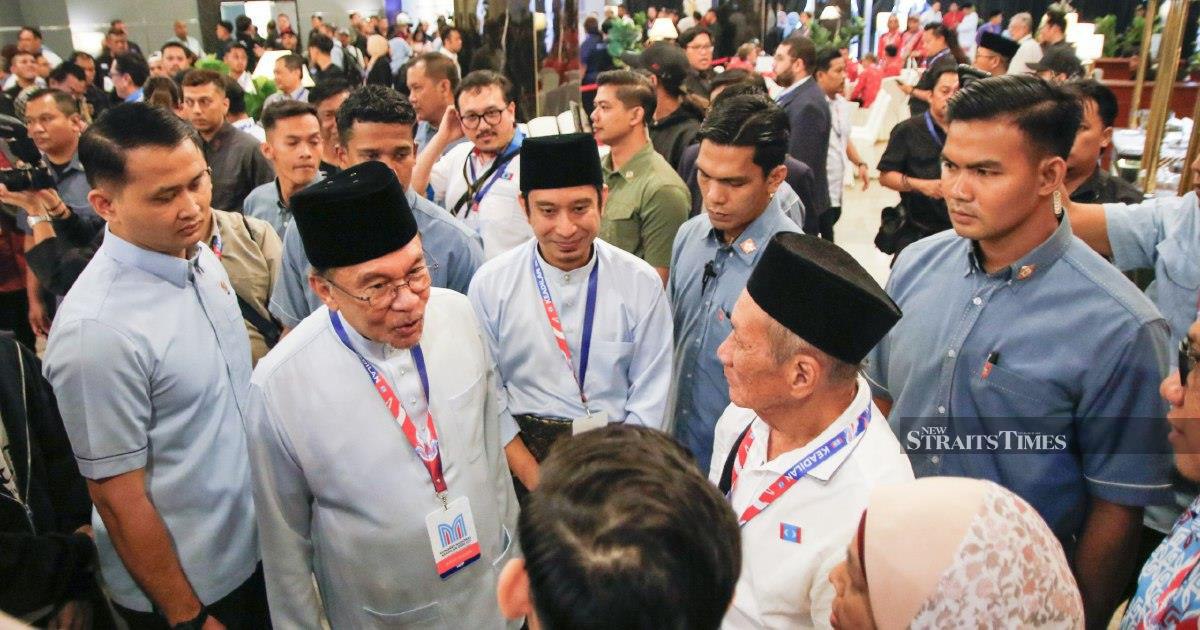
Prime Minister Datuk Seri Anwar Ibrahim moved to quell ongoing speculation about tensions within Malaysia's top leadership on Wednesday, categorically denying that his relationship with Deputy Prime Minister Datuk Seri Dr Ahmad Zahid Hamidi had deteriorated. Speaking at Ayer Keroh, Anwar sought to reassure party members and the broader public that despite periodic reports of friction, the two men continued to function effectively as a cohesive leadership team driving the government's agenda forward.
The Prime Minister's public statement carries particular significance given the scrutiny that Malaysia's coalition government has faced since its formation. In a multi-party administration where several political entities with distinct interests must work together, leadership dynamics inevitably attract media attention and speculation. Anwar's intervention signals an effort to project stability and unified direction from the federal administration, particularly important as the government pursues its policy agenda across a range of critical areas from economic recovery to institutional reform.
For Malaysian observers and international stakeholders monitoring domestic political stability, the timing and substance of such reassurances matter considerably. A fractured top leadership would create space for policy inconsistencies, delayed decision-making, and reduced effectiveness in government operations. By publicly affirming strong ties with his deputy, Anwar attempts to preempt narratives of instability that could undermine investor confidence and complicate legislative business in Parliament.
The relationship between a Prime Minister and Deputy Prime Minister typically sets the tone for ministerial cooperation more broadly. When these two positions operate in genuine alignment, cabinet meetings become more productive, policy implementation accelerates, and the ruling coalition presents a unified front to opposition and external observers. Conversely, any suggestion of distance between these office-holders can trigger a cascade of rumours about factional divisions, with various ministers and MPs aligning themselves according to perceived alliances.
Anwar's emphasis on ties remaining "good at the national level" reveals careful language designed to acknowledge that local or grassroots issues may generate different dynamics, while asserting that strategic partnership at the apex remains intact. This nuance reflects the reality of Malaysian politics, where federal-level coordination may coexist with state-level competition or distinct organisational interests. Such compartmentalisation, while potentially confusing to external observers, represents a practical compromise enabling diverse parties to function within a single government.
The Deputy Prime Minister role in Malaysia's system carries considerable institutional weight. As second-in-command, Zahid holds significant influence over government machinery and serves as a crucial conduit to his own party's parliamentary members and ground machinery. For Anwar, maintaining positive personal relations with Zahid is therefore not merely a matter of temperament but a structural necessity for effective governance. Any genuine rupture would create complications in coalition management and complicate passage of legislation requiring consensus.
Malaysia's experience with coalition governments has taught successive administrations that public displays of internal harmony, even when privately managed tensions exist, serve important stabilising functions. The investment community, foreign governments, and ordinary Malaysians conducting business all benefit from perceived stability at the top. When political leaders permit speculation about rifts to flourish unchallenged, they risk creating a narrative that detaches from actual governance realities yet influences economic behaviour and public sentiment.
The broader context of Malaysian politics also matters for understanding Anwar's statement. The country's complex ethnic, religious, and regional composition means that coalition structures themselves carry significance beyond simple arithmetic. Different coalition members represent distinct constituencies and bring specific constituencies into government. Managing these relationships requires sustained effort and consistent messaging about shared commitment to national goals, precisely what Anwar's denial attempts to signal.
For ordinary Malaysians watching their government operate, clarity about whether senior leaders function as a team or at cross-purposes affects daily confidence in state capacity. Can the government execute its economic recovery plans? Will promised infrastructure projects materialise? Will Parliament function smoothly in advancing legislative priorities? These questions hinge partly on whether citizens believe their leaders are genuinely unified. Anwar's statement thus addresses not only political insiders but also the broader electorate evaluating government performance.
The fact that such reassurances require periodic public articulation underscores the inherent fragility of coalition arrangements. Unlike single-party governments where leadership questions resolve through internal party mechanisms, coalitions must continually reaffirm their working compacts. Zahid's presence as a deputy leader from a different political party than Anwar's means their partnership depends on explicit commitment and demonstrated cooperation, not on party loyalty mechanisms.
Moving forward, observers should watch for concrete evidence of continued collaboration between the two leaders in policy announcements, joint public appearances, and their handling of cabinet-level decisions. Such actions carry more weight than denials in establishing whether any genuine distance has opened between them. The government's ability to advance its legislative agenda and implement strategic initiatives will ultimately demonstrate the substance behind Anwar's reassurance about maintained ties with his deputy.

